

Polkadot Treasury Reserves at All-Time Low And DOT Bears Aren’t Helping

Source Newsbtc

Polkadot is among the top blockchains, securing a spot in the top 20. Even though the platform promotes blockchain interoperability, a feature needed in the age of increasing fragmentation, DOT prices have failed to inspire bulls. 

This state of affairs on price charts reflects the general trend across the board, especially in leading smart contract platforms like Ethereum and Solana.

Polkadot Treasury Reserves Down To All-Time Lows

Unyielding bears have been forcing prices lower over the months since DOT rose to around $10 in Q1 2024, depleting the Polkadot Treasury Reserves.

In early November, one observer on X said they stood at all-time lows. However, it could get worse for Polkadot should the bears of Q3 2024 flow back, forcing prices below local support levels.
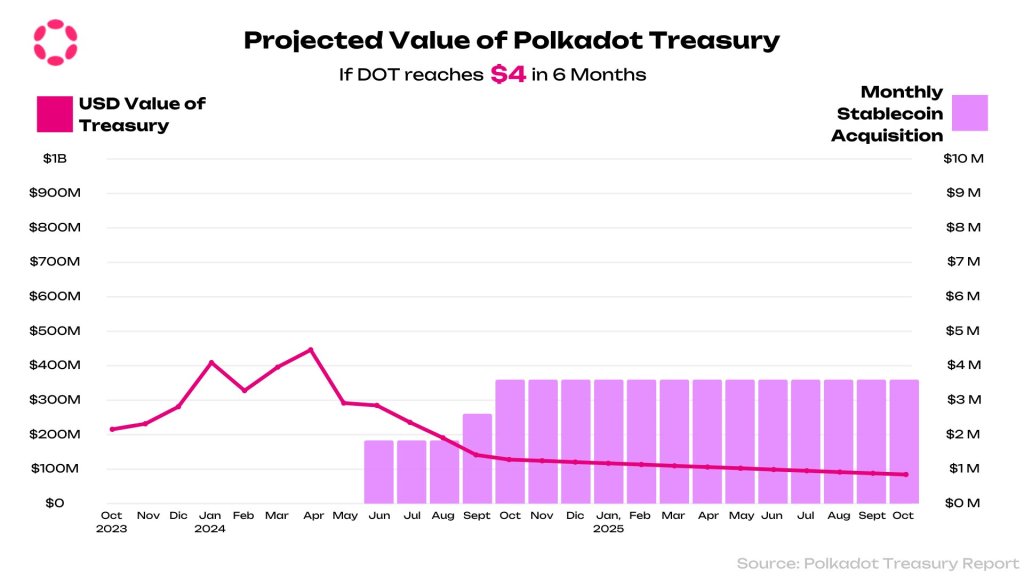
Polkadot Treasury Reserves at all-time lows | Source: @GldnCalf via X

The daily chart shows that DOT has critical support at around $3.8. This level marks September and October lows. On the other hand, the coin is facing strong liquidation pressure at $4.6 and $5.

As the coin ranges, the direction of the breakout could shape the short—to medium-term trend but also impact the Polkadot Treasury.

DOT prices trending sideways on the daily chart | Source: DOTUSDT on Binance, TradingView

A lot depends on whether DOT prices will recover, which will, in turn, help the Polkadot Treasury reserves recover. Technically, prices play a big role. When bulls take over, the reserve, denominated in DOT, increases in USD terms, easing pressure on the team.

Policy Intervention To Boost Funds

To further increase inflows into the Treasury Reserves, the Polkadot community passed a policy to reduce inflation. Specifically, the community voted to drop DOT annual inflation from 10% to 8%.

With low inflation and sustained on-chain demand, DOT prices may find support. Additionally, 15% of staking rewards distributed from stakers will be moved to the Treasury.

The analyst predicts these changes could boost the Treasury by adding 1.5 million DOT. This will be the much-needed infusion of funds that may increase the Treasury Reserves after months of low income.  

The team could build better and even strike quality partnerships, improving the blockchain’s ecosystem. Based on H1 2024 data, the team spent most on outreach, while nearly 27% went to development.
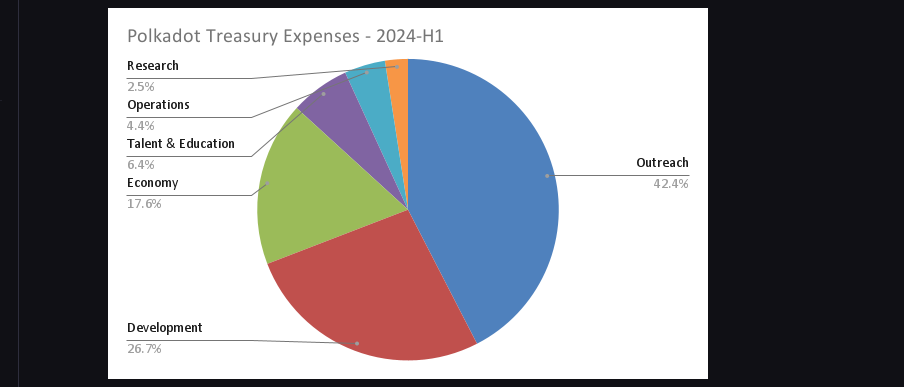
Expenditure in H1 2024 | Source: Polkadot

The rest was split between funding research, operations, talent, and the economy. Given the valuation in the year’s first half, they spent $87 million, or around 11 million DOT, in total.

Disclaimer: For information purposes only. Past performance is not indicative of future results.
placeholder
Fed hike odds near 90% into Wednesday's decision — how to trade the dollar, gold and the S&P 500A 0.3% monthly core CPI print has lifted the market-implied probability of a 25bp Fed hike on 16 September to roughly 86.5% ~ 90%, which would be the first increase since July 2023. Here is the decision timeline, the pricing versus the forecasts, both scenarios, and the key levels for the dollar, gold and the S&P 500.
Author  Suzie
Sep 14, Mon
A 0.3% monthly core CPI print has lifted the market-implied probability of a 25bp Fed hike on 16 September to roughly 86.5% ~ 90%, which would be the first increase since July 2023. Here is the decision timeline, the pricing versus the forecasts, both scenarios, and the key levels for the dollar, gold and the S&P 500.
placeholder
Bitcoin falls below $75,000 as the CLARITY Act fails in the Senate — what the vote means for cryptoThe US Senate blocked the Digital Asset Market CLARITY Act in a 49-50 procedural vote, sending Bitcoin briefly below $75,000 — its biggest one-day drop since June. Ethereum fell more than 8%, Coinbase slid 10% and $75 billion of crypto market value evaporated. Here is what the vote was, why it failed, and the levels that matter now.
Author  Suzie
Sep 16, Wed
The US Senate blocked the Digital Asset Market CLARITY Act in a 49-50 procedural vote, sending Bitcoin briefly below $75,000 — its biggest one-day drop since June. Ethereum fell more than 8%, Coinbase slid 10% and $75 billion of crypto market value evaporated. Here is what the vote was, why it failed, and the levels that matter now.
placeholder
Dollar index tops 100 for the first time since July as the Fed's hawkish dot plot sinks inThe U.S. dollar index broke back above 100 for the first time since 31 July after the Fed delivered its first rate hike since 2023, with the dot plot showing 16 of 18 officials expect at least one more increase this year. Here are the levels that matter for DXY, the currencies feeling it most, and what to watch next.
Author  Irene Q.
Sep 17, Thu
The U.S. dollar index broke back above 100 for the first time since 31 July after the Fed delivered its first rate hike since 2023, with the dot plot showing 16 of 18 officials expect at least one more increase this year. Here are the levels that matter for DXY, the currencies feeling it most, and what to watch next.
placeholder
Gold rebounds to near $4,350 on weaker US Dollar, falling oil pricesGold price (XAU/USD) rises to near $4,345 during the early Asian session on Friday. The precious metal rebounds from a six-week low amid falling oil prices and a weaker US Dollar (USD). Traders continue to assess the latest Federal Reserve (Fed) rate hike and policy cues.
Author  FXStreet
Sep 18, Fri
Gold price (XAU/USD) rises to near $4,345 during the early Asian session on Friday. The precious metal rebounds from a six-week low amid falling oil prices and a weaker US Dollar (USD). Traders continue to assess the latest Federal Reserve (Fed) rate hike and policy cues.
placeholder
US to delay new "overcapacity" tariffs on China — what the pause means for trade, inflation and the dollarWashington is expected to hold off announcing new tariffs over Chinese "overcapacity" until after the 24 September summit, according to Bloomberg. The postponed plan would have added 7.5% to Chinese goods, taking second-term US tariffs to around 20%. Here is what is on the table, and what a deal versus no deal would mean for the yuan, Hong Kong equities and the dollar.
Author  Mitrade
Sep 18, Fri
Washington is expected to hold off announcing new tariffs over Chinese "overcapacity" until after the 24 September summit, according to Bloomberg. The postponed plan would have added 7.5% to Chinese goods, taking second-term US tariffs to around 20%. Here is what is on the table, and what a deal versus no deal would mean for the yuan, Hong Kong equities and the dollar.
goTop
quote