

Render could rally if it sustains an extended move above key resistance

Source Fxstreet
  • Render is attempting to break above a key rectangle channel's $5.155 resistance level.
  • A successful move above this resistance could send Render toward the $6.097 level.
  • A notable uptick in the 30-day MVRV could cause Render to witness high selling pressure.

Render is down 2% on Wednesday as it attempts to break above the $5.155 key resistance level. This move could trigger a rally and cause a notable uptick in average gains for investors who purchased it within the last 30 days.

Render attempts move above key resistance

Render fell below the $5.155 resistance level of a key rectangle channel on Wednesday after briefly moving above it earlier on Tuesday. In the past month, Render has sustained several sideways moves within this channel.

While the AI token is looking to retest the $5.155 resistance again, it's restricted by the 200-day Simple Moving Average (SMA). An extended move above the 200-day SMA could flip the $5.155 resistance into a support and stage a rally toward the $6.097 level. Conversely, if it sees another rejection around $5.155, it could decline toward the $4.274 support level.
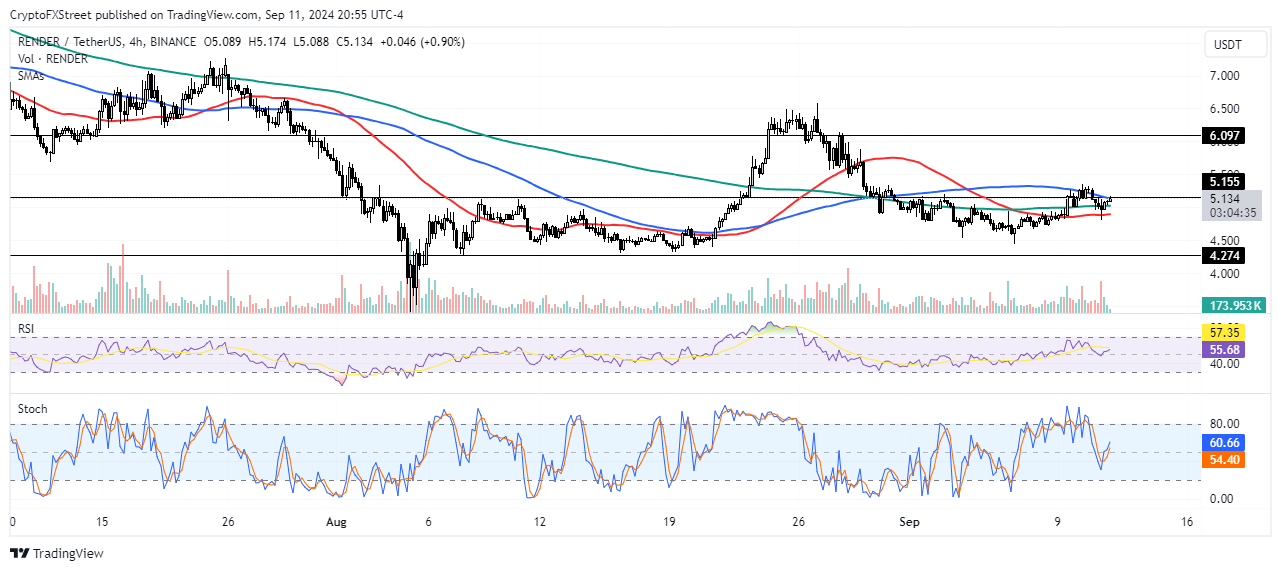
RENDER/USDT 4-hour chart

RENDER/USDT 4-hour chart

The Relative Strength Index (RSI) is at 52, just above the neutral level, indicating bullish momentum. The Stochastic Oscillator (Stoch) is below the neutral level at 47.

Render's Futures Open Interest (OI) has also been rising, increasing from $30.22 million on September 8 to $39.08 million on Wednesday. Open interest is the total number of unsettled long and short contracts within a derivatives market. The rising OI indicates that investors are increasingly placing bets on the price of Render. If prices are rising alongside it, the OI supports a bullish move.
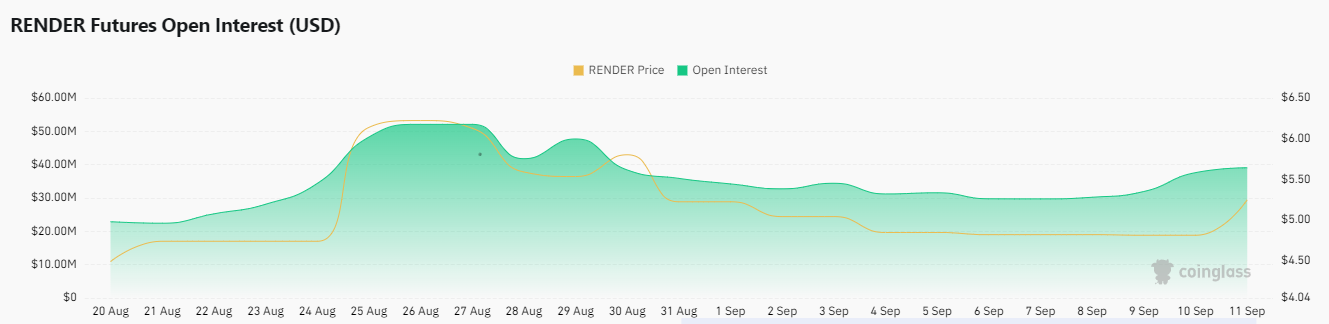
RENDER Open Interest

RENDER Open Interest

On the monthly time frame, Render is trading at a 9% gain. However, its 60-day, 90-day, 180-day and 365-day Market Value to Realized Value (MVRV) shows investors who bought Render in the past three months and upward are holding their tokens at an average loss, meaning they're less likely to sell at current prices.

The MVRV indicates the average profits or loss of all addresses that purchased a token within a specific time frame.

RENDER 30-day, 60-day, 90-day, 180-day, 365-day MVRV

RENDER 30-day, 60-day, 90-day, 180-day, 365-day MVRV

Meanwhile, Render's 30-day MVRV ratio indicates that investors who bought in the past month are only seeing an average gain of 2%. Hence, this cohort of investors is less likely to cause any selling pressure currently with such a tiny profit margin. However, a rally toward $6.097 could cause massive profit-taking among this cohort and a subsequent price correction.

A daily candlestick close below $4.74 would invalidate the thesis.

Disclaimer: For information purposes only. Past performance is not indicative of future results.
placeholder
Fed hike odds near 90% into Wednesday's decision — how to trade the dollar, gold and the S&P 500A 0.3% monthly core CPI print has lifted the market-implied probability of a 25bp Fed hike on 16 September to roughly 86.5% ~ 90%, which would be the first increase since July 2023. Here is the decision timeline, the pricing versus the forecasts, both scenarios, and the key levels for the dollar, gold and the S&P 500.
Author  Suzie
Sep 14, Mon
A 0.3% monthly core CPI print has lifted the market-implied probability of a 25bp Fed hike on 16 September to roughly 86.5% ~ 90%, which would be the first increase since July 2023. Here is the decision timeline, the pricing versus the forecasts, both scenarios, and the key levels for the dollar, gold and the S&P 500.
placeholder
Bitcoin falls below $75,000 as the CLARITY Act fails in the Senate — what the vote means for cryptoThe US Senate blocked the Digital Asset Market CLARITY Act in a 49-50 procedural vote, sending Bitcoin briefly below $75,000 — its biggest one-day drop since June. Ethereum fell more than 8%, Coinbase slid 10% and $75 billion of crypto market value evaporated. Here is what the vote was, why it failed, and the levels that matter now.
Author  Suzie
Sep 16, Wed
The US Senate blocked the Digital Asset Market CLARITY Act in a 49-50 procedural vote, sending Bitcoin briefly below $75,000 — its biggest one-day drop since June. Ethereum fell more than 8%, Coinbase slid 10% and $75 billion of crypto market value evaporated. Here is what the vote was, why it failed, and the levels that matter now.
placeholder
Dollar index tops 100 for the first time since July as the Fed's hawkish dot plot sinks inThe U.S. dollar index broke back above 100 for the first time since 31 July after the Fed delivered its first rate hike since 2023, with the dot plot showing 16 of 18 officials expect at least one more increase this year. Here are the levels that matter for DXY, the currencies feeling it most, and what to watch next.
Author  Irene Q.
Sep 17, Thu
The U.S. dollar index broke back above 100 for the first time since 31 July after the Fed delivered its first rate hike since 2023, with the dot plot showing 16 of 18 officials expect at least one more increase this year. Here are the levels that matter for DXY, the currencies feeling it most, and what to watch next.
placeholder
Gold rebounds to near $4,350 on weaker US Dollar, falling oil pricesGold price (XAU/USD) rises to near $4,345 during the early Asian session on Friday. The precious metal rebounds from a six-week low amid falling oil prices and a weaker US Dollar (USD). Traders continue to assess the latest Federal Reserve (Fed) rate hike and policy cues.
Author  FXStreet
Sep 18, Fri
Gold price (XAU/USD) rises to near $4,345 during the early Asian session on Friday. The precious metal rebounds from a six-week low amid falling oil prices and a weaker US Dollar (USD). Traders continue to assess the latest Federal Reserve (Fed) rate hike and policy cues.
placeholder
US to delay new "overcapacity" tariffs on China — what the pause means for trade, inflation and the dollarWashington is expected to hold off announcing new tariffs over Chinese "overcapacity" until after the 24 September summit, according to Bloomberg. The postponed plan would have added 7.5% to Chinese goods, taking second-term US tariffs to around 20%. Here is what is on the table, and what a deal versus no deal would mean for the yuan, Hong Kong equities and the dollar.
Author  Mitrade
Sep 18, Fri
Washington is expected to hold off announcing new tariffs over Chinese "overcapacity" until after the 24 September summit, according to Bloomberg. The postponed plan would have added 7.5% to Chinese goods, taking second-term US tariffs to around 20%. Here is what is on the table, and what a deal versus no deal would mean for the yuan, Hong Kong equities and the dollar.
goTop
quote