

Financial Giant AllianceBernstein Predicts Bitcoin At $1 Million, Here’s When

Source Newsbtc

In an analysis released Thursday, leading global investment firm AllianceBernstein with assets under management worth $725 billion significantly elevated its price target for Bitcoin, predicting the premier cryptocurrency will reach $1 million by 2033. This bullish outlook is underscored by a new wave of adoption via US spot Bitcoin exchange-traded funds (ETFs) managed by heavyweight asset managers including BlackRock, Fidelity, and Franklin Templeton.

Bitcoin’s Path To $1 Million In 2033

Analysts Gautam Chhugani and Mahika Sapra from Bernstein outline a detailed scenario where they expect the assets under management in Bitcoin-related ETFs to escalate to about $190 billion by 2025, a substantial leap from the current $60 billion. The report states, “We believe that the US regulated ETFs were the watershed moment for crypto that brought in structural demand from traditional pools of capital.”

They highlighted the considerable impact of these funds, which have already funneled approximately $15 billion in net new flows into the market.

The report extrapolates that by 2025, Bitcoin ETFs will represent about 7% of all Bitcoins in circulation, and by 2033, this figure could rise to around 15% of the total Bitcoin supply. This significant uptick in institutional interest and investment is poised to play a critical role in driving Bitcoin’s price upward.

A critical aspect of Bernstein’s analysis is the effect of Bitcoin’s supply mechanics, particularly the halving events. The most recent halving in April cut the block reward for miners from 6.25 BTC to 3.125 BTC, effectively halving the daily new supply from 900 BTC to 450 BTC.

According to Chhugani and Sapra, “The halving presents a unique circumstance, where natural Bitcoin sell-pressure from miners declines by half (or even more, as they inventory more in anticipation), while new catalysts for bitcoin demand arise, leading to exponential price moves.”

Historically, after halving events, BTC has experienced significant price rallies. The analysts draw on past cycles for context: in 2017, Bitcoin surged to approximately five times its marginal cost of production, then bottomed at 0.8 times in the following year. A similar pattern was observed in the 2021 cycle.

For the 2024-27 cycle, they project a more conservative yet substantial increase to 1.5 times Bitcoin’s marginal cost of production, translating to a predicted mid-cycle high of $200,000 by mid-2025. In the following cycle, Bernstein expects the Bitcoin price to reach half a million US dollars by 2029, before breaking the $1 million mark four years later.

Outlook For MicroStrategy

In tandem with their Bitcoin outlook, Bernstein also initiated coverage on MicroStrategy with an outperform rating, targeting a price of $2,890 for the stock by the end of 2025. MicroStrategy has become notable for its BTC acquisition strategy, now holding 214,400 BTC, or 1.1% of the cryptocurrency’s circulating supply, valued at approximately $14.5 billion.

MicroStrategy’s aggressive acquisition of Bitcoin, funded through convertible notes—a form of long-term debt that converts into stock under specific conditions—demonstrates a robust investment strategy which the analysts believe offers “limited liquidation risk” due to the already profitable nature of their holdings based on today’s Bitcoin prices. They foresee MicroStrategy’s holdings increasing to 1.5% of the Bitcoin supply by 2025.

At press time, BTC traded at $66,946.
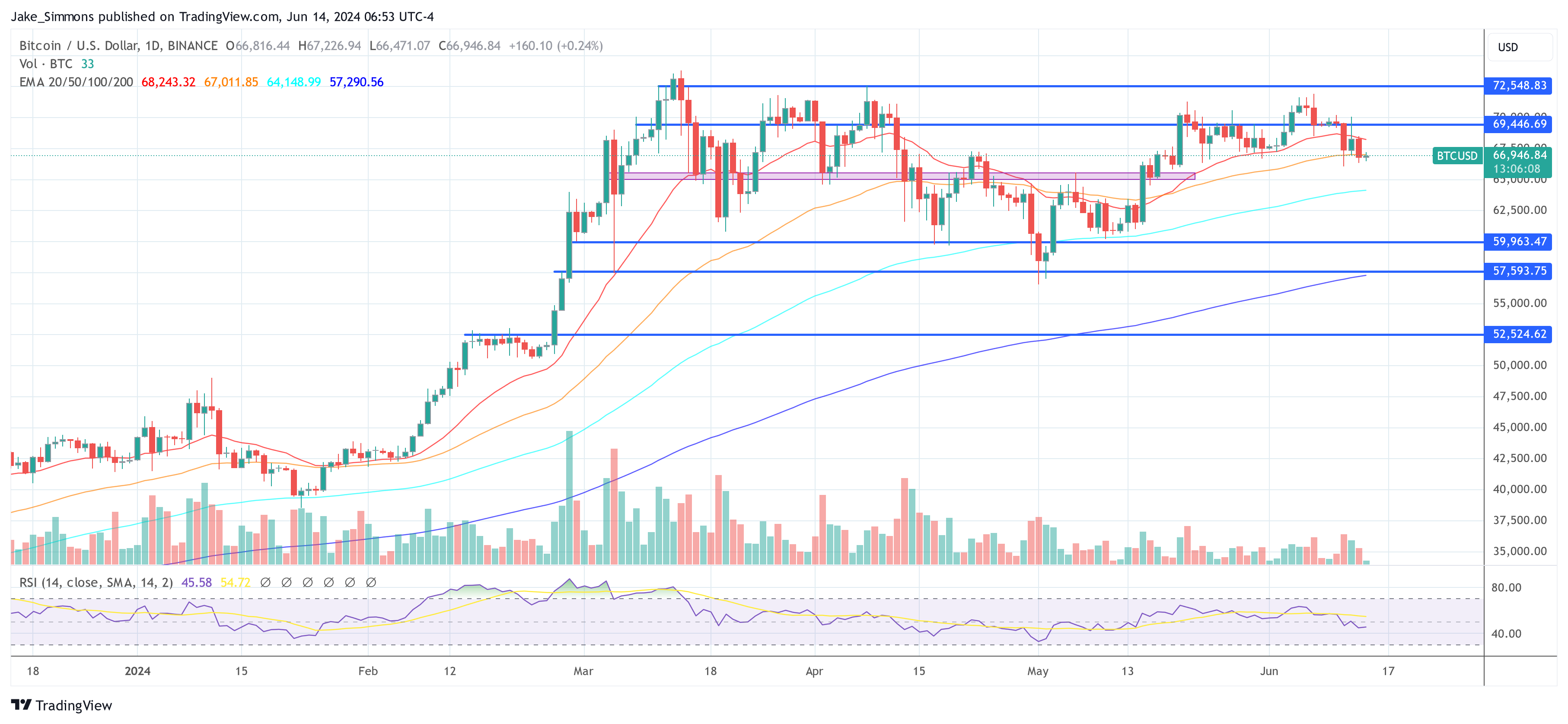
Bitcoin price
Disclaimer: For information purposes only. Past performance is not indicative of future results.
placeholder
Bitcoin To Anchor America Party—’Fiat Is Hopeless,’ Says Elon MuskMusk Pitches Bitcoin As Pillar Of America Party
Author  Bitcoinist
Jul 07, 2025
Musk Pitches Bitcoin As Pillar Of America Party
placeholder
Bitcoin briefly loses 2025 gains as crypto plunges over the weekend.Bitcoin experienced a sharp decline this weekend, briefly erasing its 2025 gains and dipping below its year-opening value of $93,507. The cryptocurrency fell to a low of $93,029 on Sunday, representing a 25% drop from its all-time high in October. Although it has rebounded slightly to around $94,209, the pressures on the market remain significant. The downturn occurred despite the reopening of the U.S. government on Thursday, which many had hoped would provide essential support for crypto markets. This year initially appeared promising for cryptocurrencies, particularly after the inauguration of President Donald Trump, who has established the most pro-crypto administration thus far. However, ongoing political tensions—including Trump's tariff strategies and the recent government shutdown, lasting a historic 43 days—have contributed to several rapid price pullbacks for Bitcoin throughout the year. Market dynamics are also being influenced by Bitcoin whales—investors holding large amounts of Bitcoin—who have been offloading portions of their assets, consequently stalling price rallies even as positive regulatory developments emerge. Despite these sell-offs, analysts from Glassnode argue that this behavior aligns with typical patterns seen among long-term investors during the concluding stages of bull markets, suggesting it is not indicative of a mass exodus. Notably, Bitcoin is not alone in its struggles, as Ethereum and Solana have also recorded declines of 7.95% and 28.3%, respectively, since the start of the year, while numerous altcoins have faced even steeper losses. Looking ahead, questions linger regarding the viability of the four-year cycle thesis, particularly given the increasing institutional support and regulatory frameworks now in place in the crypto landscape. Matt Hougan, chief investment officer at Bitwise, remains optimistic, suggesting a potential Bitcoin resurgence in 2026 driven by the “debasement trade” thesis and a broader trend toward increased adoption of stablecoins, tokenization, and decentralized finance. Hougan emphasized the soundness of the underlying fundamentals, pointing to a positive outlook for the sector in the longer term.
Author  Mitrade
Nov 17, 2025
Bitcoin experienced a sharp decline this weekend, briefly erasing its 2025 gains and dipping below its year-opening value of $93,507. The cryptocurrency fell to a low of $93,029 on Sunday, representing a 25% drop from its all-time high in October. Although it has rebounded slightly to around $94,209, the pressures on the market remain significant. The downturn occurred despite the reopening of the U.S. government on Thursday, which many had hoped would provide essential support for crypto markets. This year initially appeared promising for cryptocurrencies, particularly after the inauguration of President Donald Trump, who has established the most pro-crypto administration thus far. However, ongoing political tensions—including Trump's tariff strategies and the recent government shutdown, lasting a historic 43 days—have contributed to several rapid price pullbacks for Bitcoin throughout the year. Market dynamics are also being influenced by Bitcoin whales—investors holding large amounts of Bitcoin—who have been offloading portions of their assets, consequently stalling price rallies even as positive regulatory developments emerge. Despite these sell-offs, analysts from Glassnode argue that this behavior aligns with typical patterns seen among long-term investors during the concluding stages of bull markets, suggesting it is not indicative of a mass exodus. Notably, Bitcoin is not alone in its struggles, as Ethereum and Solana have also recorded declines of 7.95% and 28.3%, respectively, since the start of the year, while numerous altcoins have faced even steeper losses. Looking ahead, questions linger regarding the viability of the four-year cycle thesis, particularly given the increasing institutional support and regulatory frameworks now in place in the crypto landscape. Matt Hougan, chief investment officer at Bitwise, remains optimistic, suggesting a potential Bitcoin resurgence in 2026 driven by the “debasement trade” thesis and a broader trend toward increased adoption of stablecoins, tokenization, and decentralized finance. Hougan emphasized the soundness of the underlying fundamentals, pointing to a positive outlook for the sector in the longer term.
placeholder
Gold rises on softer US Dollar, traders await Trump's address on Iran warGold price (XAU/USD) extends the rally to near $4,775 during the early Asian session on Thursday. The precious metal surges amid a weakening US Dollar (USD) and cooling geopolitical tensions in the Middle East.
Author  FXStreet
Yesterday 01: 20
Gold price (XAU/USD) extends the rally to near $4,775 during the early Asian session on Thursday. The precious metal surges amid a weakening US Dollar (USD) and cooling geopolitical tensions in the Middle East.
placeholder
Silver Price Forecast: XAG/USD falls to near $72.00 amid fading safe-haven demandSilver price (XAG/USD) continues to lose ground after registering tiny losses in the previous day, trading around $72.90 during the Asian hours on Thursday. The safe-haven demand for the precious metal fades amid rising optimism over Middle East peace.
Author  FXStreet
Yesterday 08: 19
Silver price (XAG/USD) continues to lose ground after registering tiny losses in the previous day, trading around $72.90 during the Asian hours on Thursday. The safe-haven demand for the precious metal fades amid rising optimism over Middle East peace.
placeholder
Gold retreats sharply from two-week top/$4,800 as Trump’s Iran comments boost USDGold (XAU/USD) witnessed an intraday turnaround from the $4,800 mark, or a fresh two-week high set earlier this Thursday, and for now, seems to have snapped a four-day winning streak amid resurgent US Dollar (USD) demand.
Author  FXStreet
Yesterday 07: 03
Gold (XAU/USD) witnessed an intraday turnaround from the $4,800 mark, or a fresh two-week high set earlier this Thursday, and for now, seems to have snapped a four-day winning streak amid resurgent US Dollar (USD) demand.
goTop
quote