

BitMEX Founder Predicts The Dawn Of ‘Crypto Valhalla’: When Will It Start?

Source Newsbtc

In his latest essay titled “The Easy Button,” Arthur Hayes, founder of the crypto exchange BitMEX, delves into the dynamics of global monetary policies and their consequential ties to what he describes as the impending ‘Crypto Valhalla.’ Hayes analyzes the policy maneuvers of the world’s major economies, notably Japan, the United States, and China, and their effects on the crypto landscape.

The Dawn Of Crypto Valhalla

Hayes outlines the Federal Reserve’s potential strategy in coordination with the US Treasury to engage in unlimited dollar-for-yen swaps with the Bank of Japan (BOJ). This measure aims to manipulate exchange rates to stabilize the yen without causing disruptive economic shifts.

Hayes states, “The Fed, acting on orders from the Treasury, can legally swap dollars for yen in unlimited amounts for as long as they wish with the BOJ.” This tactic, according to Hayes, is designed to avert immediate financial crises by deferring hard economic decisions.

The implications for Japan’s economy are stark, with Hayes predicting severe consequences should the BOJ decide to raise interest rates: “If the BOJ raises interest rates, it commits seppuku,” Hayes notes, using the Japanese term for ritual suicide to underscore the potential self-destructive economic impact, given that the BOJ is the largest holder of Japanese Government Bonds (JGBs) and would incur massive losses.

The devaluation of the yen has also significant ramifications for China’s global economic competitiveness, especially in exports. Hayes discusses how a weaker yen harms China’s export economy by making Japanese goods cheaper internationally, directly competing with Chinese products.

He suggests that the People’s Bank of China might respond by devaluing the yuan to maintain competitive balance. “If the yen keeps weakening, China will respond by devaluing the yuan,” Hayes predicts, outlining a potential economic tit-for-tat that could destabilize global markets.

Hayes further theorizes about a dramatic monetary policy shift in China involving its substantial gold reserves. He posits that China could use these reserves to peg the yuan to gold, thereby creating a new economic landscape.

“China is estimated to have stockpiled over 31,000 tonnes of gold […] I believe that for domestic and foreign political reasons, China wishes to keep the dollar-yuan rate stable.” By pegging the yuan to gold, China could potentially insulate itself from currency fluctuations and exert greater control over its economic destiny.

The essay also touches on the intersection of US politics and economic policy, particularly in light of the approaching presidential election. Hayes speculates that domestic economic pressures, such as job losses and the reshoring of manufacturing, could significantly influence the Biden administration’s policy decisions.

He argues that the administration may avoid aggressive moves against China to prevent a backlash in pivotal states: “Biden must win these battleground states to keep the Orange Man at bay. Biden cannot afford a yuan devaluation before the election.”

Hayes suggests that these global currency maneuvers could lead to a bullish scenario for cryptocurrencies. He advises crypto traders and institutional investors to monitor the USDJPY exchange rate closely, asserting that significant movements could indicate shifts favorable to crypto valuations.

“Watch the USDJPY rate closer than Solana devs monitor uptime,” he advises, highlighting the potential for substantial financial opportunities in the cryptocurrency space.On the timing of a potential “Crypto Valhalla,” Hayes speculates that the pace of yen depreciation will accelerate into the fall. “This will put pressure on the US, Japan, and China to do something. The US election is a crucial motivating factor for the Biden administration to come up with some solution.”

According to Hayes, a USDJPY surge towards 200 is “enough to put on the Chemical Brothers and ‘Push the Button.’ This analogy to the Chemical Brothers’ song underscores the urgency and drastic nature of the action required to counter such a currency imbalance.

“If my theory becomes reality, it is trivial for any institutional investor to buy one of the US-listed Bitcoin ETFs. Bitcoin is the best-performing asset in the face of global fiat debasement, and they know it. When something is done about the weak yen, I will mathematically guestimate how flows into the Bitcoin complex will ratchet the price to $1 million and possibly beyond. Stay imaginative, stay boolish, now is not the time to be a cuck,” Hayes concludes.

At press time, Bitcoin traded at $70,835.
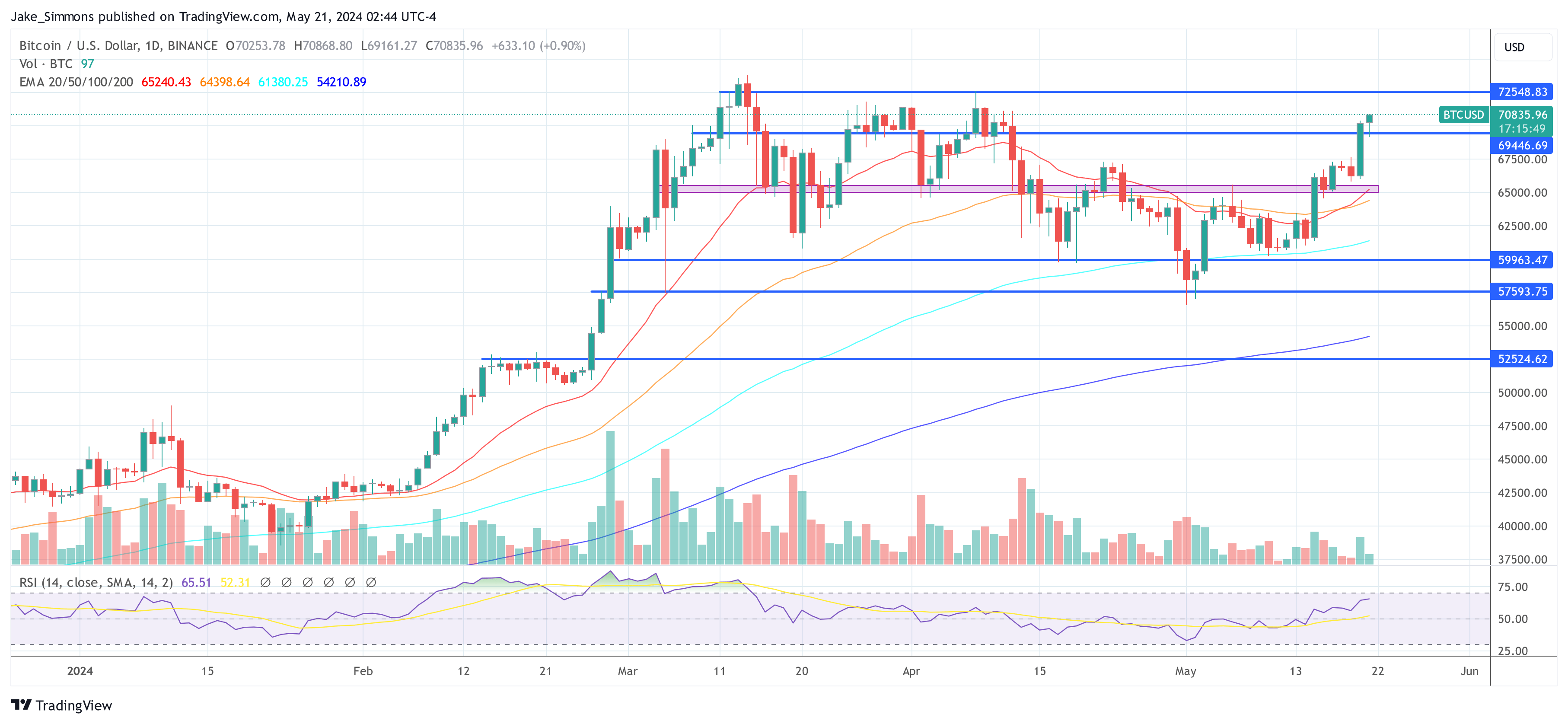
Bitcoin price
Disclaimer: For information purposes only. Past performance is not indicative of future results.
placeholder
Bitcoin CME gaps at $35,000, $27,000 and $21,000, which one gets filled first?Prioritize filling the $27,000 gap and even try higher.
Author  FXStreet
Aug 22, 2023
Prioritize filling the $27,000 gap and even try higher.
placeholder
Bitcoin briefly loses 2025 gains as crypto plunges over the weekend.Bitcoin experienced a sharp decline this weekend, briefly erasing its 2025 gains and dipping below its year-opening value of $93,507. The cryptocurrency fell to a low of $93,029 on Sunday, representing a 25% drop from its all-time high in October. Although it has rebounded slightly to around $94,209, the pressures on the market remain significant. The downturn occurred despite the reopening of the U.S. government on Thursday, which many had hoped would provide essential support for crypto markets. This year initially appeared promising for cryptocurrencies, particularly after the inauguration of President Donald Trump, who has established the most pro-crypto administration thus far. However, ongoing political tensions—including Trump's tariff strategies and the recent government shutdown, lasting a historic 43 days—have contributed to several rapid price pullbacks for Bitcoin throughout the year. Market dynamics are also being influenced by Bitcoin whales—investors holding large amounts of Bitcoin—who have been offloading portions of their assets, consequently stalling price rallies even as positive regulatory developments emerge. Despite these sell-offs, analysts from Glassnode argue that this behavior aligns with typical patterns seen among long-term investors during the concluding stages of bull markets, suggesting it is not indicative of a mass exodus. Notably, Bitcoin is not alone in its struggles, as Ethereum and Solana have also recorded declines of 7.95% and 28.3%, respectively, since the start of the year, while numerous altcoins have faced even steeper losses. Looking ahead, questions linger regarding the viability of the four-year cycle thesis, particularly given the increasing institutional support and regulatory frameworks now in place in the crypto landscape. Matt Hougan, chief investment officer at Bitwise, remains optimistic, suggesting a potential Bitcoin resurgence in 2026 driven by the “debasement trade” thesis and a broader trend toward increased adoption of stablecoins, tokenization, and decentralized finance. Hougan emphasized the soundness of the underlying fundamentals, pointing to a positive outlook for the sector in the longer term.
Author  Mitrade
Nov 17, 2025
Bitcoin experienced a sharp decline this weekend, briefly erasing its 2025 gains and dipping below its year-opening value of $93,507. The cryptocurrency fell to a low of $93,029 on Sunday, representing a 25% drop from its all-time high in October. Although it has rebounded slightly to around $94,209, the pressures on the market remain significant. The downturn occurred despite the reopening of the U.S. government on Thursday, which many had hoped would provide essential support for crypto markets. This year initially appeared promising for cryptocurrencies, particularly after the inauguration of President Donald Trump, who has established the most pro-crypto administration thus far. However, ongoing political tensions—including Trump's tariff strategies and the recent government shutdown, lasting a historic 43 days—have contributed to several rapid price pullbacks for Bitcoin throughout the year. Market dynamics are also being influenced by Bitcoin whales—investors holding large amounts of Bitcoin—who have been offloading portions of their assets, consequently stalling price rallies even as positive regulatory developments emerge. Despite these sell-offs, analysts from Glassnode argue that this behavior aligns with typical patterns seen among long-term investors during the concluding stages of bull markets, suggesting it is not indicative of a mass exodus. Notably, Bitcoin is not alone in its struggles, as Ethereum and Solana have also recorded declines of 7.95% and 28.3%, respectively, since the start of the year, while numerous altcoins have faced even steeper losses. Looking ahead, questions linger regarding the viability of the four-year cycle thesis, particularly given the increasing institutional support and regulatory frameworks now in place in the crypto landscape. Matt Hougan, chief investment officer at Bitwise, remains optimistic, suggesting a potential Bitcoin resurgence in 2026 driven by the “debasement trade” thesis and a broader trend toward increased adoption of stablecoins, tokenization, and decentralized finance. Hougan emphasized the soundness of the underlying fundamentals, pointing to a positive outlook for the sector in the longer term.
placeholder
ECB Policy Outlook for 2026: What It Could Mean for the Euro’s Next MoveWith the ECB likely holding rates steady at 2.15% and the Fed potentially extending cuts into 2026, EUR/USD may test 1.20 if Eurozone growth proves resilient, but weaker growth and an ECB pivot could pull the pair back toward 1.13 and potentially 1.10.
Author  Mitrade
Dec 26, 2025
With the ECB likely holding rates steady at 2.15% and the Fed potentially extending cuts into 2026, EUR/USD may test 1.20 if Eurozone growth proves resilient, but weaker growth and an ECB pivot could pull the pair back toward 1.13 and potentially 1.10.
placeholder
Gold Price Forecast: XAU/USD opens lower around $4,450 on fears of widening Iran conflictsGold price (XAU/USD) opens over 1% lower to near $4,445.00 on Monday, as oil prices have rallied further on fears of further widening of conflicts in the Middle East. WTI Oil price is up almost 3% above $102.50 in the opening trade, increasing fears of higher inflation expectations globally.
Author  FXStreet
Mar 30, Mon
Gold price (XAU/USD) opens over 1% lower to near $4,445.00 on Monday, as oil prices have rallied further on fears of further widening of conflicts in the Middle East. WTI Oil price is up almost 3% above $102.50 in the opening trade, increasing fears of higher inflation expectations globally.
placeholder
Silver Price Forecast: XAG/USD falls to near $72.00 amid fading safe-haven demandSilver price (XAG/USD) continues to lose ground after registering tiny losses in the previous day, trading around $72.90 during the Asian hours on Thursday. The safe-haven demand for the precious metal fades amid rising optimism over Middle East peace.
Author  FXStreet
Apr 02, Thu
Silver price (XAG/USD) continues to lose ground after registering tiny losses in the previous day, trading around $72.90 during the Asian hours on Thursday. The safe-haven demand for the precious metal fades amid rising optimism over Middle East peace.
goTop
quote