

Crypto Post-Mortem: Here’s How Pump.Fun Was Exploited For $2 Million

Source Newsbtc

Solana-based platform Pump.fun suffered an exploit that left the crypto community with many questions. The attack stole millions of dollars in users’ funds, but the reasons behind it and the exact amount of the loot were unclear. Amid the uncertainty, some claimed that a crypto Robinhood had emerged.

$80 Million Taken In Crypto Heist?

On Thursday, the platform Pump.fun announced its bounding curve contracts had been compromised. In the post, the team alerted users that all trading was temporarily halted while they investigated the incident.

Pump.fun is a trading platform created to “prevent rugs” by ensuring that all created crypto tokens are safe. The platform allows users to easily launch instantly tradeable tokens with no presale and no team allocation.

This solution became an extremely popular alternative among influencers and users who wanted to create tokens without the complexity or high costs of launching a project.

It uses bonding curve contracts for the tokens, a mathematical model that determines a token’s price based on supply, increasing with the number of tokens bought. After the token’s market capitalization reaches $69,000, part of the liquidity is deposited on Raydium to be burned.

Since the attack, the team has assured users that the contracts have been upgraded to prevent further fund loss, adding that the protocol’s total value locked (TVL) is safe.

However, the community’s reports were contradictory and alarming. Some users claimed the attacker had taken $80 million in crypto from the platform’s bonding curve contracts, which worried the affected users.

According to Lookonchain’s report, the hacker was quickly identified. At first, he pretended to be an unaware user, asking what the damages were. However, he later accused the platform’s founders of withdrawing the exact amount stolen a day prior.
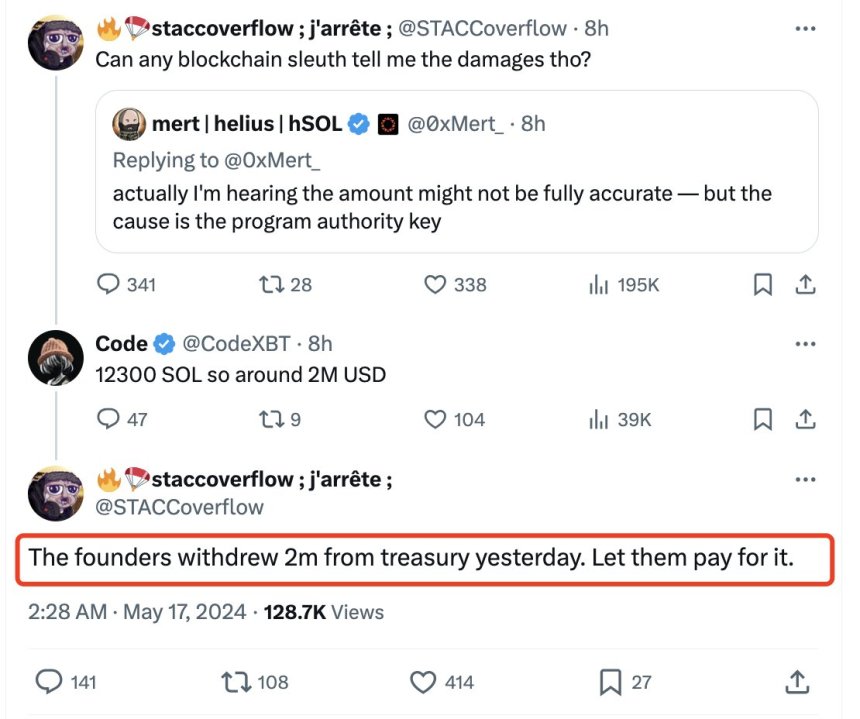
crypto

An X user claimed the individual chose to “be a Robin Hood, dropping hacked cash to $SOL communities.” The attacker also stated in a post his desire to “change the course of history.” However, his “heroic outlaw” endeavors affected 1,882 addresses.

What Happened?

Despite the speculation and the attacker’s posts, it was later revealed that he was a Pump.fun ex-employee. In its post-mortem post, the platform’s team revealed that the individual had used their position to misappropriate funds from the bonding curve contracts.

The attacker illegitimately accessed the accounts after obtaining the private keys, “using their privileged position at the company.” The former employee used flash loans from Solana lending protocol to steal 12,300 SOL, worth around $1.9 million.

Per the post, he borrowed SOL to buy as many tokens as possible in Pump.fun. When the tokens hit 100% on their respective bonding curves, the attacker used the keys to access the bonding curve liquidity and repay the flash loans.

Fortunately, the attacker could only access $1.9 million out of the $45 million liquidity in contracts. Since then, the team has redeployed the bonding curve contracts and offered a plan to help affected crypto investors.

To make users whole, the team will “seed the LPs for each affected coin with an equal or greater amount of SOL liquidity that the coin had at 15:21 UTC within the next 24 hours.” Moreover, they are offering 0% trading fees for the next 7 days. As a user pointed out, this action is “non-trivial” since Pump.fun makes $1 million daily from fees.
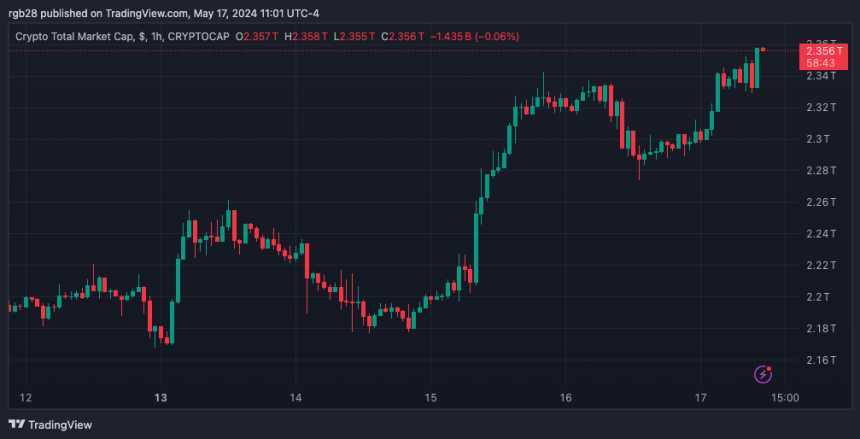
crypto, TOTAL
Disclaimer: For information purposes only. Past performance is not indicative of future results.
placeholder
Bitcoin falls below $75,000 as the CLARITY Act fails in the Senate — what the vote means for cryptoThe US Senate blocked the Digital Asset Market CLARITY Act in a 49-50 procedural vote, sending Bitcoin briefly below $75,000 — its biggest one-day drop since June. Ethereum fell more than 8%, Coinbase slid 10% and $75 billion of crypto market value evaporated. Here is what the vote was, why it failed, and the levels that matter now.
Author  Suzie
Sep 16, Wed
The US Senate blocked the Digital Asset Market CLARITY Act in a 49-50 procedural vote, sending Bitcoin briefly below $75,000 — its biggest one-day drop since June. Ethereum fell more than 8%, Coinbase slid 10% and $75 billion of crypto market value evaporated. Here is what the vote was, why it failed, and the levels that matter now.
placeholder
Dollar index tops 100 for the first time since July as the Fed's hawkish dot plot sinks inThe U.S. dollar index broke back above 100 for the first time since 31 July after the Fed delivered its first rate hike since 2023, with the dot plot showing 16 of 18 officials expect at least one more increase this year. Here are the levels that matter for DXY, the currencies feeling it most, and what to watch next.
Author  Irene Q.
Sep 17, Thu
The U.S. dollar index broke back above 100 for the first time since 31 July after the Fed delivered its first rate hike since 2023, with the dot plot showing 16 of 18 officials expect at least one more increase this year. Here are the levels that matter for DXY, the currencies feeling it most, and what to watch next.
placeholder
US to delay new "overcapacity" tariffs on China — what the pause means for trade, inflation and the dollarWashington is expected to hold off announcing new tariffs over Chinese "overcapacity" until after the 24 September summit, according to Bloomberg. The postponed plan would have added 7.5% to Chinese goods, taking second-term US tariffs to around 20%. Here is what is on the table, and what a deal versus no deal would mean for the yuan, Hong Kong equities and the dollar.
Author  Mitrade
Sep 18, Fri
Washington is expected to hold off announcing new tariffs over Chinese "overcapacity" until after the 24 September summit, according to Bloomberg. The postponed plan would have added 7.5% to Chinese goods, taking second-term US tariffs to around 20%. Here is what is on the table, and what a deal versus no deal would mean for the yuan, Hong Kong equities and the dollar.
placeholder
Gold ends three-week slide at the $4,400 line — eight straight days of ETF inflows vs a 5% 10-year and a 100 dollarSpot gold closed Friday at $4,378.39, up 0.84% on the day and about 0.8% for the week — its first weekly gain in four weeks — with the intraday high of $4,399.67 leaving it 33 cents shy of the $4,400 line. Gold ETFs have now logged eight straight sessions of inflows, but with the 10-year back above 5% and the dollar index near 100, here is what decides whether this is a reversal or a bounce.
Author  Suzie
Yesterday 05: 53
Spot gold closed Friday at $4,378.39, up 0.84% on the day and about 0.8% for the week — its first weekly gain in four weeks — with the intraday high of $4,399.67 leaving it 33 cents shy of the $4,400 line. Gold ETFs have now logged eight straight sessions of inflows, but with the 10-year back above 5% and the dollar index near 100, here is what decides whether this is a reversal or a bounce.
placeholder
Bitcoin squeezes back above $80,000 — 110,000 traders liquidated as the hawkish Fed and CLARITY setback fail to hold it down; is $83,000 next?Bitcoin closed above $80,000 on Friday for the first time since September 7, and pushed to $81,299 over the weekend, triggering about $603 million of liquidations — $523 million of them shorts — across more than 110,000 traders. With the Fed's hike already priced and the SEC and CFTC advancing crypto rules after the CLARITY Act failed, here is what stands between BTC and the $83,000 gate.
Author  Suzie
Yesterday 06: 19
Bitcoin closed above $80,000 on Friday for the first time since September 7, and pushed to $81,299 over the weekend, triggering about $603 million of liquidations — $523 million of them shorts — across more than 110,000 traders. With the Fed's hike already priced and the SEC and CFTC advancing crypto rules after the CLARITY Act failed, here is what stands between BTC and the $83,000 gate.
goTop
quote