

OpenAI parts ways with cofounder and chief scientist Ilya Sutskever

Source Fxstreet
  • OpenAI cofounder Ilya Sutskever is exiting the firm for reasons not disclosed yet.
  • Jakub Pachocki replaces Sutskever, taking the baton after running many of OpenAI’s most important projects, Altman says.
  • Reportedly, Sutskever played a key role in the November ouster of CEO Sam Altman.

OpenAI’s Sam Altman’ ouster subject is being revisited again after confirmation that the firm’s cofounder and chief scientist Ilya Sutskever is exiting after a decade’s tenure with the company.

Also Read: Top AI tokens bleed despite reports of Apple closing deal to use OpenAI features

OpenAI’s Ilya Sutskever steps down

In a Tuesday post on X, Sutskever announced the end of his service at OpenAI, not disclosing any reasons for leaving. Based on the announcement, what lies ahead for him is “a project that is very personally meaningful,” adding that he would share details in due time.

OpenAI CEO, Sam Altman, has since confirmed the move, adding that Jakub Pachocki would be coming in as new Chief Scientist in place of Sutskever. Pachocki is not new at the firm after running “many of our most important projects,” Altman indicates, adding, and “I am very confident he will lead us to make rapid and safe progress towards our mission of ensuring that AGI benefits everyone.”

Amid reports that Sutskever was instrumental in the failed board ouster of Altman in November, his position has been on the balance since the attempted usurp failed. Citing two people familiar with the company, Business Insider had reported in December that Sutskever had essentially been shut out of OpenAI in the aftermath of the attempt to remove Altman as CEO.

OpenAI debuts GPT-4o

Meanwhile,  OpenAI has recently launched GPT-4o, advertised as “a new flagship model which can reason across audio, vision, and text in real-time.” In a live demo of GPT-4o voice variation, the model demonstrated its capabilities with maximal emotions.

Access to GPT-4o started on May 14, with OpenAI committing to rolling out the new voice and vision capabilities demonstrated in the webinar to ChatGPT Plus over the coming weeks.

At the time of writing, Worldcoin (WLD) price is $4.76, down almost 15%, as AI crypto coins continue to bleed alongside the broader market.
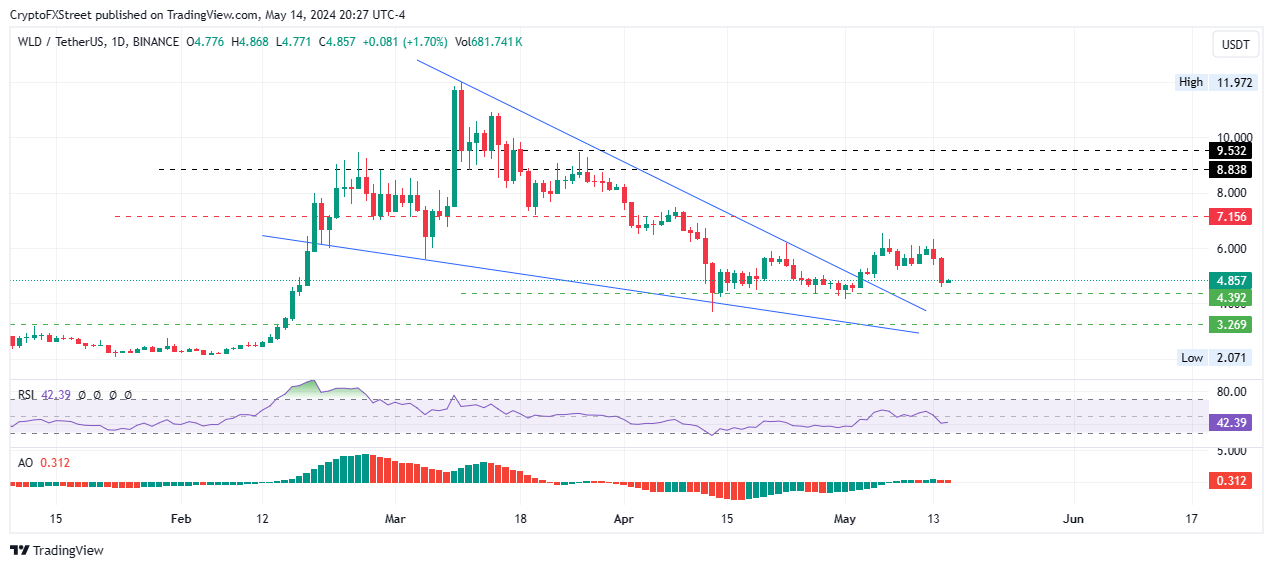
WLD/USDT 1-day chart

Disclaimer: For information purposes only. Past performance is not indicative of future results.
placeholder
Fed hike odds near 90% into Wednesday's decision — how to trade the dollar, gold and the S&P 500A 0.3% monthly core CPI print has lifted the market-implied probability of a 25bp Fed hike on 16 September to roughly 86.5% ~ 90%, which would be the first increase since July 2023. Here is the decision timeline, the pricing versus the forecasts, both scenarios, and the key levels for the dollar, gold and the S&P 500.
Author  Suzie
Sep 14, Mon
A 0.3% monthly core CPI print has lifted the market-implied probability of a 25bp Fed hike on 16 September to roughly 86.5% ~ 90%, which would be the first increase since July 2023. Here is the decision timeline, the pricing versus the forecasts, both scenarios, and the key levels for the dollar, gold and the S&P 500.
placeholder
Bitcoin falls below $75,000 as the CLARITY Act fails in the Senate — what the vote means for cryptoThe US Senate blocked the Digital Asset Market CLARITY Act in a 49-50 procedural vote, sending Bitcoin briefly below $75,000 — its biggest one-day drop since June. Ethereum fell more than 8%, Coinbase slid 10% and $75 billion of crypto market value evaporated. Here is what the vote was, why it failed, and the levels that matter now.
Author  Suzie
Sep 16, Wed
The US Senate blocked the Digital Asset Market CLARITY Act in a 49-50 procedural vote, sending Bitcoin briefly below $75,000 — its biggest one-day drop since June. Ethereum fell more than 8%, Coinbase slid 10% and $75 billion of crypto market value evaporated. Here is what the vote was, why it failed, and the levels that matter now.
placeholder
Dollar index tops 100 for the first time since July as the Fed's hawkish dot plot sinks inThe U.S. dollar index broke back above 100 for the first time since 31 July after the Fed delivered its first rate hike since 2023, with the dot plot showing 16 of 18 officials expect at least one more increase this year. Here are the levels that matter for DXY, the currencies feeling it most, and what to watch next.
Author  Irene Q.
Sep 17, Thu
The U.S. dollar index broke back above 100 for the first time since 31 July after the Fed delivered its first rate hike since 2023, with the dot plot showing 16 of 18 officials expect at least one more increase this year. Here are the levels that matter for DXY, the currencies feeling it most, and what to watch next.
placeholder
Gold rebounds to near $4,350 on weaker US Dollar, falling oil pricesGold price (XAU/USD) rises to near $4,345 during the early Asian session on Friday. The precious metal rebounds from a six-week low amid falling oil prices and a weaker US Dollar (USD). Traders continue to assess the latest Federal Reserve (Fed) rate hike and policy cues.
Author  FXStreet
Yesterday 01: 32
Gold price (XAU/USD) rises to near $4,345 during the early Asian session on Friday. The precious metal rebounds from a six-week low amid falling oil prices and a weaker US Dollar (USD). Traders continue to assess the latest Federal Reserve (Fed) rate hike and policy cues.
placeholder
US to delay new "overcapacity" tariffs on China — what the pause means for trade, inflation and the dollarWashington is expected to hold off announcing new tariffs over Chinese "overcapacity" until after the 24 September summit, according to Bloomberg. The postponed plan would have added 7.5% to Chinese goods, taking second-term US tariffs to around 20%. Here is what is on the table, and what a deal versus no deal would mean for the yuan, Hong Kong equities and the dollar.
Author  Mitrade
22 hours ago
Washington is expected to hold off announcing new tariffs over Chinese "overcapacity" until after the 24 September summit, according to Bloomberg. The postponed plan would have added 7.5% to Chinese goods, taking second-term US tariffs to around 20%. Here is what is on the table, and what a deal versus no deal would mean for the yuan, Hong Kong equities and the dollar.
goTop
quote