


AI Agents Have Claimed 9,200 Jobs in 2026: Here Is What Workers Need to Do Now
AI agents have now claimed over 9,200 jobs in 2026. Companies like Block explicitly link their layoffs to automation. The workforce is changing faster than most expected.
A new report from RationalFX tracked 45,363 tech layoffs worldwide since January. Roughly 20% of those cuts trace directly to AI implementation and organizational restructuring.
How to Protect Your Jobs
Block tops the list with 4,000 layoffs. CEO Jack Dorsey said the decision was not financially driven. He pointed instead to AI tools now handling tasks once performed by humans. The company is shrinking from 10,000 to around 6,000 employees.
WiseTech Global cut 2,000 roles. Other companies, such as eBay, axed 800 jobs, while Pinterest cut 675 positions.
The question is no longer whether AI will affect your job. It already has. And the impact on younger workers is growing severe.
ServiceNow CEO Bill McDermott sounded one of the starkest warnings yet. He told CNBC’s Squawk on the Street that entry-level roles are disappearing to AI agents:
“Unemployment for new college graduates could easily go into the mid-30s in the next couple of years. So much of the work is going to be done by agents. So it’s going to be challenging for young people to differentiate themselves in the corporate environment.” — Bill McDermott, CEO of ServiceNow
The Federal Reserve Bank of New York reported that the unemployment rate for recent college graduates at the end of 2025 was about 5.7%, with an underemployment rate of 42.5%, the highest since 2020. McDermott’s warning signals how fast that number could climb.
However, industry leaders believe that workers who adapt to AI are more likely to survive. Nvidia CEO Jensen Huang addressed the survival equation directly at the Milken Institute:
“Every job will be affected, and immediately. It is unquestionable. You’re not going to lose your job to an AI, but you’re going to lose your job to someone who uses AI.” — Jensen Huang said.
Investor Naval Ravikant put the divide even more plainly on X. He argued the real split is not between junior and senior workers. It is between those who are good with AI and those who are not.
Google CEO Sundar Pichai has called for a collective response. At the Bloomberg Technology Summit in June 2025, he argued that reskilling cannot fall on workers alone:
“It’s a shared responsibility of governments, educational institutions, and private companies to prepare the workforce… We need massive reskilling efforts to ensure that this technology benefits everyone.” — Sundar Pichai, said.
Workers with AI skills already command up to 56% higher wages than peers without them, according to a PwC analysis. The advantage grows each quarter that passes without action.
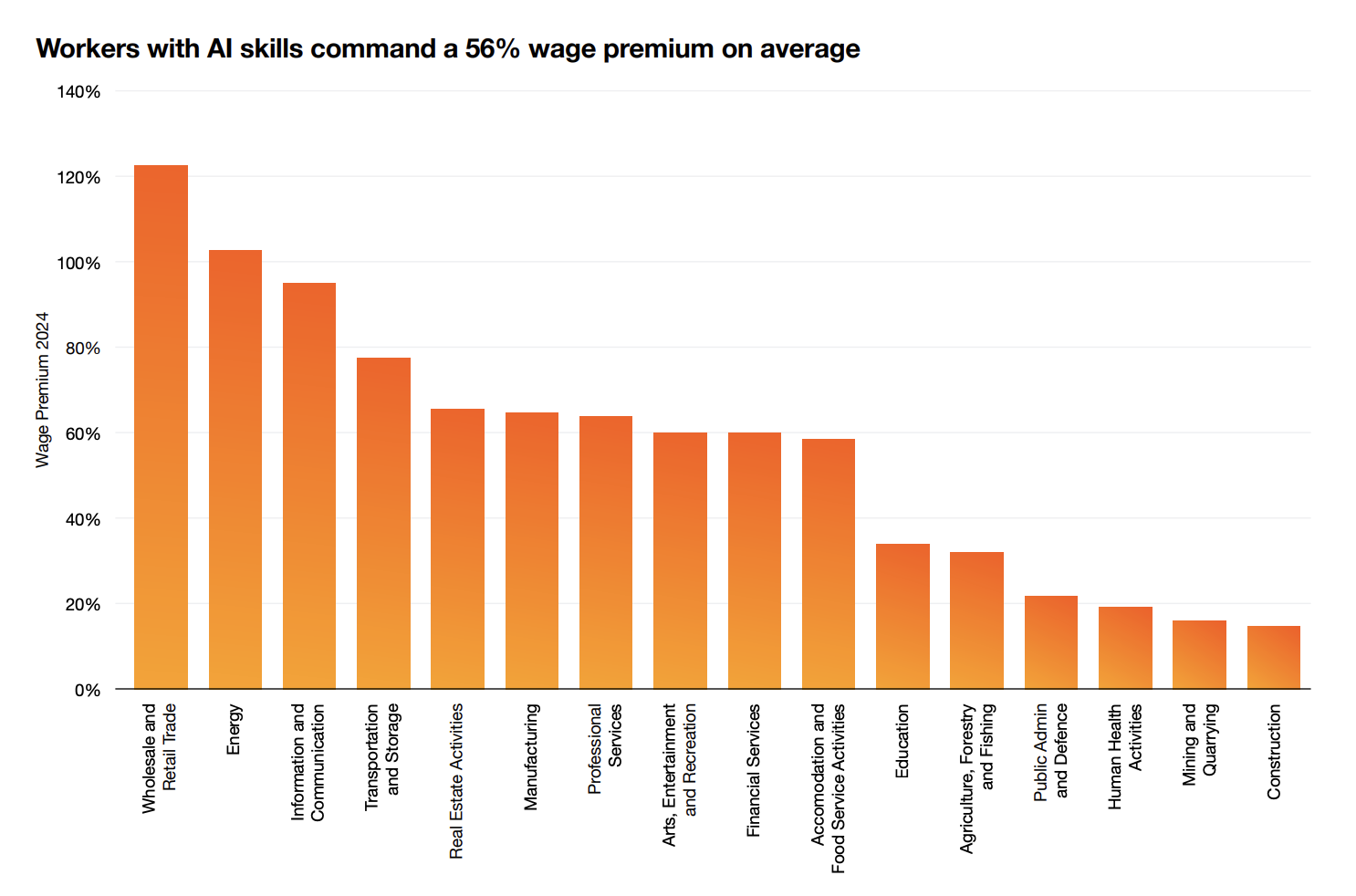 Workers with AI skills already command up to 56% higher wages. Source: PwC
The World Economic Forum projects AI will create 170 million new roles by 2030. But those roles go to workers who adapt now, not those who wait for the transition to slow.
Recommended Articles


