


Solana ETFs ‘Defy Physics’ Amid Price Weakness: Where Is the Demand Coming From?
The broader crypto market weakness and investor risk aversion have weighed heavily on Solana’s (SOL) price, with the asset down over 31% year-to-date.
Despite this, the spot exchange-traded funds (ETFs) still paint a picture of resilience. This raises a key question: Where is the demand coming from?
Solana ETFs See Demand Even as SOL Price Falls Since Launch
In a recent X (formerly Twitter) post, Bloomberg’s senior ETF analyst Eric Balchunas highlighted that Solana spot exchange-traded funds (ETFs) attracted $1.5 billion in inflows since launching in July 2025, even as SOL’s price dropped roughly 57% over the same period.
Balchunas noted that, when adjusted for Solana’s market cap compared to Bitcoin (BTC), the inflows equated to approximately $54 billion. That figure is roughly twice the pace of Bitcoin ETFs at a comparable stage, at a period when BTC was actually rising.
Follow us on X to get the latest news as it happens
“In reality/history of ETFs launching into that kind of downturn is near imposs to get inflows. Most wouldn’t even make it to age 1 or 2 if they went down 57% in first 6mo. timing is very imp. Solana defying physics here,” he wrote on March 6.
BeInCrypto previously highlighted the divergence between SOL’s declining price and its persistent ETF demand. The ETFs maintained a positive inflow streak since February 10, defying broader market volatility.
However, that positive streak ended recently. Data from SoSoValue showed that over the past three trading sessions, Solana ETFs saw consecutive outflows totalling nearly $16 million. This marked their longest red streak. Furthermore, cumulative inflows now stand at $955.5 million.
SOL was not alone. Ethereum and XRP (XRP) ETFs also recorded three consecutive days of outflows. Bitcoin ETFs attracted $167.03 million on March 9, snapping a two-day outflow streak of its own.
The broader pullback coincided with elevated geopolitical tensions that weighed on risk assets across crypto and equities.
Analysts Debate Solana ETF Demand: Real Buying or In-Kind Swaps?
Despite the drawdown, the ETFs have held strong in a market marked by extreme fear and cooling demand for risk assets. James Seyffart, senior research analyst at Bloomberg Intelligence, noted that the buyer list includes major institutional players, including market makers and crypto-focused investment funds.
Electric Capital, Goldman Sachs, Multicoin Capital, and Morgan Stanley are among those with the largest allocations.
“Almost 50% of the holders as of the end of 2025 are known via 13F. Very high for such young products,” he said.
When it comes to inflows into these products, Seyffart ruled out the “basis trade” (arbitrage of futures vs. spot prices) as a major driver, noting that “basis on Solana has been extremely low so far in 2026.”
“Money continued to come in despite terrible price performance. it was a lot of institutional money. this money is likely and mostly directionally long investments. Not basis trading,” the analyst remarked.
Jeff Dorman, chief investment officer at Arca, argued that “there were no buyers.” According to him, the activity stems from “in-kind swaps” by existing SOL holders.
Seyffart partially agreed, noting that seed capital and early inflows likely included such swaps, but insisted that there was still “plenty of buying.”
“Yes, very valid point! Almost certainly true that the seed capital and a chunk of initial flows were just swapped SOL exposure. That said — it definitely wasn’t all of the money that came into these things. 13Fs account for 50% of the AUM. So even if we assume 100% of 13F filers were swapped exposure “buyers” (they weren’t). There was still plenty of buying. Not quite BTC etf level buying but very very healthy for a new-ish ETF category,” he replied.
Meanwhile, the broader market rebound has pushed Solana’s price higher. BeInCrypto Markets data showed that the altcoin was up nearly 4% over the past day. It traded at $86.7 at press time.
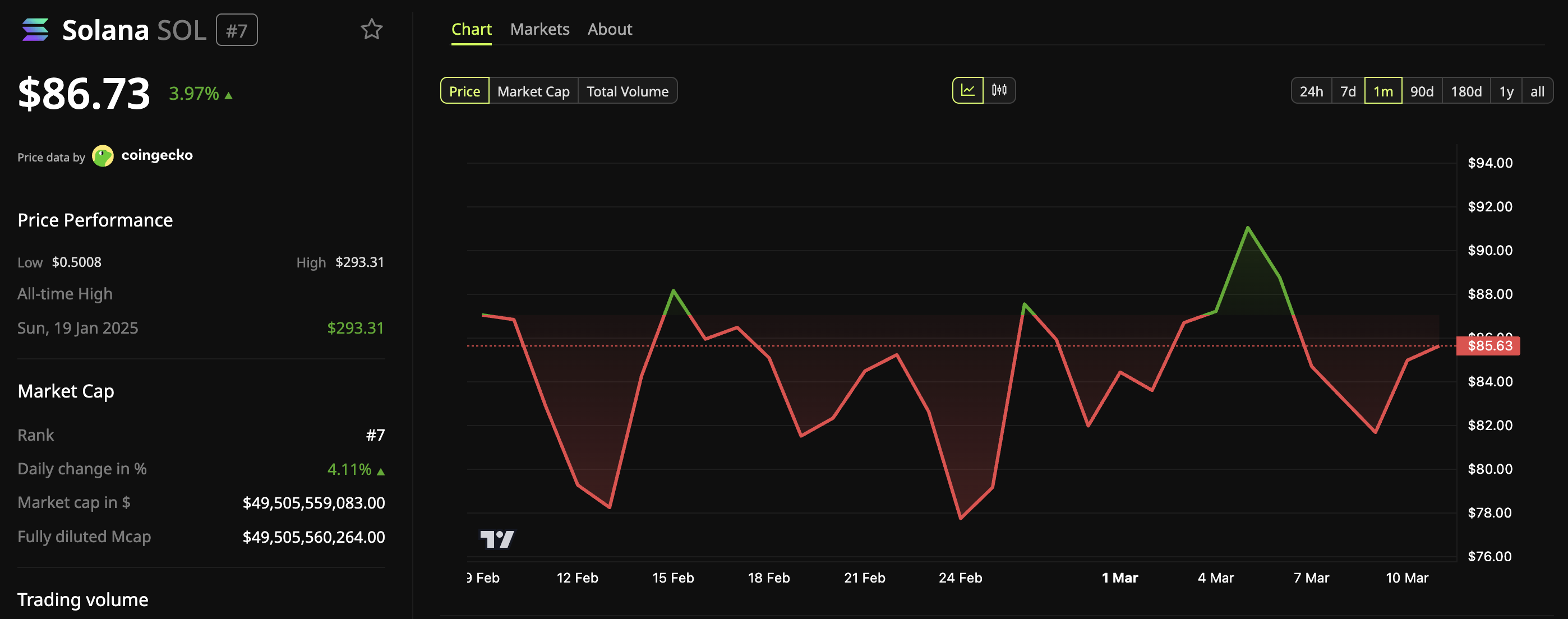 Solana (SOL) Price Performance on March 10, 2026. Source: BeInCrypto Markets
Whether renewed optimism will translate into fresh ETF inflows or the outflow streak will continue remains to be seen.
Subscribe to our YouTube channel to watch leaders and journalists provide expert insights
Recommended Articles


