

Dogecoin Price Forecast: DOGE consolidates despite weakening institutional and retail demand
- Dogecoin trades under pressure, with the 50, 100 and 200-day EMAs limiting upside.
- Retail traders stay on the sidelines as Open Interest lags amid zero ETF inflows.
- The MACD upholds a slight positive edge, but the general outlook remains bearish.
Dogecoin (DOGE) is trading marginally above its intraday open of $0.1403 at the time of writing on Friday. Support at $0.1321 has been holding steady since November 20, despite the risk-off sentiment across the cryptocurrency market.
The Federal Reserve’s (Fed) decision to cut interest rates by 25 basis points on Wednesday was characterised by a sharp rise in volatility, as investors digested the hawkish outlook likely to set the tone in 2026.
Inflation risks and a weak labor market stood out as factors that could prompt the central bank to pause its monetary easing cycle, an outlook that may continue to drive macroeconomic uncertainty.
Dogecoin faces declining institutional and retail interest
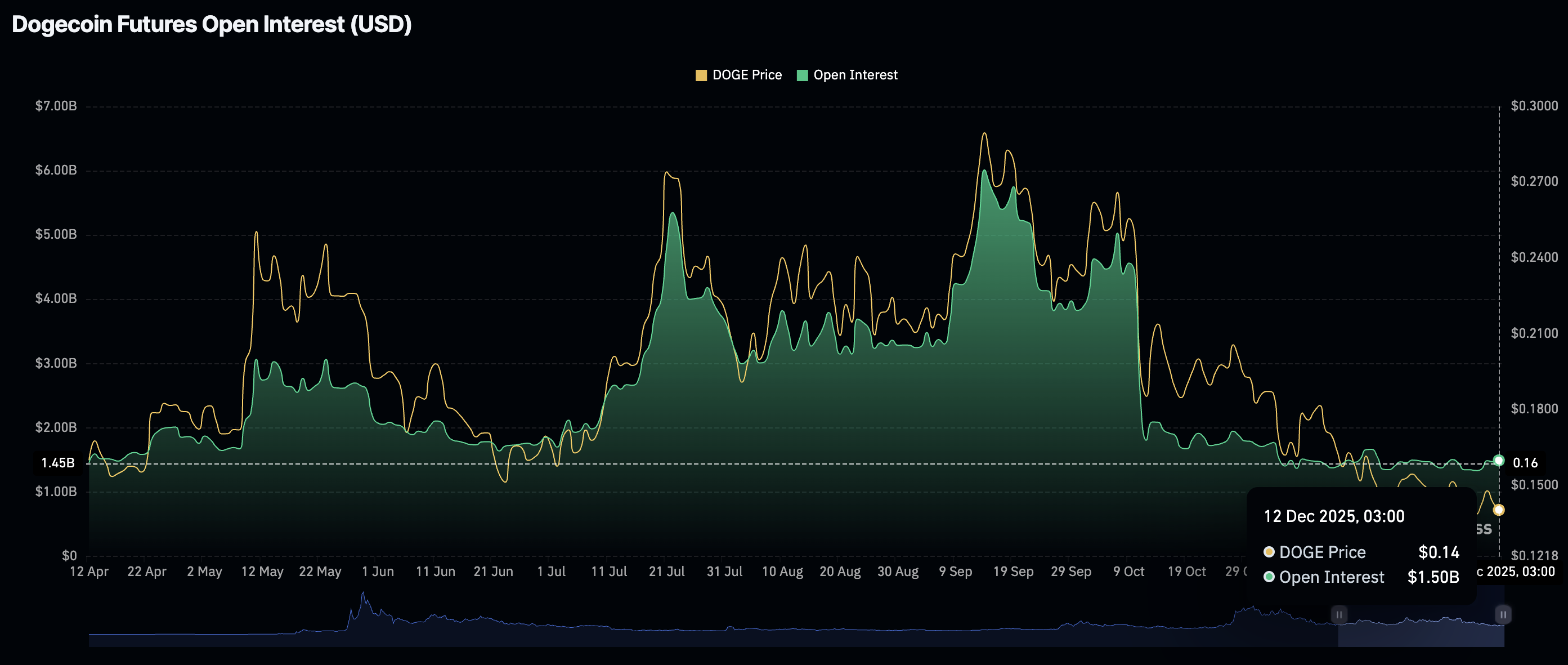
The Dogecoin derivatives market is significantly suppressed, with futures Open Interest (OI) at $1.5 billion on Friday, down from $4.4 billion on October 10.
This sharp decline in OI, which represents the notional value of outstanding futures contracts, was triggered by macroeconomic uncertainty and the October crash, which liquidated over $19 billion in assets in a single day.
Retail interest has since then remained significantly subdued, reflecting a sticky risk-off sentiment as investors stay on the sidelines. Low OI also suggests that investors have lost confidence in the market, which may continue to cap rebounds.
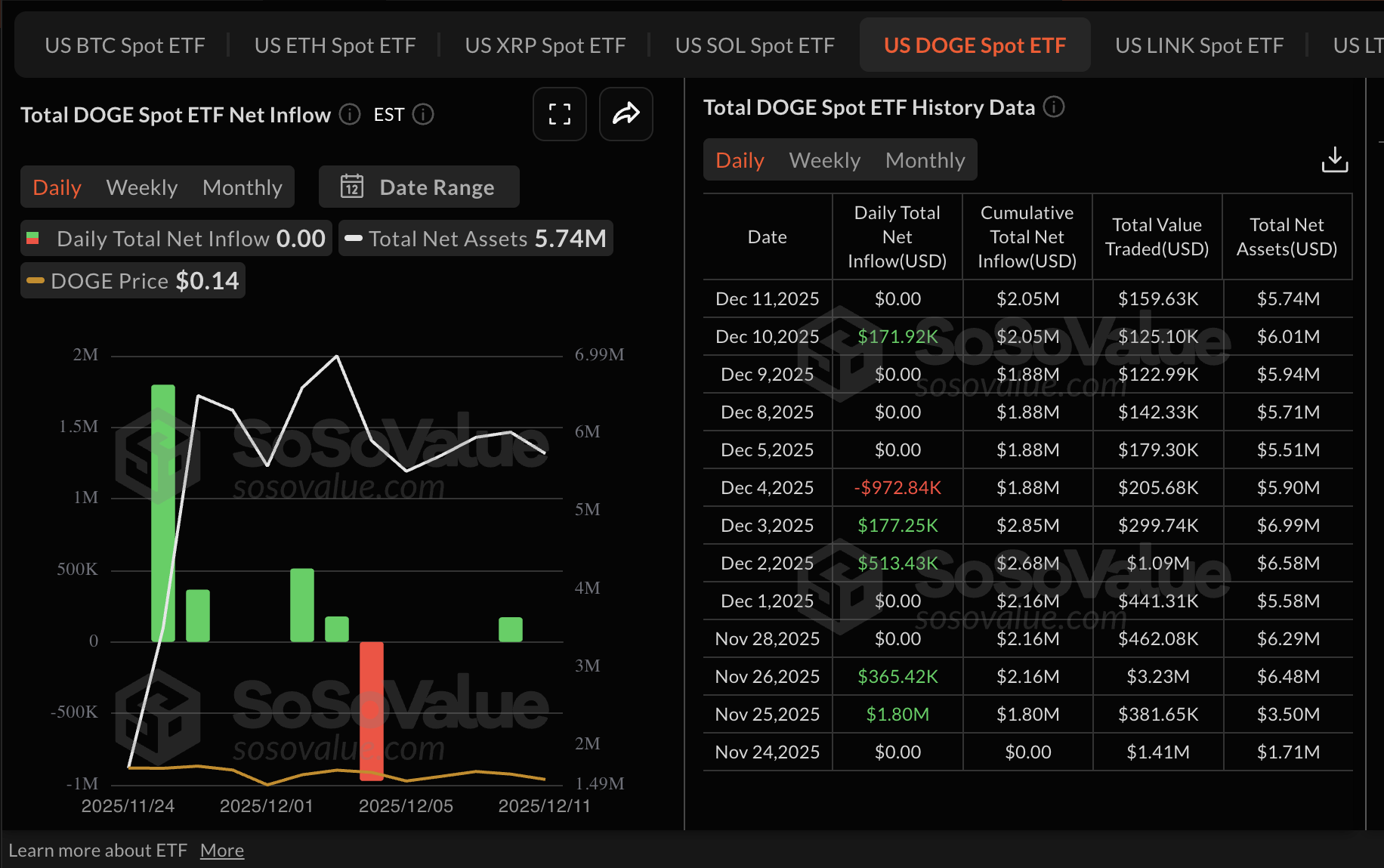
The launch of spot Exchange Traded Funds (ETFs) in November was a major milestone for Dogecoin, being the largest meme coin by market capitalisation. However, institutional interest has remained on the back foot, characterised by mild ETF inflows.
According to SoSoValue data, US-listed DOGE ETFs recorded no flows on Thursday, after posting nearly $172,000 in inflows on Wednesday. The cumulative inflow volume averages $2 million with net assets of $5.74 million. Two Dogecoin spot ETFs are operating in the US, including Grayscale’s GDOG and Bitwise’s BWOW.
Technical outlook: Dogecoin extends sideways trading
XRP is trading at $0.1397 and remains below the falling 50-day Exponential Moving Average (EMA) at $0.1625, 100-day EMA at $0.1813 and 200-day EMA at $0.1957, keeping the broader bias bearish. The Moving Average Convergence Divergence (MACD) indicator holds marginally above the signal line (red), while the green histogram bars contract on the daily chart, suggesting fading bullish momentum. Dogecoin could extend the downtrend below the support at $0.1332 if the Relative Strength Index (RSI) at 41 declines further.
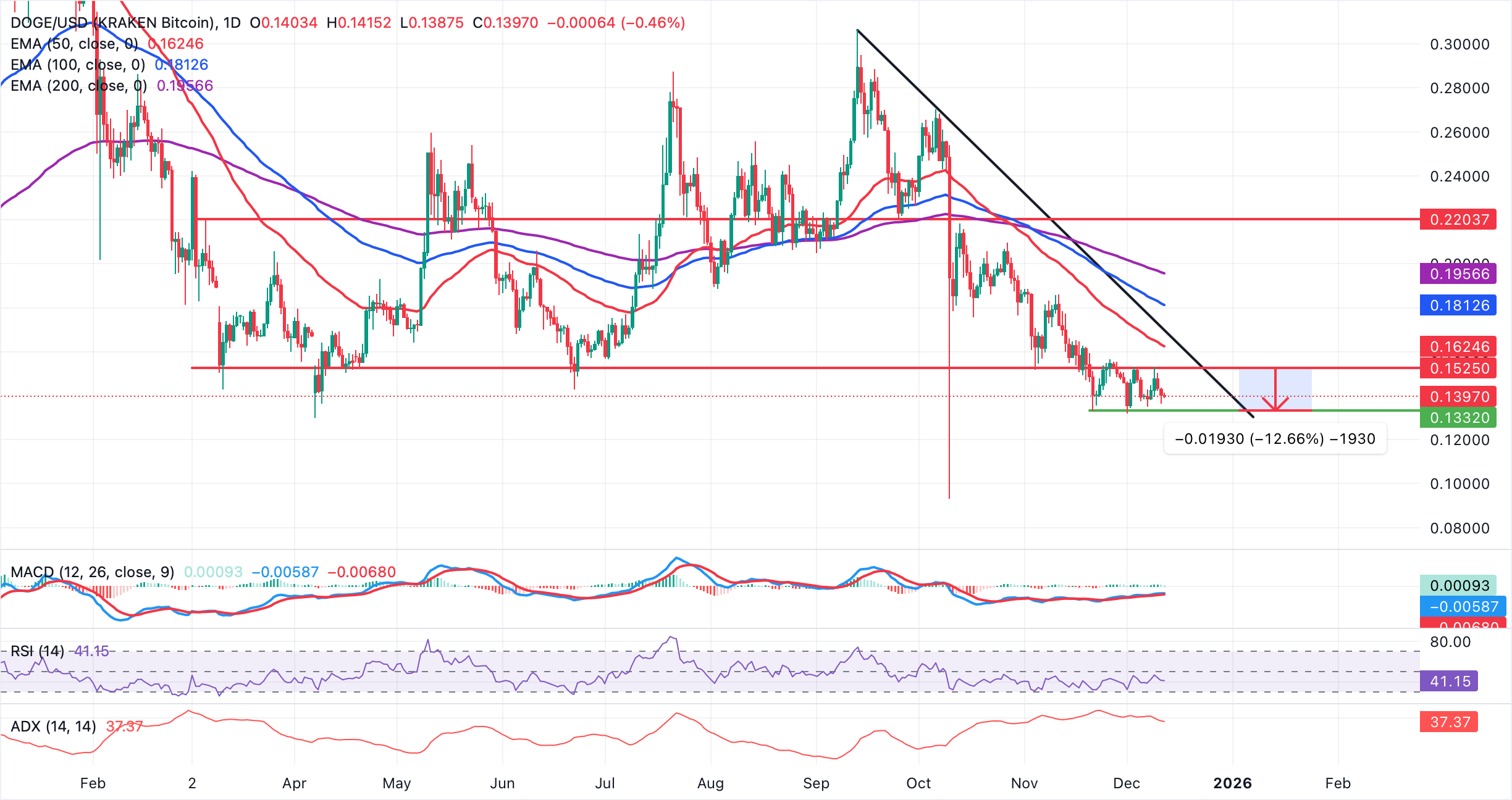
The descending trend line from $0.3063 limits rebounds, with resistance at $0.1688. DOGE's trend strength remains elevated but easing, as the Average Directional Index (ADX) hovers near 37. A daily close above the initial barrier at $0.1688 would improve the tone and expose the 100-day EMA at $0.1813. Failure to reclaim the 50-day EMA would keep rallies capped and leave sellers in control.
Crypto ETF FAQs
An Exchange-Traded Fund (ETF) is an investment vehicle or an index that tracks the price of an underlying asset. ETFs can not only track a single asset, but a group of assets and sectors. For example, a Bitcoin ETF tracks Bitcoin’s price. ETF is a tool used by investors to gain exposure to a certain asset.
Yes. The first Bitcoin futures ETF in the US was approved by the US Securities & Exchange Commission in October 2021. A total of seven Bitcoin futures ETFs have been approved, with more than 20 still waiting for the regulator’s permission. The SEC says that the cryptocurrency industry is new and subject to manipulation, which is why it has been delaying crypto-related futures ETFs for the last few years.
Yes. The SEC approved in January 2024 the listing and trading of several Bitcoin spot Exchange-Traded Funds, opening the door to institutional capital and mainstream investors to trade the main crypto currency. The decision was hailed by the industry as a game changer.
The main advantage of crypto ETFs is the possibility of gaining exposure to a cryptocurrency without ownership, reducing the risk and cost of holding the asset. Other pros are a lower learning curve and higher security for investors since ETFs take charge of securing the underlying asset holdings. As for the main drawbacks, the main one is that as an investor you can’t have direct ownership of the asset, or, as they say in crypto, “not your keys, not your coins.” Other disadvantages are higher costs associated with holding crypto since ETFs charge fees for active management. Finally, even though investing in ETFs reduces the risk of holding an asset, price swings in the underlying cryptocurrency are likely to be reflected in the investment vehicle too.
(The technical analysis of this story was written with the help of an AI tool)
Recommended Articles


