

Fed to End QT: Could this Trigger Multi-Year Altcoin Rally Akin to 2019-2022?
The end of the Federal Reserve’s quantitative tightening (QT) program on December 1, 2024, marks a pivotal shift for crypto markets.
Despite this milestone, experts note that visible impact could take time. Balance sheet expansion may be delayed until early 2026 due to treasury settlement lags, mirroring past cycles.
Historical Patterns Link Fed Policy to Altcoin Performance
The Fed’s monetary policy increasingly influences the crypto market. Historically, when the Fed was not engaged in QT, altcoins showed notable strength against Bitcoin, sparking multi-year rallies and altering market dynamics.
These shifts signal a clear relationship between liquidity policy and crypto performance. Analyst Matthew Hyland identifies historical trends where non-QT periods were followed by sustained altcoin rallies lasting between 29 and 42 months, highlighted by the OTHERS.D/BTC.D ratio.
Hyland’s research spotlights the periods 2014-2017 and 2019-2022. During these periods, the absence of QT allowed altcoins to sustain uptrends for 42 and 29 months, respectively.
“Altcoins historically outperform BTC when QT is not active. Alts have seen a 42-month & 29-month uptrend whilst QT was not active during 2014-2017 & 2019-2022. Based on the very strong correlation to the Fed’s balance sheet, it’s highly favorable Alts outperform BTC for many years going forward,” wrote Hyland.
The OTHERS.D/BTC.D ratio, which compares altcoin market dominance to Bitcoin, climbed as monetary conditions improved, encouraging greater risk appetite.
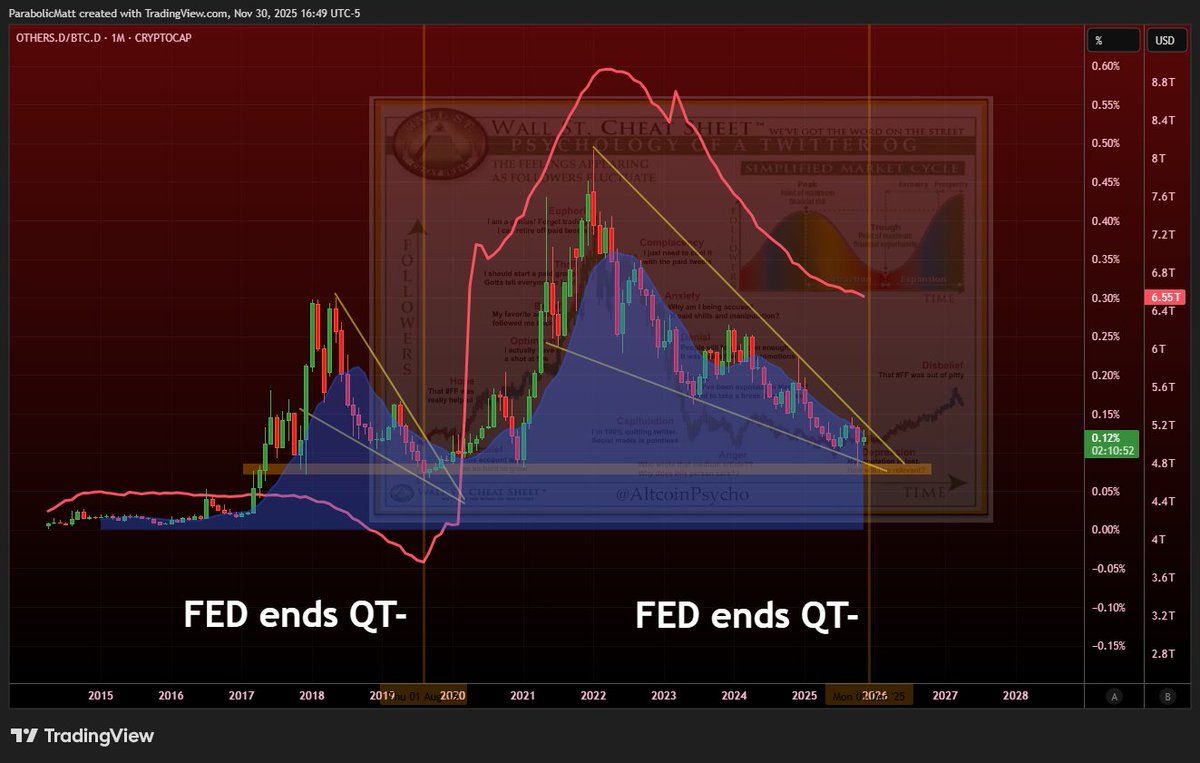 OTHERS.D/BTC.D ratio demonstrates historical altcoin outperformance during non-QT periods. Source: Matthew Hyland on X
The Fed’s approach closely mirrors these shifts. From 2014 to 2017, a supportive stance led to strong altcoin growth. Likewise, after QT ended in August 2019, another altcoin rally unfolded and lasted through 2022. These cycles suggest Fed liquidity policy is a core influence on crypto risk assets.
Hyland emphasized that the current balance sheet, around $6.55 trillion and stabilizing post-QT, supports optimism for multi-year altcoin outperformance relative to Bitcoin.
Critical 0.25 Level May Signal Altcoin Season Launch
Technical analysis shows the ALT/BTC pair historically bottomed at 0.25 after QT ended. This threshold is seen as a key marker signaling the potential start of an altcoin rally and may again indicate the next phase of upward momentum.
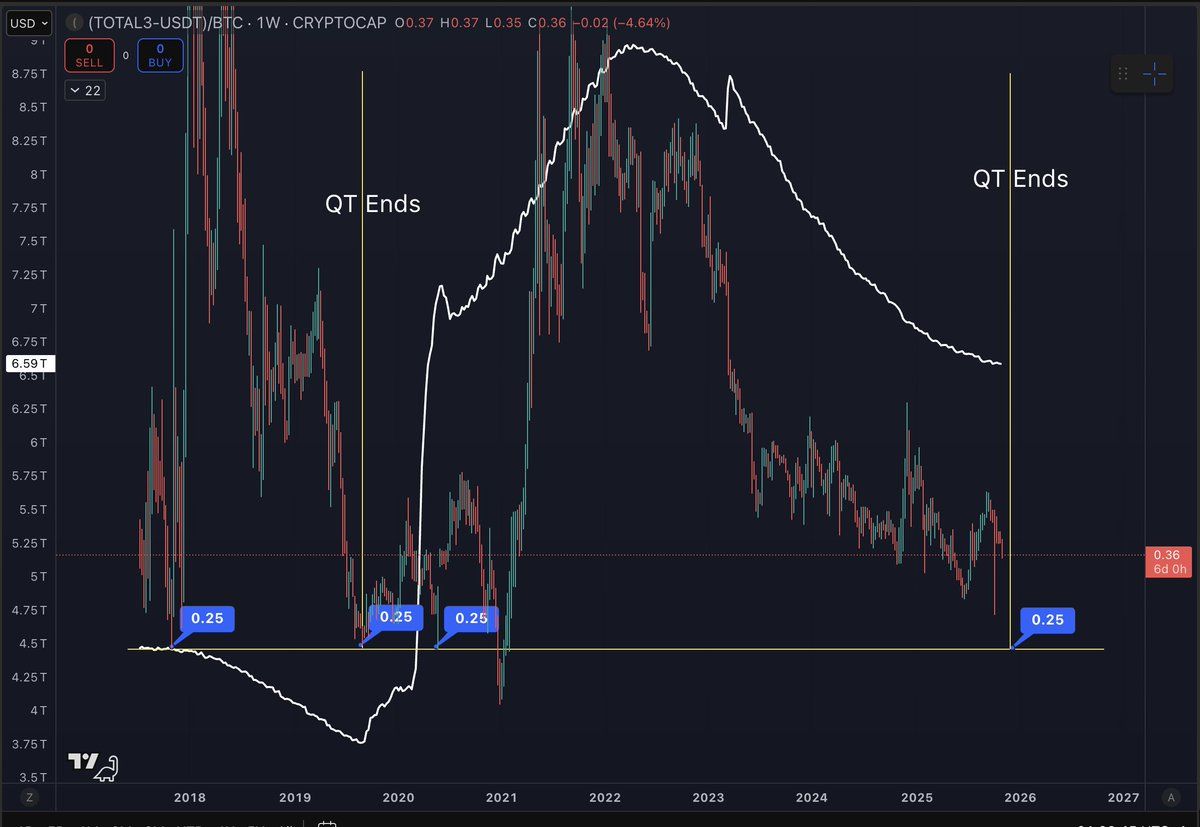 ALT/BTC pair historically bottoms at 0.25 when QT concludes, signaling potential rally starts. Source: TradingView
The ALT/BTC ratio is now at 0.36, which is above this vital support level. If this measure approaches 0.25, it could signal the typical capitulation that precedes lasting altcoin strength.
The 0.25 line holds strong technical and psychological significance, often representing where altcoins regain upward momentum against Bitcoin.
Capital often rotates into alternative cryptocurrencies when Bitcoin dominance declines. According to August 2025 Coinbase research, Bitcoin’s dominance dropped from 65% in May to about 59% by August.
This trend points to early capital flows favoring altcoins, a hallmark of “altcoin season.”
Balance Sheet Expansion Delays Could Postpone Market Impact
While QT has officially ended, immediate effects are unlikely. The experience from 2019 shows that settlement lags can postpone observable balance sheet expansion and, by extension, crypto market reactions.
Benjamin Cowen highlighted operational factors. In 2019, although QT ended in August, balance sheet growth lagged as treasury maturities settled later that month. Policy changes can thus take time to reach financial markets, including cryptocurrencies.
“Just because QT ends December 1 does not mean the balance sheet immediately starts going up. It might take until early 2026 to notice that,” wrote Cowen.
These operational realities matter for market timing. Mechanisms such as treasury settlements and reserve management can delay balance sheet expansion by months, causing uncertain conditions for traders awaiting clear policy impact. Volatility may persist during this window.
Fed research underlines these complexities. Shifts in the Treasury General Account and settlement schedules may skew short-term balance sheet readings.
The experience of August 2019 shows that patience is needed before definitive market patterns emerge, likely in 2025 or 2026.
Despite near-term uncertainties, the outlook for altcoin markets remains constructive. Once Fed-driven liquidity expansion becomes evident, historical trends indicate altcoins often benefit.
Recommended Articles


