

MINA price down nearly 4% on eve of final test for Berkeley upgrade

Source Fxstreet
  • Mina Protocol’s devnet upgrade, the final test before Berkeley, is lined up for April 9. 
  • The upgrade will bring three key features to the community, likely to boost the protocol’s utility. 
  • MINA price is losing nearly 4% of its value on Tuesday. 

MINA Protocol (MINA) price is preparing for the final step before Berkeley, a major mainnet upgrade for the project. The devnet upgrade is planned for April 9, and the focus is on three key features that are likely to boost MINA’s utility among users. 

MINA price is down nearly 4% on Tuesday. 

MINA prepares for devnet upgrade on April 9

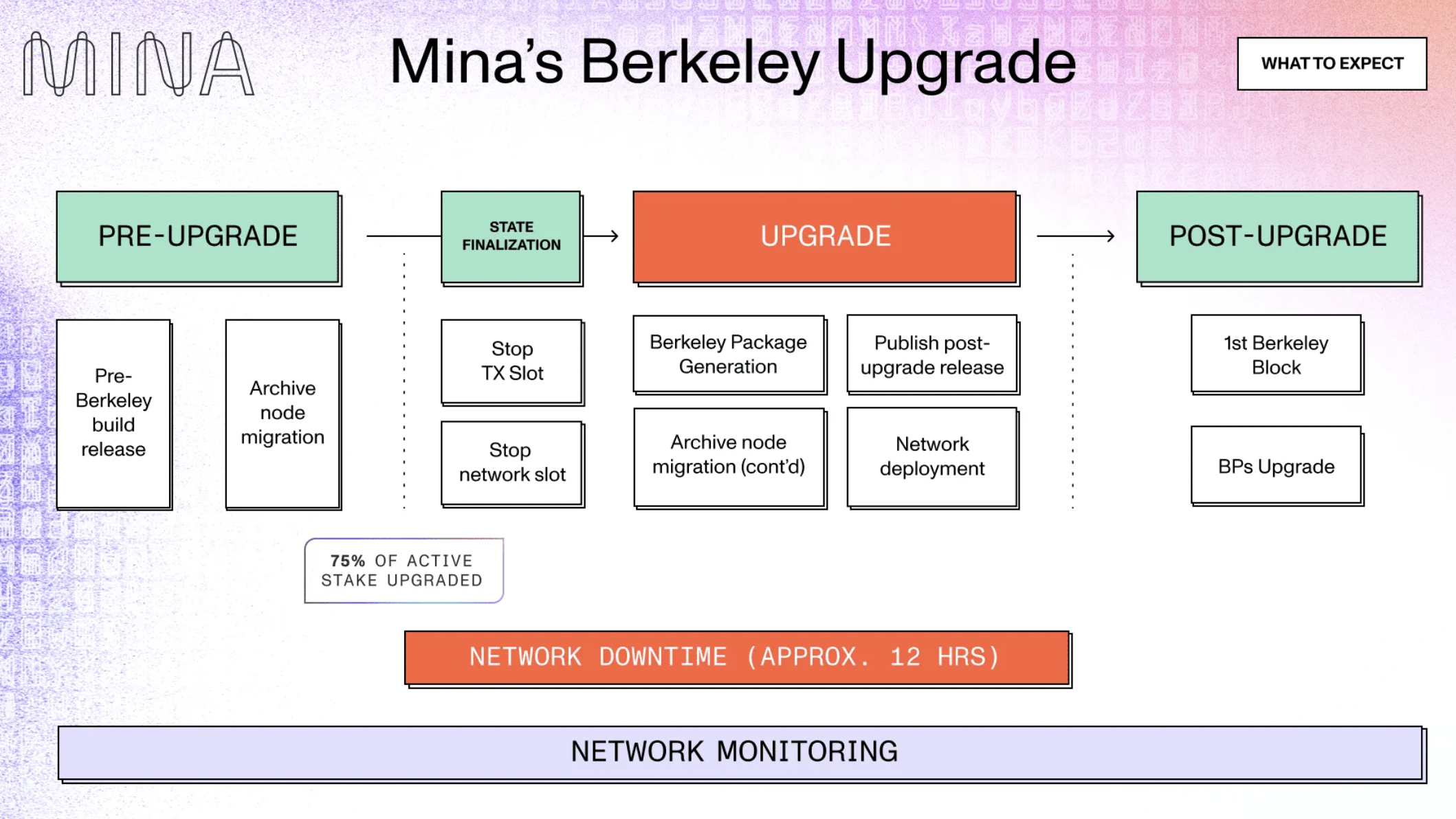
MINA protocol, considered one of the lightest blockchains, is currently counting down to the devnet upgrade. The devnet upgrade on April 9 is the final step in the process to launch Mina’s major upgrade, Berkeley. 

The technical enhancement is focused on three features voted on by the community:

  • Easier zero-knowledge application programmability (Mina Improvement Proposal (MIP) 4)
  • Introduction of a powerful proof system (MIP 3)
  • Removal of a short-term incentive, Supercharged Rewards (MIP 1)

The protocol’s official blog post outlines how contributors have extensively tested and pushed the network to its limit, and MINA is ready for its final stage of testing on April 9. The devnet is an environment designed for experimentation before technical upgrades go live on the project’s mainnet. 
MINA

Mina’s Berkeley Upgrade plan 

MINA price corrects ahead of key upgrade

MINA price is down nearly 4% on Tuesday, as the project prepares to take its Berkeley upgrade live on the devnet. MINA is trading at $1.0866 on Binance, down nearly 7% on the monthly time frame. 

MINA price has been in a downtrend since its March 12 local top of $1.7226, consistently forming lower highs and lower lows on the daily timeframe. 

Disclaimer: For information purposes only. Past performance is not indicative of future results.
placeholder
Bitcoin falls below $75,000 as the CLARITY Act fails in the Senate — what the vote means for cryptoThe US Senate blocked the Digital Asset Market CLARITY Act in a 49-50 procedural vote, sending Bitcoin briefly below $75,000 — its biggest one-day drop since June. Ethereum fell more than 8%, Coinbase slid 10% and $75 billion of crypto market value evaporated. Here is what the vote was, why it failed, and the levels that matter now.
Author  Suzie
Sep 16, Wed
The US Senate blocked the Digital Asset Market CLARITY Act in a 49-50 procedural vote, sending Bitcoin briefly below $75,000 — its biggest one-day drop since June. Ethereum fell more than 8%, Coinbase slid 10% and $75 billion of crypto market value evaporated. Here is what the vote was, why it failed, and the levels that matter now.
placeholder
Dollar index tops 100 for the first time since July as the Fed's hawkish dot plot sinks inThe U.S. dollar index broke back above 100 for the first time since 31 July after the Fed delivered its first rate hike since 2023, with the dot plot showing 16 of 18 officials expect at least one more increase this year. Here are the levels that matter for DXY, the currencies feeling it most, and what to watch next.
Author  Irene Q.
Sep 17, Thu
The U.S. dollar index broke back above 100 for the first time since 31 July after the Fed delivered its first rate hike since 2023, with the dot plot showing 16 of 18 officials expect at least one more increase this year. Here are the levels that matter for DXY, the currencies feeling it most, and what to watch next.
placeholder
Gold ends three-week slide at the $4,400 line — eight straight days of ETF inflows vs a 5% 10-year and a 100 dollarSpot gold closed Friday at $4,378.39, up 0.84% on the day and about 0.8% for the week — its first weekly gain in four weeks — with the intraday high of $4,399.67 leaving it 33 cents shy of the $4,400 line. Gold ETFs have now logged eight straight sessions of inflows, but with the 10-year back above 5% and the dollar index near 100, here is what decides whether this is a reversal or a bounce.
Author  Suzie
Yesterday 05: 53
Spot gold closed Friday at $4,378.39, up 0.84% on the day and about 0.8% for the week — its first weekly gain in four weeks — with the intraday high of $4,399.67 leaving it 33 cents shy of the $4,400 line. Gold ETFs have now logged eight straight sessions of inflows, but with the 10-year back above 5% and the dollar index near 100, here is what decides whether this is a reversal or a bounce.
placeholder
Bitcoin squeezes back above $80,000 — 110,000 traders liquidated as the hawkish Fed and CLARITY setback fail to hold it down; is $83,000 next?Bitcoin closed above $80,000 on Friday for the first time since September 7, and pushed to $81,299 over the weekend, triggering about $603 million of liquidations — $523 million of them shorts — across more than 110,000 traders. With the Fed's hike already priced and the SEC and CFTC advancing crypto rules after the CLARITY Act failed, here is what stands between BTC and the $83,000 gate.
Author  Suzie
Yesterday 06: 19
Bitcoin closed above $80,000 on Friday for the first time since September 7, and pushed to $81,299 over the weekend, triggering about $603 million of liquidations — $523 million of them shorts — across more than 110,000 traders. With the Fed's hike already priced and the SEC and CFTC advancing crypto rules after the CLARITY Act failed, here is what stands between BTC and the $83,000 gate.
placeholder
Brent slides below $102 after Houthis' first strike on Riyadh — why oil can't hold $100Houthi forces struck Riyadh for the first time on September 19 and hit Yanbu facilities — yet Brent opened at $104.71, peaked at $104.90 and settled at $101.68 (-1.63% on the day). Here is the four-way data tug-of-war between strike escalation and supply recovery, and the two switches that decide where oil goes next.
Author  Irene Q.
12 hours ago
Houthi forces struck Riyadh for the first time on September 19 and hit Yanbu facilities — yet Brent opened at $104.71, peaked at $104.90 and settled at $101.68 (-1.63% on the day). Here is the four-way data tug-of-war between strike escalation and supply recovery, and the two switches that decide where oil goes next.
goTop
quote