


2026 Global AI Agent Industry In-Depth Analysis: Paradigm Shift From Productivity Tools to New Gateways of the Digital Economy
In the first quarter of 2026, global capital markets are undergoing a profound structural adjustment. With the maturation of AI Agent technology—particularly agents represented by GPT-5.4 surpassing average human performance in general computing tasks for the first time—the market capitalization of global software stocks has evaporated by over $800 billion in just two months. This volatility is not merely market turbulence, but a paradigm shift akin to the "iPhone moment." This article aims to explore the technological drivers of AI Agents, their impact on the business models of tech giants, the restructuring of workplace logic, and the deep-seated maneuvers in the investment landscape, providing a professional perspective on the digital economy over the next five years.
Technological Tipping Point: The Leap from "Dialogue Models" to "Action Agents"
For a long time, the application of artificial intelligence was confined to the interaction and processing of natural language—the so-called "answering questions." However, entering 2026, this logic has been completely shattered. The essence of an AI Agent lies in its capacity for autonomous decision-making and execution based on environmental perception. According to the latest official benchmark data released by OpenAI, GPT-5.4 achieved a success rate of 75% in the OSWorld-Verified test for operating computer tasks, while the human average was only 72.4%. This means that general AI has already demonstrated the qualities necessary to surpass ordinary administrative or junior technical staff in operating complex software systems, multi-task scheduling, and long-chain execution logic.
The catalyst for this technological explosion was the unification of open-source architectures. An open-source project named OpenClaw garnered 250,000 stars on GitHub within three weeks, becoming the fastest-growing software in terms of downloads in human history. The significance of OpenClaw lies in providing a unified interface standard, similar to "USB-C," for AI Agents, allowing them to seamlessly call various SaaS tools, banking APIs, and low-level operating system commands. Nvidia CEO Jensen Huang explicitly stated at the Morgan Stanley TMT Conference in March 2026 that OpenClaw is "the most important software release ever." This unification of underlying architecture marks the evolution of AI from a mere "brain" to an execution phase with "hands."
The Battle of Giants: Redefining the "Entry Rights" of the Digital Economy
For the past two decades, the hegemony of tech giants has been built upon the control of "entry points." Google monopolized the search entry point, Apple locked down the app distribution entry point, and Meta controlled the social entry point. Whoever controls the user's first interaction with the digital world holds the power to levy a digital tax. However, the rise of AI Agents is putting these traditional entry points at risk of obsolescence.
The core value of a search engine is "information retrieval," whereas the core value of an Agent is "completing decisions and executing tasks." When users no longer compare prices via browsers or manually click apps to book flights—but instead have Agents directly complete cross-platform task scheduling at the underlying level—traditional UI interfaces and advertising windows will lose their capacity to carry traffic.
This anxiety is evidenced by the stock price volatility and legal maneuvers of the giants. Anthropic’s release of the Claude Cowork agent, capable of autonomously completing extremely complex office tasks on a computer, has caused market expectations for the premium space of traditional SaaS software (such as Microsoft 365) to shake violently. Year-to-date, Microsoft's market value has contracted by approximately $600 billion, influenced by this factor and the overall correction in the software sector. Meanwhile, Amazon is suing Perplexity’s AI shopping proxy, essentially defending its ad recommendation logic based on user attention. When Agents screen on behalf of humans, their decision criteria are pure parameter comparison and efficiency optimization; thus, the ad slots, recommendation weights, and impulse-buy inducements of traditional e-commerce will completely fail. This is not just a technological battle, but a fight for the very foundations of commerce.
Workplace Reshaping: The "Broken Ladder" Phenomenon in the Social Division of Labor
In the labor market, the impact of AI Agents is exhibiting an "asymmetry." According to survey data from the Anthropic Economic Index, approximately 75% of basic coding work for programmers and 70% of routine feedback for customer service representatives can now be completed independently by Agents. A deeper crisis lies in the fact that between 2025 and 2026, the number of entry-level job postings fell by 35% year-over-year compared to 2023. Companies are no longer optimizing their structures through large-scale layoffs, but instead adopting a more stealthy strategy: silently ceasing the recruitment of new talent.
This phenomenon has led to what is called a "broken ladder" crisis. Traditional career advancement paths rely on the honing of skills in junior roles, which are essential for training experts. When AI Agents cut off the bottom rungs of the ladder, where will the senior experts, veteran lawyers, and attending physicians of ten years from now come from? The rupture in the talent supply chain is forcing Gen Z to rethink their career paths. Research from CBS News shows that 77% of young people are beginning to gravitate toward blue-collar professions that are less susceptible to automation, such as advanced technicians and precision maintenance. The workplace no longer has a "starting zone," and this misalignment in talent structure will become a core challenge for social governance over the next decade.
Investment Logic Reconstruction: Shovel-Sellers, Gatekeepers, and Bubble Warnings
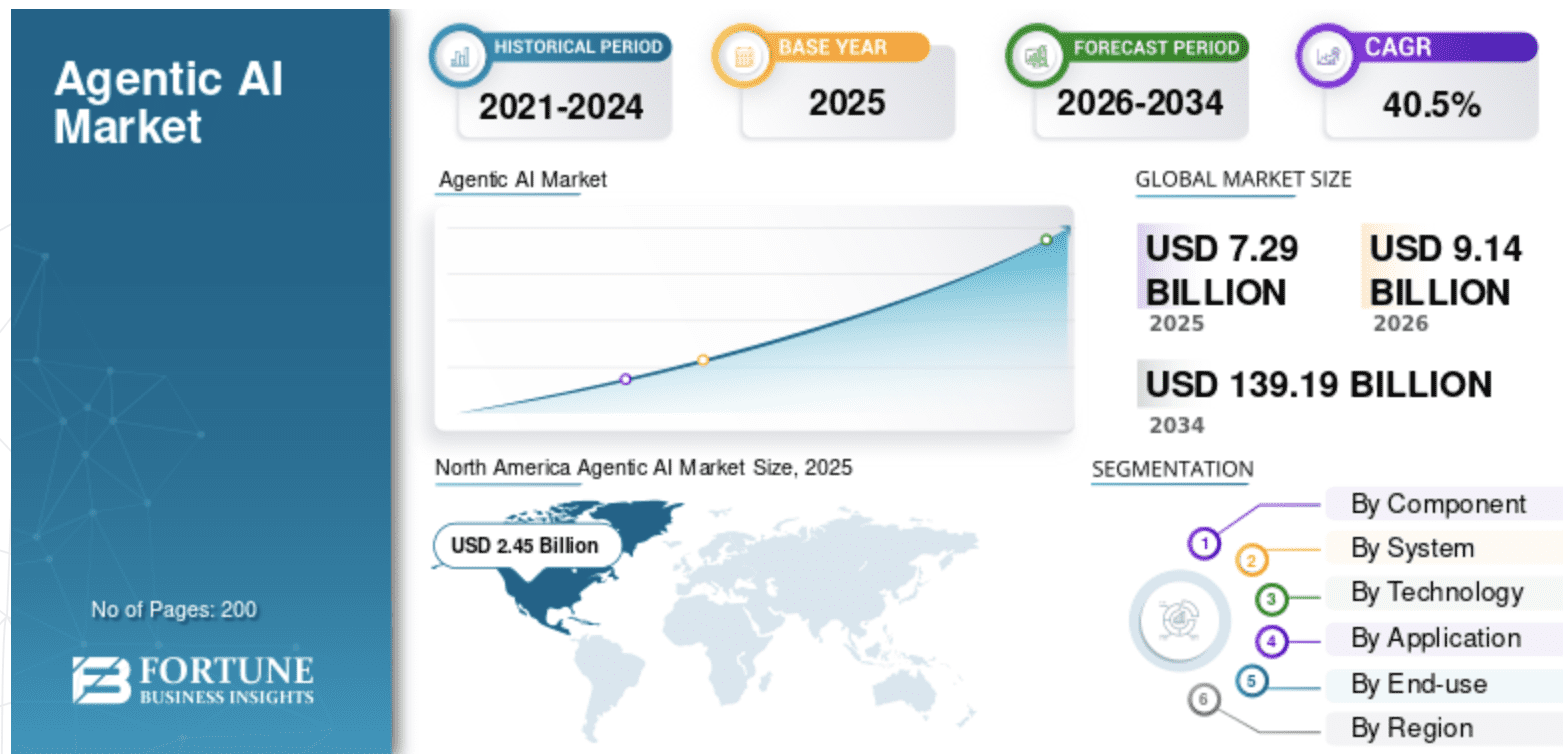
In the investment cycle driven by AI Agents, the benefit chain follows a distinctly counter-intuitive order. According to forecasts by Fortune Business Insights, the global Agentic AI market is expected to climb rapidly from $9.14 billion in 2026 to $139 billion by 2034. While the growth prospects for the application layer are enticing, because the technology is in its early explosion phase, market consensus is rapidly shifting from front-end applications to the infrastructure and security layers.
 \\
\\
Source: fortunebusinessinsights
The 5GW computing power collaboration plan between Nvidia and Nebius shows that to support the massive real-time inference needs of agents, power consumption has reached the level of nuclear power plants. Companies selling shovels (compute) and generators (energy) remain in the first tier of beneficiaries. However, the most undervalued certainty for growth lies in cybersecurity. Compared to the Agentic AI application market reaching $139 billion by 2034, the AI cybersecurity market is expected to reach $134 billion as early as 2030. This growth "inversion" stems from a simple logic: the expansion of Agent permissions (reading emails, operating accounts) creates the largest attack surface in human history. The recently exposed "prompt injection" vulnerability in OpenClaw proves that security protection is currently the weakest link. For companies like CrowdStrike, Palo Alto Networks, and Okta, every deployed Agent is essentially a high-net-worth security order.
At the same time, significant bubbles exist in the market. A survey by Wiz Research points out that Moltbook, which claims to have 1.6 million active Agent users, has an actual human account ratio of only 88:1, with most traffic generated by agents interacting with each other. The 26% decline in the iShares Software ETF this year is precisely the process of the market squeezing out false metrics amidst the frenzy.
The End of Brand Premium and the Rise of the Efficiency World
The endgame for AI Agents will be a total restructuring of the application ecosystem, showing a clear bipolar divergence between "functional redundancy" and "experiential premium."
- The Systematic Extinction of "Task-Oriented" Apps: The core value of functional applications like ride-hailing, fund transfers, and ticket booking lies in "completing a task." Since these processes cannot provide users with emotional value or sensory enjoyment, they will be completely "erased" by Agents in the background. Users will no longer need to deal with cumbersome interactive interfaces, which means a large number of utility apps will face a mass extinction, relegated to bits of underlying code called by Agents.
- The Defensive Survival of "Experience-Oriented" Apps: By contrast, "experience-oriented" content platforms that provide dopamine hits, such as TikTok and Netflix, will fare better. Because an Agent can book a ticket for you, it cannot "enjoy the process" for you. This uniquely human sensory premium will become the only moat for app survival in the future.
- The Collapse of Brand Premium and Trust Transfer: Current surveys show that 65% of people trust AI for price comparison, but only 14% trust AI to place orders on their behalf. This 86% "trust gap" is the blue ocean for future growth. When the trust ratio exceeds 50% in three years, Agents will become the true decision-makers. At that point, brands based on visual marketing and emotional premiums (such as Nike and Apple) will face the challenge of "machine logic": in the face of an Agent's parameter comparison (material, wear and tear, cost-performance ratio), the premium effect of a century-old brand may vanish instantly.
The future consumer market will diverge into a "sensory world" where humans participate personally and an "efficiency world" fully delegated to Agents. The leap from AI "dialogue" to "execution" is the transfer of digital power to general intelligence. Only companies that reconstruct their interaction logic with Agents will secure an entry ticket to the new civilization.
Recommended Articles


