

Sushi price eyes $3 after clearing key weekly resistance level

Source Fxstreet
  • Sushi price flips the $1.628 resistance level into a support floor after a month of struggle.
  • A temporary retracement might be a good opportunity to accumulate SUSHI before a retest of $3.
  • A breakdown of the $1.267 barrier would invalidate the bullish thesis.

Sushi (SUSHI) price shows signs of kickstarting an uptrend on the weekly chart. But since this outlook is on a higher time frame, it might take a while before SUSHI triggers this upward move.

Also read: Sushi price primed for 70% rally as SUSHI bulls clear critical resistance level

Sushi price confirms a potential uptrend

Sushi price uptrend began after it flipped $1.012, the weekly resistance level into a support floor in early February. Since then, SUSHI has surged 105% in just a month, overcoming the next critical hurdle at $1.628 and setting up a local top at $2.153.

Now, Sushi price is trying to establish itself above the aforementioned hurdle, confirming a successful flip of $1.628. While this setup looks extremely promising, investors must be prepared for a potential pullback before the uptrend begins.

If Bitcoin moves out of its consolidation and attempts to set up a new all-time high at $75,000 or higher, it would give the altcoins a ‘go’ signal. Such a bullish market development is likely to trigger a Sushi price rally to $3, the next psychological level. This move would constitute a nearly 85% gain from the $1.628 level and is likely where the Sushi price will form the next top. 

Both the Relative Strength Index (RSI) and the Awesome Oscillator (AO) momentum indicators reflect bullish momentum with no bearish signs.
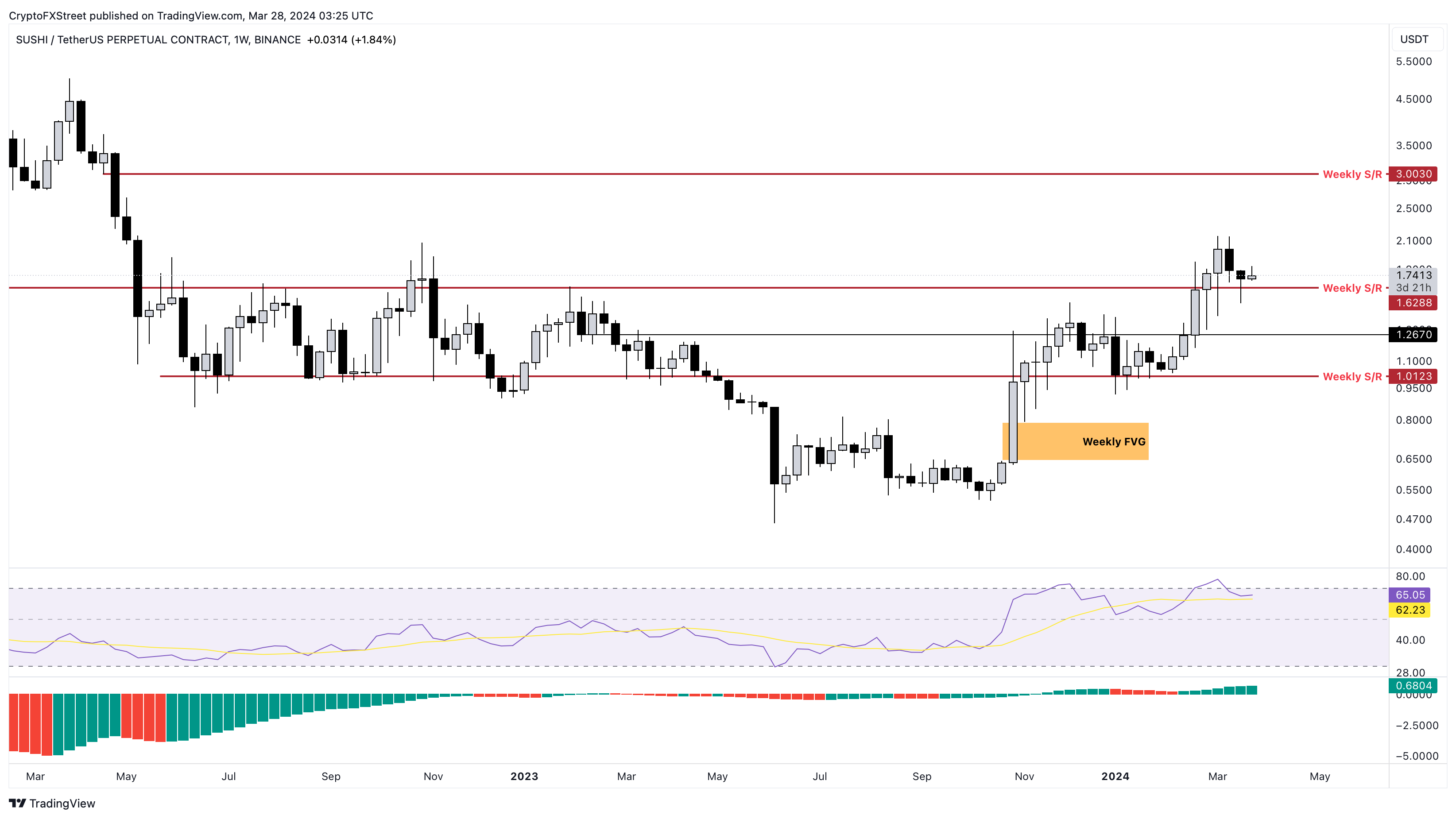
SUSHI/USDT 1-week chart

SUSHI/USDT 1-week chart

Santiment’s 30-day Market Value to Realized Value (MVRV) ratio indicator has improved from -11.85% on March 20 to -3.99% as of March 28, noting the number of investors in loss has reduced. 

The MVRV indicator is used to determine the average profit/loss of investors who purchased SUSHI in the past month. A negative value means that investors are at a loss, and this is likely where the long-term buyers tend to accumulate. Moreover, as seen in the chart, every time Sushi’s 30-day MVRV dipped beyond -10%, it served as a buying opportunity that propelled the SUSHI price higher.

Additionally, a negative MVRV value suggests that a potential sell-off is unlikely. Therefore, the recovery in 30-day MVRV from -11.85% to near-zero levels indicates that the Sushi price is primed for an uptrend.

SUSHI 30-day MVRV

SUSHI 30-day MVRV

Lastly, we can see a clear accumulation from whales holding between 100,000 to 1,000,000 SUSHI. The number of tokens held by this cohort has spiked from 55.42 million on March 13 to 59.88 million on March 28. Likewise, the addresses that hold between 10,000 to 100,000 SUSHI have their holdings remain steady at around 14 million tokens after accumulating all the way from nearly 13 million on February 13. 

SUSHI Supply Distribution

SUSHI Supply Distribution

If SUSHI produces a daily candlestick close below $1.267, it will create a lower low on the daily time frame. This shift in trend favoring bulls on a lower time frame would invalidate the bullish thesis and likely attract short-sellers or profit-taking. 

In such a case, the Sushi price could revisit the next key weekly support level at $1.012, which is roughly 20% away from $1.267.

Disclaimer: For information purposes only. Past performance is not indicative of future results.
placeholder
October hike odds climb toward 60% as Goldman and BofA both flip — what Warsh's "dose of accommodation" really changedRate futures now price roughly 55% to 62% for a 25bp hike at the October 27-28 FOMC, up from about 30% before Chair Warsh's post-meeting framing that the Fed is merely "removing some accommodation." Goldman Sachs has added an October hike to its forecast and Bank of America now sees moves in both October and December. Here is the repricing, the language behind it, and the two data points that decide it.
Author  Irene Q.
Sep 23, Wed
Rate futures now price roughly 55% to 62% for a 25bp hike at the October 27-28 FOMC, up from about 30% before Chair Warsh's post-meeting framing that the Fed is merely "removing some accommodation." Goldman Sachs has added an October hike to its forecast and Bank of America now sees moves in both October and December. Here is the repricing, the language behind it, and the two data points that decide it.
placeholder
Four jobs reports in five days: what JOLTS, ADP, claims and the September payrolls mean for the October Fed decisionThe US labour market faces its densest data week of the month. JOLTS job openings land Tuesday (7.2 million expected), ADP on Wednesday (70,000 expected), initial claims on Thursday and the September non-farm payrolls on Friday (100,000 expected, down from 162,000). Markets price a 64%-70% chance of another quarter-point Fed hike on October 28. The dollar index sits at 100.77 and the S&P 500 at 7,729.8.
Author  Mitrade
Sep 28, Mon
The US labour market faces its densest data week of the month. JOLTS job openings land Tuesday (7.2 million expected), ADP on Wednesday (70,000 expected), initial claims on Thursday and the September non-farm payrolls on Friday (100,000 expected, down from 162,000). Markets price a 64%-70% chance of another quarter-point Fed hike on October 28. The dollar index sits at 100.77 and the S&P 500 at 7,729.8.
placeholder
Nvidia's $150 billion buyback landed — and the AI sector fell anyway. That's the signal worth tradingNvidia closed up 1.68% at $228.86 on 28 September after announcing a $150 billion share repurchase authorisation, the largest single corporate buyback on record, while the rest of the AI complex sold off: AMD -3.6%, Micron -2.6%, Meta -4.8% and the Philadelphia Semiconductor Index -1.61%. The divergence is not noise. Capital is rotating toward cash-flow certainty, not abandoning the AI theme. With Micron reporting after the close on 30 September, here is what the split means.
Author  Irene Q.
Sep 29, Tue
Nvidia closed up 1.68% at $228.86 on 28 September after announcing a $150 billion share repurchase authorisation, the largest single corporate buyback on record, while the rest of the AI complex sold off: AMD -3.6%, Micron -2.6%, Meta -4.8% and the Philadelphia Semiconductor Index -1.61%. The divergence is not noise. Capital is rotating toward cash-flow certainty, not abandoning the AI theme. With Micron reporting after the close on 30 September, here is what the split means.
placeholder
【Daily Brief】30-year Treasury tops 5.59%, S&P 500 slips to 7,670 and gold holds $4,180 — PCE lands tonightThe 30-year Treasury yield closed at 5.59%, its highest since June 2002, and the Dow fell 131.59 points to 51,349.92. US consumer confidence dropped to 81.9, a 12-year low, and JOLTS job openings fell to 7.1 million. August PCE and Q3 GDP both land at 8:30am ET tonight.
Author  Suzie
21 hours ago
The 30-year Treasury yield closed at 5.59%, its highest since June 2002, and the Dow fell 131.59 points to 51,349.92. US consumer confidence dropped to 81.9, a 12-year low, and JOLTS job openings fell to 7.1 million. August PCE and Q3 GDP both land at 8:30am ET tonight.
placeholder
Gold falls to near $4,150 as higher Treasury yields, oil prices outweigh softer PCE inflationGold price (XAU/USD) tumbles to near $4,150 during the early Asian session on Thursday, pressured by elevated US Treasury bond yields. Traders await the US September employment data for fresh impetus, which will be released later on Friday. 
Author  FXStreet
3 hours ago
Gold price (XAU/USD) tumbles to near $4,150 during the early Asian session on Thursday, pressured by elevated US Treasury bond yields. Traders await the US September employment data for fresh impetus, which will be released later on Friday. 
goTop
quote