

Max Keiser Says Wall Street’s Ethereum Obsession Poses Major Risk | US Crypto News

Source Beincrypto

Welcome to the US Crypto News Morning Briefing—your essential rundown of the most important developments in crypto for the day ahead. 

Grab a coffee to read about the intersection of Wall Street and Ethereum (ETH), at least from a Bitcoin maxi’s perspective. Institutional interest in Ethereum has been loud and aggressive over the past several weeks, with even the most diehard Bitcoiners raising eyebrows and sounding alarms.

Crypto News of the Day: Ethereum Is Reuniting Money and State, But At Everyone’s Peril

Wall Street’s growing infatuation with Ethereum has triggered sharp warnings from Bitcoin maximalists, including Max Keiser.

As major players move to accumulate vast reserves of ETH, some industry veterans fear Ethereum is stepping into a role it was never meant to play- a programmable instrument of state-backed financial control.

In a recent US Crypto News publication, Fundstrat’s Tom Lee revealed a commitment to amass 5% of the total ETH supply through BitMine.

The new institutional vehicle for Ethereum is reportedly accelerating faster than Michael Saylor’s Bitcoin strategy. BeInCrypto reported that BitMine surpassed $2.9 billion in Ethereum holdings, claiming the largest ETH treasury.

According to Bankless, a technology podcast, Wall Street and possibly the US government are backing BitMine as a vehicle for its Ethereum play. However, Max Keiser, Senior Bitcoin Advisor to El Salvador, is not impressed.

“Bitcoin’s primary use case is separating money from state. No other fiat money or crypto does that,” Keiser told BeInCrypto.

The Bitcoin pioneer articulated that BTC and other crypto treasury companies go in opposite directions in uniting money and the state.

“Investors should note this adds immeasurable risk when compared to self-custodied Bitcoin,” he noted.

Keiser alludes to Bitcoin empowering individuals to opt out of centralized control. Meanwhile, Ethereum’s adoption by Wall Street signals a return to traditional hierarchies, only this time, on-chain.

In his view, ETH-backed treasury strategies might seem novel, but they reintroduce the systemic risks crypto was designed to eliminate.

Meanwhile, Ethereum’s supporters see a different picture. To them, ETH’s programmability, alignment with regulatory trends, and growing use in real-world asset (RWA) tokenization make it a natural choice for institutions seeking compliant crypto exposure.

Still, Keiser’s critique touches on a deeper philosophical divide. Bitcoiners believe in decentralized self-sovereignty. Based on this, Ethereum’s expanding institutional ties could, in their eyes, compromise that ethos.

Chart of the Day
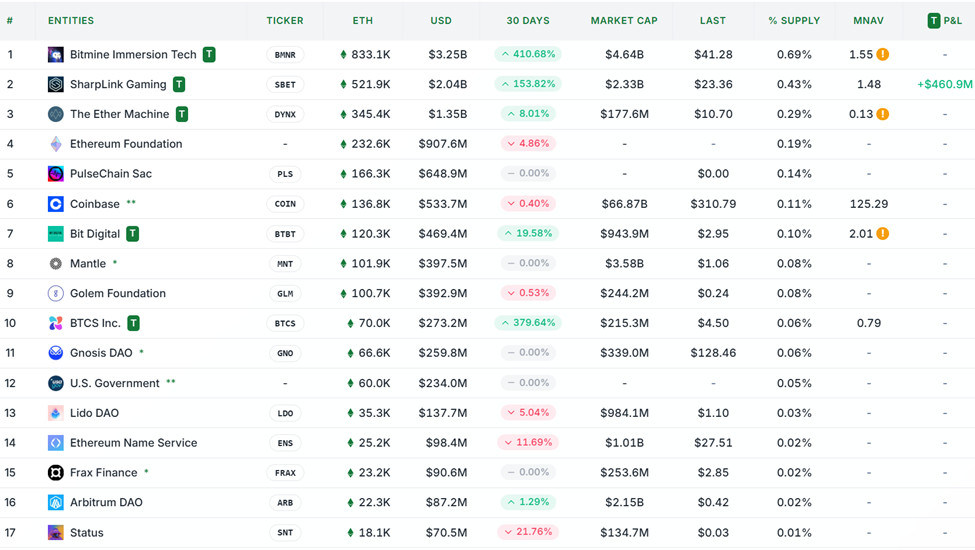
Ethereum Treasuries. Source: Strategic ETH ReserveEthereum Treasuries. Source: Strategic ETH Reserve.xyz

Byte-Sized Alpha

Here’s a summary of more US crypto news to follow today:

Disclaimer: For information purposes only. Past performance is not indicative of future results.
placeholder
Anthropic files for a $2 trillion IPO — the $80.7 billion loss is the decoy, the $450 billion compute bill is the riskAnthropic publicly filed its S-1 on October 26, revealing $16.29 billion of first-half revenue (+1,304% year over year) and a $80.7 billion net loss — of which $72.4 billion is a non-cash convertible-note charge. The real number is the $450 billion of signed, mostly non-cancelable compute commitments. Here is what the filing says, why NVDA, ARM and MU are the tradeable read-through, and the conditions that decide whether the AI trade passes its first public valuation test.
Author  Irene Q.
Oct 27, Tue
Anthropic publicly filed its S-1 on October 26, revealing $16.29 billion of first-half revenue (+1,304% year over year) and a $80.7 billion net loss — of which $72.4 billion is a non-cash convertible-note charge. The real number is the $450 billion of signed, mostly non-cancelable compute commitments. Here is what the filing says, why NVDA, ARM and MU are the tradeable read-through, and the conditions that decide whether the AI trade passes its first public valuation test.
placeholder
Brent's $115 front month sits $4.6 above January — the $14 spread to WTI is the supply-risk premiumDecember Brent trades at $115.29 while January is $110.71, a $4.58 backwardation. The December Brent-WTI spread is $14.2, versus a $3-5 normal. That gap, not the headline, is where the Middle East supply risk is priced. Here is what the curve says, why the December contract's expiry on October 30 will mechanically cut the headline by $4.6, and the 108.81 neckline that decides the next move.
Author  Irene Q.
Oct 28, Wed
December Brent trades at $115.29 while January is $110.71, a $4.58 backwardation. The December Brent-WTI spread is $14.2, versus a $3-5 normal. That gap, not the headline, is where the Middle East supply risk is priced. Here is what the curve says, why the December contract's expiry on October 30 will mechanically cut the headline by $4.6, and the 108.81 neckline that decides the next move.
placeholder
Gold Price Analysis Today | Forex Gold Analysis | XAU/USD Analysis - October 29, 2026Get the latest gold price analysis, forex gold insights, and XAU/USD analysis for October 29, 2026. Read on for the details.
Author  Mitrade
Oct 29, Thu
Get the latest gold price analysis, forex gold insights, and XAU/USD analysis for October 29, 2026. Read on for the details.
placeholder
Gold Price Analysis Today | Forex Gold Analysis | XAU/USD Analysis - October 30, 2026Get the latest gold price analysis, forex gold insights, and XAU/USD analysis for October 30, 2026. Read on for the details.
Author  Mitrade
Yesterday 02: 21
Get the latest gold price analysis, forex gold insights, and XAU/USD analysis for October 30, 2026. Read on for the details.
placeholder
US GDP grew 3.4% and core PCE held at 3.1% — December is now a hike trade, not a cut tradeUS Q3 GDP rose 3.4%, above the 3.1% estimate, while September headline PCE hit 3.6% and core held at 3.1%. December hike odds are near 90%; inventories, AI capex and energy explain why.
Author  Irene Q.
Yesterday 07: 12
US Q3 GDP rose 3.4%, above the 3.1% estimate, while September headline PCE hit 3.6% and core held at 3.1%. December hike odds are near 90%; inventories, AI capex and energy explain why.
goTop
quote