

Crypto markets could gain $1 trillion as Gold price reaches $3,000: Tokenized-Gold expert explains

Source Fxstreet
  • Tokenized-Gold assets hit a $1.8 billion market cap on Monday after Gold (XAU) price reached new all-time highs above $3,000.
  • Crypto markets have declined 28% since Trump’s inauguration, while Gold prices rose 11%, signalling investors’ sensitivity to geopolitical and macroeconomic risks.
  • In an exclusive interview, RAAC CEO Kevin Rusher explains how the tokenized-Gold sector could impact the next crypto market recovery phase.

Tokenized-Gold assets hit a $1.8 billion market cap on Monday after the Gold (XAU) price marked new all-time highs above $3,000 per troy ounce. In an exclusive interview with FXStreet, RAAC CEO Kevin Rusher explains how tokenized Gold assets could impact the next crypto market recovery phase.

Gold rallies to $3,000 as Trump’s policies unsettle crypto markets 

Since President Donald Trump's inauguration on January 20, the global cryptocurrency market has experienced a significant downturn with its total capitalization declining by 30%. 
Bitcoin (BTC) saw its value drop by 31% from its record high on inauguration day, currently trading around $83,325.

In contrast, Gold prices have hit record highs. On Monday, Gold traded at an all-time high of $3,005 per troy ounce, reflecting investor anxiety over economic growth due to trade policies and a testy geopolitical landscape. 

Gold (XAU) price action vs. Bitcoin (BTC), March 2025 | Source: TradingView

Gold (XAU) price action vs. Bitcoin (BTC), March 2025 | Source: TradingView

With the US Fed rate decision slated for Wednesday forming an active bearish overhang, investors are rotating assets to navigate the market lull. 

The crypto market is stagnating amid uncertainties surrounding multiple regulatory changes and active policy proposals.

Trump’s multifaceted tariffs are drawing the ire of financial markets as some observers predict they will lead to a recession or reduced growth.

As Gold’s rally to all-time highs above $3,000 draws investor mind share, skews capital allocation, it could impact the global markets’ momentum in the near-term. 

RAAC CEO sets $1 trillion target as XAU rally propels tokenized-Gold sector to $1.8 billion 

Cryptocurrencies markets remain on edge as Q1 2025 grinds to a close.

Having shed over $1 trillion of market cap since Bitcoin price hit an all-time high of $109,000 ahead of Trump’s inauguration on January 20, a majority of investors are anticipating more outflows ahead of the upcoming US Fed rate decision slated for Wednesday. 

In late February, Analysts at Goldman Sachs adjusted their forecasts and predicting that Gold prices may surpass $3,100 per ounce in 2025, driven by a variety of economic and geopolitical factors. UBS raised their Gold price target on Monday to $3,200.
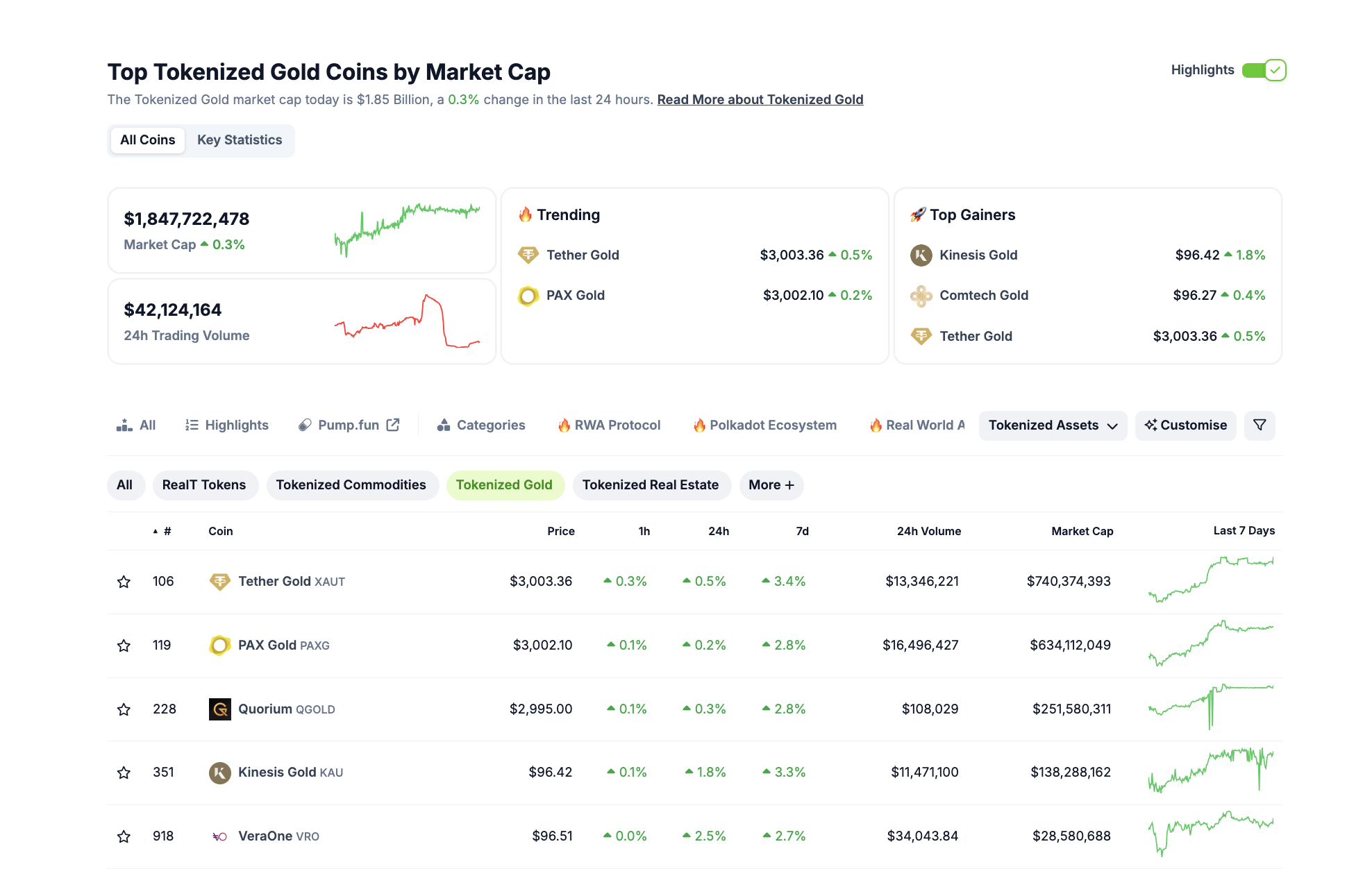
Tokenized Gold Assets performance, March 17 2025 | Source: Coingecko

However, the Real World Asset (RWA) lending and borrowing ecosystem offers innovative options to keep crypto market liquidity on-chain during volatile periods of geopolitical upheaval or hawkish macro economic policy swings.  

According to Coingecko data, the aggregate tokenization sector hit $1.8 billion as Gold prices crossed the $3,000 mark on Monday. 

In an exclusive FXStreet interview, ahead of its latest testnet launch that could see $235 million in Gold-backed deposits tokenized from one of the largest Gold reserves in North America, RAAC CEO Kevin Rusher offers experts how crypto traders could benefit from the current Gold rally:

  • Question 1 (Q1): The U.S. Crypto Strategic Reserve effective pits Bitcoin's against other commodities and traditional treasury assets like Gold.  How could this impact sovereign and institutional appetite for Gold in the coming years?

Kevin Rusher: “Central banks and sovereign wealth funds will likely continue holding physical Gold for its historical security and legal clarity, tokenized Gold could offer a more liquid, cost-effective alternative that appeals to institutions seeking faster transactions or diversification into digital assets. 

“Over time, this may shift some portion of institutional liquidity toward tokenized Gold, particularly for trading or yield-generating opportunities, though physical Gold is likely to remain a cornerstone of sovereign reserves.”

  • Q2 : Proof of reserves is a major issue for Gold-backed tokens. What standards should investors demand to ensure transparency and prevent fractionalization?

Kevin Rusher: “Investors should insist on verifiable proof of reserves for tokenized Gold that includes frequent third-party audits by reputable firms, along with transparent reporting and on-chain verification mechanisms.

Importantly, these audits need to confirm a 1:1 ratio between the Gold reserves and the issued tokens - this will prevent any hidden fractionalization.” 

  • Q3: Gold provenance is increasingly important due to supply chain ethics and sustainability concerns. How does the RAAC team and the Gold tokenization sector address these issues? Any Internal governance, Industry SOPs or Decentralized solution? 

Kevin Rusher: “Through RAAC’s partnership with the Pretio DAO Treasury, mining operations and suppliers adhere to strict ethical and sustainability standards.

These sources are documented via standardized audits, and blockchain-based tracking maintains a verifiable record of all Gold extracted, refined and securely stored. 

This approach ensures full visibility into the supply chain, allowing stakeholders to confirm that the Gold is responsibly sourced and meets agreed-upon ESG criteria”.

  • Q4: Gold markets have long faced price manipulation through paper contracts. Could blockchain-based reserves bring more transparency to global Gold pricing?

Kevin Rusher: "Unlike paper markets, anything put on-chain is immutable and  cannot be tampered with.

Tokenized Gold offers the opportunity for real-time monitoring and verifiable proof of physical Gold backing each token.

With tokenized Gold, traders can also eliminate broker fees, storage, and other third-party costs, without exposure to additional handling costs or custody risk." 

  • Q5: Traditional Gold traders are used to dealing with spot XAU and ETF markets. What aspects of tokenized Gold would be most compelling to them?

Kevin Rusher: "Tokenized Gold offers several benefits over traditional markets. These include faster settlement, immediate access, and real-time price discovery. Having Gold on-chain gives traders much more flexibility to earn yield, without affecting the inherent security and reliability of the asset."

  • Q6: Meme coins and AI have dominated crypto narratives in 2025. Can Gold-backed investments tap into these trends for wider adoption?

Kevin Rusher: "As the current price of Gold shows, Gold-backed investments remain the go-to stable asset for most investors. As such, we would not rule out the possibility of integrating AI and meme culture into the tokenized Gold ecosystem. 

Our team believes passionately in increasing access to the world’s most stable assets in one of the world’s most volatile sectors. We don't just want to bring the next billion users into decentralized finance, but the next $100 billion."

  • Q7. When Gold reached $3,000, the market capitalization of tokenized Gold assets hit $1.8 billion, representing less than 1% of the total crypto market dominance.

Kevin Rusher: "Looking ahead, what do you project the Gold Real World Asset (RWA) sector will be worth in terms of its aggregate valuation and market share within the crypto space over the next five years?

Currently, RAAC reserves are valued at approximately $400 million — 20% of a discounted spot price of $2,000 per troy ounce. Over a 10 to 15-year production cycle, the tokenized asset’s total estimated value could reach up to $3 billion, depending on market conditions and future Gold prices.

If the tokenized Gold market follows the trajectory of gold ETFs, achieving tokenization of even 5% of Gold’s $15 trillion total market cap would effectively increase the crypto sector valuation by more than $1 trillion." 

In summary: 

Since Trump’s inauguration, crypto market's 28% slump coinciding with Gold price rallying11% to $3,000 all time highs, hints that investors increasingly pulling liquidity out of crypto sector as  economic uncertainty signals mount.

As the next US Fed’s rate decision nears under hakwish pressure from Trump’s recent trade tarrif policies,  RAAC CEO Kevin Rusher sees innovations around tokenized Gold asset as a potential $1 trillion catalyst for recovery and bridging liquidity gaps between traditional marktets and the crytptocurrency sector.

By combining Gold's price stability with blockchain’s efficiency with transparency and 24/7 trading liquidity, the RWA sector may attract new institutional investors and traditional Gold day traders towards the crypto-based products.

Beyond that, by rotating into tokenized Gold tokens, crypto-native traders can retain more capital on-chain during during periods of geopolitcal upheaval or contractionary monetary policy cycles.

Disclaimer: For information purposes only. Past performance is not indicative of future results.
placeholder
Gold Price Forecast: XAU/USD drifts higher above $4,200 as Fed delivers expected cutGold price (XAU/USD) gains momentum to around $4,235 during the early Asian session on Thursday. The precious metal extends its upside after the US Federal Reserve (Fed) delivered an expected third consecutive interest rate cut and maintained its outlook for just one cut in 2026.
Author  FXStreet
Dec 11, Thu
Gold price (XAU/USD) gains momentum to around $4,235 during the early Asian session on Thursday. The precious metal extends its upside after the US Federal Reserve (Fed) delivered an expected third consecutive interest rate cut and maintained its outlook for just one cut in 2026.
placeholder
Ethereum Price Slips Lower — $3,000 Looms as the Key BattlegroundEthereum is attempting to recover from a $3,026 low but remains below $3,200 and the 100-hour SMA, with a bearish trend line near $3,175 capping rebounds as bulls need a clean break above $3,200 to target $3,250–$3,400, while a drop below $3,050 risks a retest of $3,000 and $2,940.
Author  Mitrade
Dec 15, Mon
Ethereum is attempting to recover from a $3,026 low but remains below $3,200 and the 100-hour SMA, with a bearish trend line near $3,175 capping rebounds as bulls need a clean break above $3,200 to target $3,250–$3,400, while a drop below $3,050 risks a retest of $3,000 and $2,940.
placeholder
Bitcoin Slides 5% as Sellers Lean In — Can BTC Reclaim $88,000?Bitcoin has dropped back below $88,000 after rolling over from $90,500, with price still trading under the 100-hour Simple Moving Average. The sell-off found a floor at $85,151, and BTC is now consolidating near that base, but rebounds are facing pressure from a bearish trend line around $89,000. Bulls need to retake $88,000–$89,000 to ease downside risk; failure to do so keeps $85,500–$85,000 and then $83,500 in play, with $80,000 as the deeper “line in the sand.” Bitcoin (BTC) is back in damage-control mode after a sharp pullback wiped out recent gains. The price failed to reclaim the $90,000–$90,500 band, rolled over, and slid through $88,500 before briefly dipping under $87,000. Buyers did show up around $85,000, but the rebound so far looks more like stabilization than a clear trend reversal. Bitcoin dips hard, finds a bid near $85,000(h3) BTC’s latest move lower began when it couldn’t build follow-through above $90,000 and $90,500. Once that upside stalled, sellers took control and pushed price down through $88,500. The slide accelerated enough to spike below $87,000, but the market didn’t free-fall. Bulls defended the $85,000 zone, printing a low at $85,151. Since then, Bitcoin has been consolidating below the 23.6% Fibonacci retracement of the drop from the $93,560 swing high to the $85,151 low — a clue that the bounce is still shallow and that sellers haven’t fully backed off yet. Structurally, BTC is still on the back foot: It’s trading below $88,000, and It remains below the 100-hour Simple Moving Average, keeping short-term trend pressure pointed downward. Resistance is layered, and $89,000 is the problem area(h3) If bulls try to turn this into a recovery, they’ll have to climb through multiple ceilings in quick succession. First, BTC faces resistance around $87,150, followed by a more meaningful barrier near $87,500. From there, the market’s attention snaps back to $88,000 — the level BTC just lost and now needs to reclaim. A close back above $88,000 would improve the tone, but it doesn’t solve the bigger issue: there’s a bearish trend line on the hourly BTC/USD chart (Kraken feed) with resistance near $89,000, which also lines up with the next technical hurdle. If BTC can push through $89,000 and hold, the rebound could extend toward $90,000, with follow-through targets at $91,000 and $91,500. But until price clears that $88,000–$89,000 zone, rallies are at risk of being sold rather than chased. If BTC fails to reclaim resistance, the downside path is clear(h3) The near-term bear case is simple: if Bitcoin can’t climb back above the $87,000 area and keep traction, sellers may attempt another leg lower. Support levels line up like this: Immediate support: $85,500 First major support: $85,000 Next support: $83,500 Then $82,500 in the near term Below that, the major “don’t break this” level is still $80,000. If BTC slips under $80,000, the risk of acceleration to the downside increases significantly — not because it’s magic, but because it’s the kind of psychological and structural level that tends to trigger forced de-risking. Indicators: momentum still leans bearish(h3) The intraday indicators aren’t offering much comfort yet: Hourly MACD is losing pace in the bearish zone. Hourly RSI remains below 50, suggesting sellers still have the upper hand on short timeframes. So while the $85,000 defense held for now, the market hasn’t flipped bullish — it’s just stopped bleeding.
Author  Mitrade
Dec 16, Tue
Bitcoin has dropped back below $88,000 after rolling over from $90,500, with price still trading under the 100-hour Simple Moving Average. The sell-off found a floor at $85,151, and BTC is now consolidating near that base, but rebounds are facing pressure from a bearish trend line around $89,000. Bulls need to retake $88,000–$89,000 to ease downside risk; failure to do so keeps $85,500–$85,000 and then $83,500 in play, with $80,000 as the deeper “line in the sand.” Bitcoin (BTC) is back in damage-control mode after a sharp pullback wiped out recent gains. The price failed to reclaim the $90,000–$90,500 band, rolled over, and slid through $88,500 before briefly dipping under $87,000. Buyers did show up around $85,000, but the rebound so far looks more like stabilization than a clear trend reversal. Bitcoin dips hard, finds a bid near $85,000(h3) BTC’s latest move lower began when it couldn’t build follow-through above $90,000 and $90,500. Once that upside stalled, sellers took control and pushed price down through $88,500. The slide accelerated enough to spike below $87,000, but the market didn’t free-fall. Bulls defended the $85,000 zone, printing a low at $85,151. Since then, Bitcoin has been consolidating below the 23.6% Fibonacci retracement of the drop from the $93,560 swing high to the $85,151 low — a clue that the bounce is still shallow and that sellers haven’t fully backed off yet. Structurally, BTC is still on the back foot: It’s trading below $88,000, and It remains below the 100-hour Simple Moving Average, keeping short-term trend pressure pointed downward. Resistance is layered, and $89,000 is the problem area(h3) If bulls try to turn this into a recovery, they’ll have to climb through multiple ceilings in quick succession. First, BTC faces resistance around $87,150, followed by a more meaningful barrier near $87,500. From there, the market’s attention snaps back to $88,000 — the level BTC just lost and now needs to reclaim. A close back above $88,000 would improve the tone, but it doesn’t solve the bigger issue: there’s a bearish trend line on the hourly BTC/USD chart (Kraken feed) with resistance near $89,000, which also lines up with the next technical hurdle. If BTC can push through $89,000 and hold, the rebound could extend toward $90,000, with follow-through targets at $91,000 and $91,500. But until price clears that $88,000–$89,000 zone, rallies are at risk of being sold rather than chased. If BTC fails to reclaim resistance, the downside path is clear(h3) The near-term bear case is simple: if Bitcoin can’t climb back above the $87,000 area and keep traction, sellers may attempt another leg lower. Support levels line up like this: Immediate support: $85,500 First major support: $85,000 Next support: $83,500 Then $82,500 in the near term Below that, the major “don’t break this” level is still $80,000. If BTC slips under $80,000, the risk of acceleration to the downside increases significantly — not because it’s magic, but because it’s the kind of psychological and structural level that tends to trigger forced de-risking. Indicators: momentum still leans bearish(h3) The intraday indicators aren’t offering much comfort yet: Hourly MACD is losing pace in the bearish zone. Hourly RSI remains below 50, suggesting sellers still have the upper hand on short timeframes. So while the $85,000 defense held for now, the market hasn’t flipped bullish — it’s just stopped bleeding.
placeholder
December Santa Claus Rally: New highs in sight for US and European stocks?Historical data show a rising trend of US and European stocks in December. If the momentum is strong, fund managers may rush in with a buying frenzy.
Author  Mitrade
22 hours ago
Historical data show a rising trend of US and European stocks in December. If the momentum is strong, fund managers may rush in with a buying frenzy.
placeholder
XRP’s Price Action Flashes a Warning Even as ETF Flows Stay PositiveXRP’s structure remains weak despite 18 straight positive closes in spot XRP ETFs, with analysts warning that $1.98 and other nearby resistance zones could cap rebounds unless the YO region is reclaimed, while deeper downside scenarios keep $1.53 on watch as a potential (not guaranteed) accumulation area.
Author  Mitrade
19 hours ago
XRP’s structure remains weak despite 18 straight positive closes in spot XRP ETFs, with analysts warning that $1.98 and other nearby resistance zones could cap rebounds unless the YO region is reclaimed, while deeper downside scenarios keep $1.53 on watch as a potential (not guaranteed) accumulation area.
goTop
quote