

WTI rallies, en route to $79.00 after EIA Crude Oil inventories slightly miss forecasts

Source Fxstreet
  • Crude Oil markets on the rebound on Thursday after supplies ease.
  • Distillate inventories showed a surprise drop, fueling a bounce.
  • Geopolitical tensions are mixed, with a possible Gaza ceasefire on the table.

West Texas Intermediate (WTI) US Crude Oil rallied on Thursday as energy markets find relief from Energy Information Administration (EIA) barrel counts came in just below forecasts, and eased back from a previous 12 million-plus barrel supply count.

EIA Distillate Inventories declined a little over 4 million barrels, sparking a relief rally in Crude Oil, and the EIA’s Crude Oil Inventories rose 3.514 million barrels for the week ended February 16 compared to the forecast 3.75 million barrels. The below-forecast barrel count sent prices higher as barrel traders shrug off the previous EIA barrel counts, as well as the American Petroleum Insititute’s (API) Weekly Crude Oil Stocks count of 7.168 million released on Wednesday.

According to the EIA, overall US gasoline production averaged 9 million barrels per day over the week, down slightly from the previous week’s 9.2 million bpd.

Geopolitical tensions eased slightly early Thursday as there are signs that a hostage exchange and possible ceasefire negotiation is still on the table in the ongoing Gaza conflict between Israel and Palestinian Hamas. Tensions rose immediately after when Iranian-backed Houthi rebels in Yemen declared that they will continue to target civilian vessels in the Red Sea, and intend to step up the rate of attacks.

Yemeni Houthis have declared that they expanded the scope of ships they plan to attack, and are now including American and UK-owned vessels that they find crossing the Suez Canal. 

WTI technical outlook

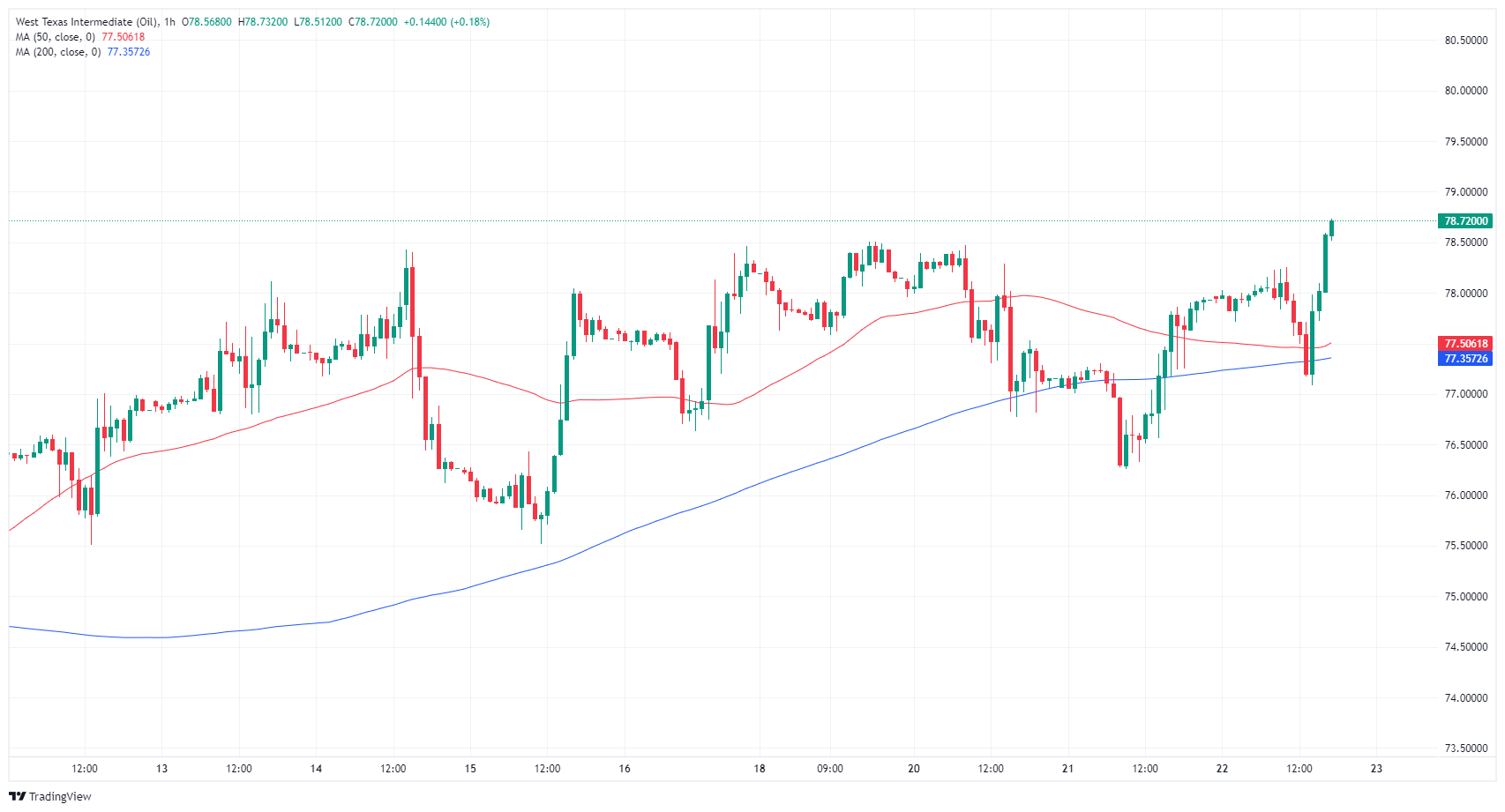
US Crude Oil rallied over 2% bottom-to-top on Thursday, lifting from above the $77.00 handle to clear $78.00, and WTI is poised to reclaim $79.00. Thursday’s rally saw a clean bounce from the 200-hour Simple Moving Average (SMA) near $77.35.

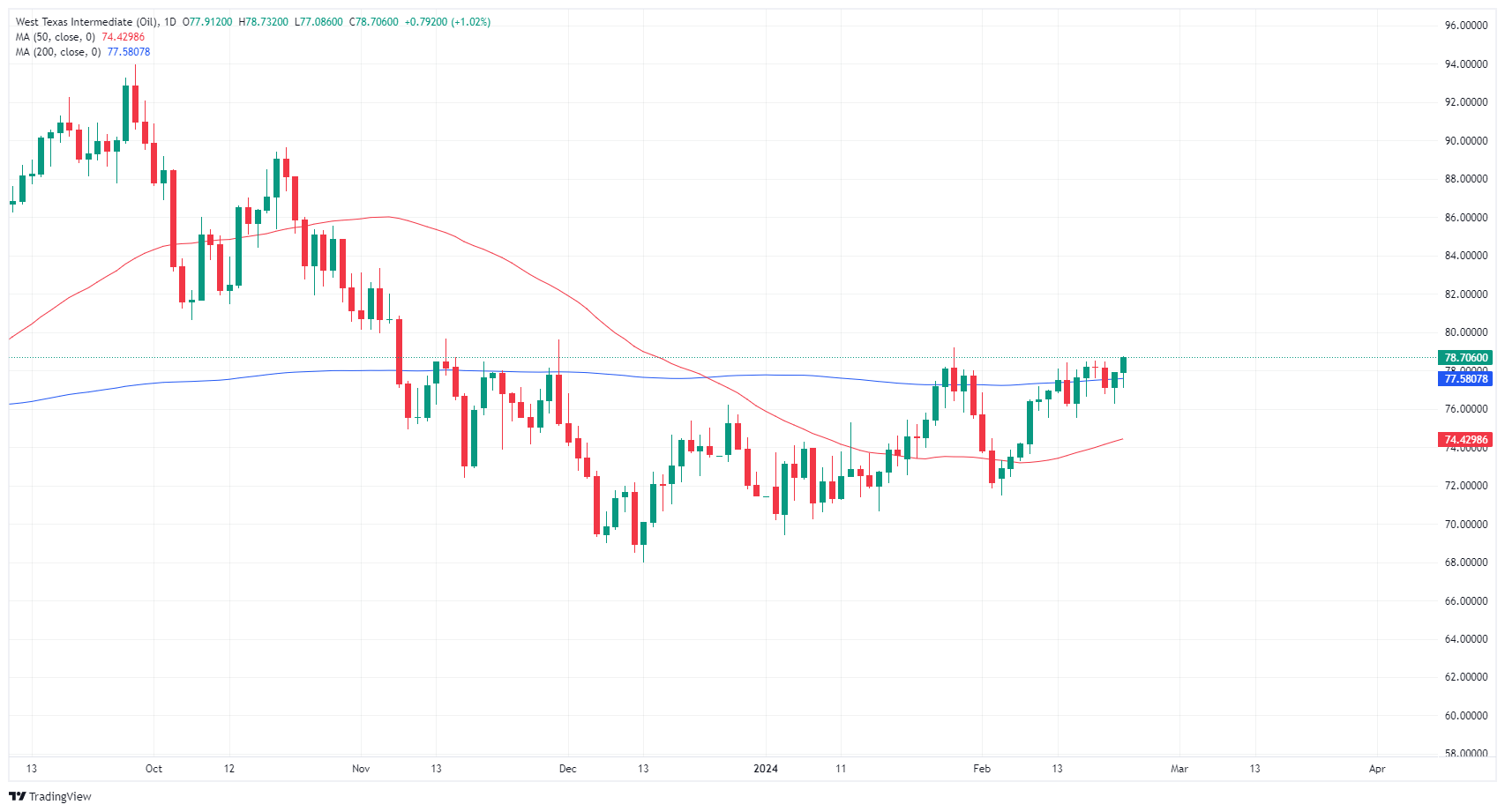
WTI has risen to its highest bids since late January, and US Crude Oil has closed higher or flat for all but two of the last fourteen consecutive trading days.

Thursday’s rise in barrel bids also sees WTI set for a bullish extension above the 200-day SMA near $77.60, and the nearest swing high sits at January’s late peak at $79.20.

WTI hourly chart
WTI daily chart
 

Disclaimer: For information purposes only. Past performance is not indicative of future results.
placeholder
Fed hike odds near 90% into Wednesday's decision — how to trade the dollar, gold and the S&P 500A 0.3% monthly core CPI print has lifted the market-implied probability of a 25bp Fed hike on 16 September to roughly 86.5% ~ 90%, which would be the first increase since July 2023. Here is the decision timeline, the pricing versus the forecasts, both scenarios, and the key levels for the dollar, gold and the S&P 500.
Author  Suzie
Sep 14, Mon
A 0.3% monthly core CPI print has lifted the market-implied probability of a 25bp Fed hike on 16 September to roughly 86.5% ~ 90%, which would be the first increase since July 2023. Here is the decision timeline, the pricing versus the forecasts, both scenarios, and the key levels for the dollar, gold and the S&P 500.
placeholder
Bitcoin falls below $75,000 as the CLARITY Act fails in the Senate — what the vote means for cryptoThe US Senate blocked the Digital Asset Market CLARITY Act in a 49-50 procedural vote, sending Bitcoin briefly below $75,000 — its biggest one-day drop since June. Ethereum fell more than 8%, Coinbase slid 10% and $75 billion of crypto market value evaporated. Here is what the vote was, why it failed, and the levels that matter now.
Author  Suzie
Sep 16, Wed
The US Senate blocked the Digital Asset Market CLARITY Act in a 49-50 procedural vote, sending Bitcoin briefly below $75,000 — its biggest one-day drop since June. Ethereum fell more than 8%, Coinbase slid 10% and $75 billion of crypto market value evaporated. Here is what the vote was, why it failed, and the levels that matter now.
placeholder
Dollar index tops 100 for the first time since July as the Fed's hawkish dot plot sinks inThe U.S. dollar index broke back above 100 for the first time since 31 July after the Fed delivered its first rate hike since 2023, with the dot plot showing 16 of 18 officials expect at least one more increase this year. Here are the levels that matter for DXY, the currencies feeling it most, and what to watch next.
Author  Irene Q.
Sep 17, Thu
The U.S. dollar index broke back above 100 for the first time since 31 July after the Fed delivered its first rate hike since 2023, with the dot plot showing 16 of 18 officials expect at least one more increase this year. Here are the levels that matter for DXY, the currencies feeling it most, and what to watch next.
placeholder
Gold rebounds to near $4,350 on weaker US Dollar, falling oil pricesGold price (XAU/USD) rises to near $4,345 during the early Asian session on Friday. The precious metal rebounds from a six-week low amid falling oil prices and a weaker US Dollar (USD). Traders continue to assess the latest Federal Reserve (Fed) rate hike and policy cues.
Author  FXStreet
Sep 18, Fri
Gold price (XAU/USD) rises to near $4,345 during the early Asian session on Friday. The precious metal rebounds from a six-week low amid falling oil prices and a weaker US Dollar (USD). Traders continue to assess the latest Federal Reserve (Fed) rate hike and policy cues.
placeholder
US to delay new "overcapacity" tariffs on China — what the pause means for trade, inflation and the dollarWashington is expected to hold off announcing new tariffs over Chinese "overcapacity" until after the 24 September summit, according to Bloomberg. The postponed plan would have added 7.5% to Chinese goods, taking second-term US tariffs to around 20%. Here is what is on the table, and what a deal versus no deal would mean for the yuan, Hong Kong equities and the dollar.
Author  Mitrade
Sep 18, Fri
Washington is expected to hold off announcing new tariffs over Chinese "overcapacity" until after the 24 September summit, according to Bloomberg. The postponed plan would have added 7.5% to Chinese goods, taking second-term US tariffs to around 20%. Here is what is on the table, and what a deal versus no deal would mean for the yuan, Hong Kong equities and the dollar.
goTop
quote