

Oil edges up as US inventories decline to lowest level since January

Source Fxstreet
  • Oil briefly spikes after US weekly EIA data showed a big decline in stockpiles. 
  • WTI Oil snaps $83, but faces resistance to break back above it again. 
  • The US Dollar Index retreats further, forming a bearish pattern. 

Oil prices edge up on Thursday as traders digest the US Crude Inventory release, which was taken as bullish for near-term prices. Overall, the release showed a chunky draw of 6.368 million barrels, which puts the US inventory at its lowest level since January 19 by 453.6 million barrels. This might trigger some buying from the US Energy Department in order to build up stockpiles again ahead of the next heating season. 

The US Dollar Index (DXY) has fallen in a bearish pattern. For a third day in a row, the index is posting lower highs and lower lows on the daily chart. This could point to a gruesome correction ahead, and with preliminary US Gross Domestic Product (GDP) release on Thursday and the Personal Consumption Expenditures (PCE) Price Index on Friday, catalysts are enough to trigger that breakdown. 

Crude Oil (WTI) trades at $82.71 and Brent Crude at $87.11 at the time of writing.

Oil news and market movers: Restocking

  • Fuel distillate Inventories (gasoil and jet fuel) at the Asian distribution hub of Singapore rose to the highest level since July 2021, according to official data released Thursday, Bloomberg reports.
  • Chinese refiners are heading to Venezuela for cheap Oil. Venezuela is offering the discount after the US reimposed sanctions on the South American country.
  • Some more details on the  Crude stockpile number from the Energy Information Administration (EIA):
    • US Gulf Coast refineries are processing the most crude since 2019 ahead of the summer driving season.
    • The 6.368 million barrel drawdown in US crude inventories was unexpected – consensus was for a 1.6 million barrel buildup – as refineries ramp up Oil processing following maintenance and exports pick up. 
    • US Exports ticked above 5 million barrels a day amid robust outflow to Europe. 

Oil Technical Analysis: US shooting itself in the foot 

Oil prices are set for some buying pressure with US refiners and traders getting ready for the summer season. That always coincides with a lot of travel, be it via airspace (flights) or car (gasoline). With the recent chunky drawdown and nearly lowest level for the year in Crude stockpiles, refiners might ramp up prices. 

With geopolitical tensions lingering and the US crude stockpile in low levels, the November 3 high at $83.34 and the $90 handle are the first key levels on the upside. One small barrier in the way is $89.64, the peak from October 20. In case of further escalating tensions, expect even September’s peak at $94 to become a possibility. 

On the downside, the October 6 low at $80.63 is the next candidate as a pivotal support level. Below that level, the 55-day and the 200-day Simple Moving Averages (SMAs) at $80.37 and $79.67 should halt any further downturn. 
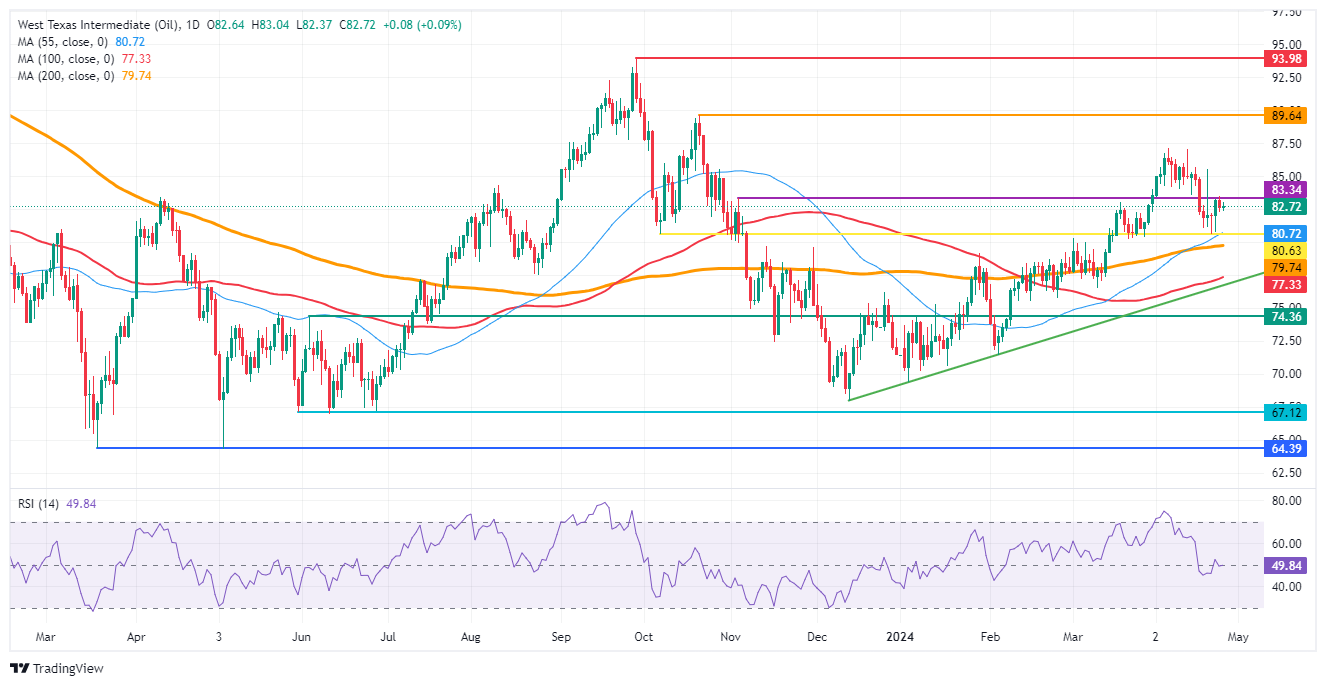
US WTI Crude Oil: Daily Chart

US WTI Crude Oil: Daily Chart


Disclaimer: For information purposes only. Past performance is not indicative of future results.
placeholder
October hike odds climb toward 60% as Goldman and BofA both flip — what Warsh's "dose of accommodation" really changedRate futures now price roughly 55% to 62% for a 25bp hike at the October 27-28 FOMC, up from about 30% before Chair Warsh's post-meeting framing that the Fed is merely "removing some accommodation." Goldman Sachs has added an October hike to its forecast and Bank of America now sees moves in both October and December. Here is the repricing, the language behind it, and the two data points that decide it.
Author  Irene Q.
Sep 23, Wed
Rate futures now price roughly 55% to 62% for a 25bp hike at the October 27-28 FOMC, up from about 30% before Chair Warsh's post-meeting framing that the Fed is merely "removing some accommodation." Goldman Sachs has added an October hike to its forecast and Bank of America now sees moves in both October and December. Here is the repricing, the language behind it, and the two data points that decide it.
placeholder
Four jobs reports in five days: what JOLTS, ADP, claims and the September payrolls mean for the October Fed decisionThe US labour market faces its densest data week of the month. JOLTS job openings land Tuesday (7.2 million expected), ADP on Wednesday (70,000 expected), initial claims on Thursday and the September non-farm payrolls on Friday (100,000 expected, down from 162,000). Markets price a 64%-70% chance of another quarter-point Fed hike on October 28. The dollar index sits at 100.77 and the S&P 500 at 7,729.8.
Author  Mitrade
Sep 28, Mon
The US labour market faces its densest data week of the month. JOLTS job openings land Tuesday (7.2 million expected), ADP on Wednesday (70,000 expected), initial claims on Thursday and the September non-farm payrolls on Friday (100,000 expected, down from 162,000). Markets price a 64%-70% chance of another quarter-point Fed hike on October 28. The dollar index sits at 100.77 and the S&P 500 at 7,729.8.
placeholder
Nvidia's $150 billion buyback landed — and the AI sector fell anyway. That's the signal worth tradingNvidia closed up 1.68% at $228.86 on 28 September after announcing a $150 billion share repurchase authorisation, the largest single corporate buyback on record, while the rest of the AI complex sold off: AMD -3.6%, Micron -2.6%, Meta -4.8% and the Philadelphia Semiconductor Index -1.61%. The divergence is not noise. Capital is rotating toward cash-flow certainty, not abandoning the AI theme. With Micron reporting after the close on 30 September, here is what the split means.
Author  Irene Q.
Yesterday 06: 31
Nvidia closed up 1.68% at $228.86 on 28 September after announcing a $150 billion share repurchase authorisation, the largest single corporate buyback on record, while the rest of the AI complex sold off: AMD -3.6%, Micron -2.6%, Meta -4.8% and the Philadelphia Semiconductor Index -1.61%. The divergence is not noise. Capital is rotating toward cash-flow certainty, not abandoning the AI theme. With Micron reporting after the close on 30 September, here is what the split means.
placeholder
The 30-year Treasury just hit a 22-year high — and the bond market is not pricing the Fed, it is pricing the deficitThe 30-year Treasury yield closed at 5.56% on 28 September, the highest since June 2004, while the 10-year reached 5.24% and the 20-year 5.60%. The curve has steepened roughly 30bp in eight sessions even as October hike odds sit at 70.3%. That gap is the story: the long end is repricing fiscal and inflation risk, not policy. With PCE on Wednesday and payrolls on Friday, here is what the long end is really saying.
Author  Irene Q.
Yesterday 07: 08
The 30-year Treasury yield closed at 5.56% on 28 September, the highest since June 2004, while the 10-year reached 5.24% and the 20-year 5.60%. The curve has steepened roughly 30bp in eight sessions even as October hike odds sit at 70.3%. That gap is the story: the long end is repricing fiscal and inflation risk, not policy. With PCE on Wednesday and payrolls on Friday, here is what the long end is really saying.
placeholder
【Daily Brief】30-year Treasury tops 5.59%, S&P 500 slips to 7,670 and gold holds $4,180 — PCE lands tonightThe 30-year Treasury yield closed at 5.59%, its highest since June 2002, and the Dow fell 131.59 points to 51,349.92. US consumer confidence dropped to 81.9, a 12-year low, and JOLTS job openings fell to 7.1 million. August PCE and Q3 GDP both land at 8:30am ET tonight.
Author  Suzie
8 hours ago
The 30-year Treasury yield closed at 5.59%, its highest since June 2002, and the Dow fell 131.59 points to 51,349.92. US consumer confidence dropped to 81.9, a 12-year low, and JOLTS job openings fell to 7.1 million. August PCE and Q3 GDP both land at 8:30am ET tonight.
Related Instrument
goTop
quote