


Gold price exhibits strength near fresh all-time high on firm Fed rate cut hopes
- Gold price corrects slightly after refreshing a new all-time high at $2,265 ahead of US data-packed week.
- Jerome Powell sees the pace of decline in February’s core PCE inflation aligned with the Fed’s required rate.
- Investors await the US ISM Manufacturing PMI for fresh guidance on the US Dollar’s next move.
Gold price (XAU/USD) trades close to a fresh all-time high of around $2,260 ahead of a busy week in the United States’ economic calendar. The precious metal clings to gains as expectations for the Federal Reserve (Fed) lean towards June as the meeting to cut interest rates have increased. Fed Chair Jerome Powell validated the decline in February’s core Personal Consumption Expenditures inflation (PCE) data as the Fed looks for evidence of price pressures easing to the 2% target.
Higher expectations for the Fed to cut rates, especially after a two-year period of rate hikes, dent yields on interest-bearing assets such as US bonds. However, this increases the investment value of Gold. 10-year US Treasury yields were slightly up in Monday’s European session but have come down to 4.20%.
The US Dollar Index (DXY), which tracks the value of the US Dollar against six major currencies, consolidates around 104.50. The upside in the US Dollar remains capped due to firm Fed rate cut expectations, while uncertainty ahead of the release of the United States Nonfarm Payrolls (NFP) report and related labor data is limiting the downside.
Daily digest market movers: Gold price capitalizes on firm Fed rate cut prospects
- Gold price turns sideways after refreshing an all-time high near $2,260. The demand for the precious metal remains buoyant as market expectations for the Federal Reserve starting its rate-cut cycle in June escalate.
- Fed Chair Jerome Powell said Friday at a that the latest US inflation data was "along the lines of what we would like to see," while interviewed by public radio's "Marketplace" program, boosted rate-cut expectations for June. According to the CME FedWatch tool, traders see a 68% chance that rate cuts will be announced in June. The expectations have increased from the 60% observed before the release of February’s core PCE Price Index data on Friday.
- While Fed Powell remains confident in progress in easing inflation, he acknowledged that the central bank doesn’t need to hurry for rate cuts with the economy on a strong footing. He recognized the need to see more progress on inflation before cutting interest rates and cautioned the need to be careful on rate cuts, citing strong economy and labor market conditions.
- The monthly and annual core PCE inflation grew by 0.3% and 2.8% in February as expected. However, January’s estimates were upwardly revised to 0.5% on month and 2.9% on year from the 0.4% and 2.8% increases previously estimated, respectively.
- The Fed’s preferred inflation measure is at its lowest level in almost two years, supporting higher Fed rate cut expectations for June.
- This week, the United States NFP report for March, scheduled for Friday, is the main event to look at as it will likely provide more clarity on when the Fed could start reducing interest rates.
- In Monday’s session, market participants will keenly focus on the US ISM Manufacturing PMI for March, which will be published at 14:00 GMT. The factory data is estimated to increase to 48.4 from 47.8 in February, below 50.0 or the 16th month in a row. A figure below the 50.0 threshold suggests that the business activity in the US manufacturing sector contracted in this period.
Technical Analysis: Gold price prints fresh highs at $2,265
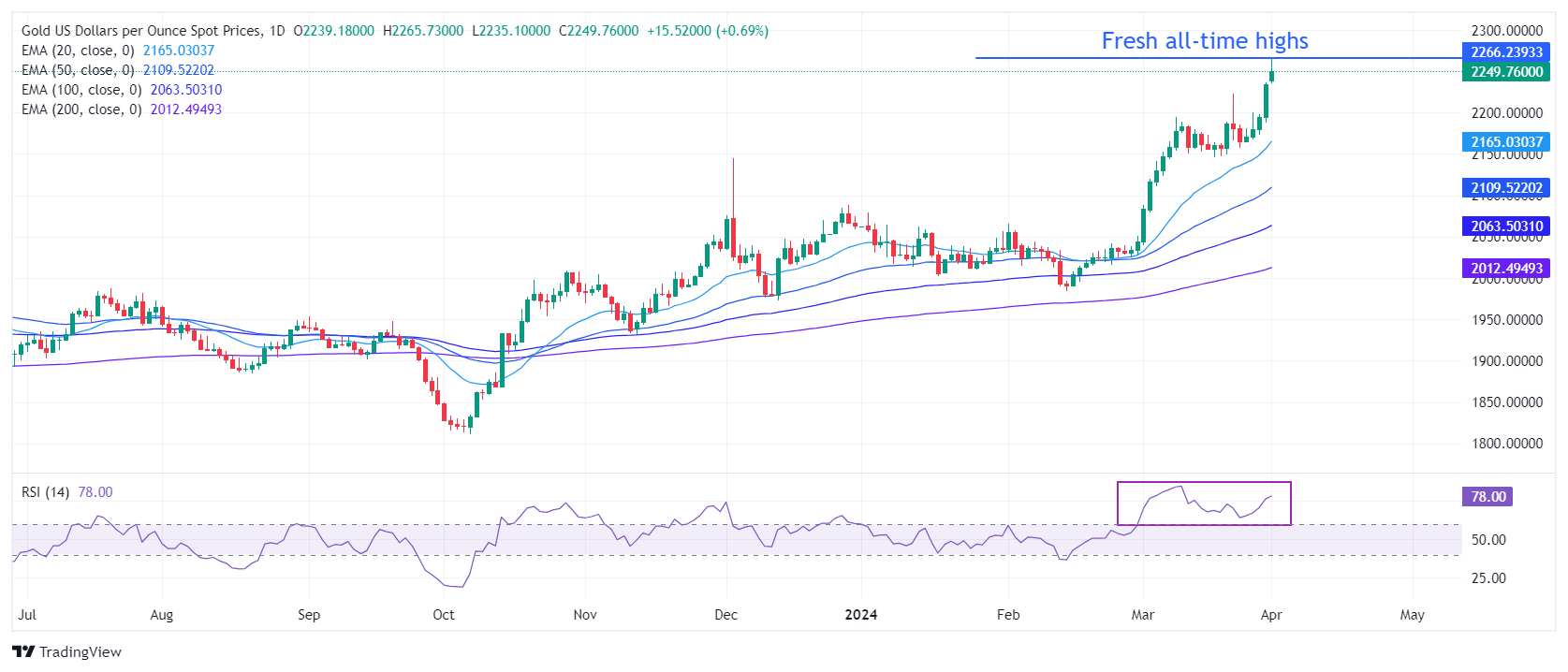
Gold price refreshes all-time highs at $2,265. The precious metal strengthened after breaking above the prior lifetime high of $2,223, printed on March 21. More upside in the Gold price is possible as it is trading in unchartered territory. All short-to-long term Exponential Moving Averages (EMAs) are sloping higher, suggesting strong near-term demand.
The 14-period Relative Strength Index (RSI) reaches 78.00, indicating strong upside momentum but already in overbought territory. Signs of divergence are absent, and an overbought signal cannot be ruled out.
Gold FAQs
Gold has played a key role in human’s history as it has been widely used as a store of value and medium of exchange. Currently, apart from its shine and usage for jewelry, the precious metal is widely seen as a safe-haven asset, meaning that it is considered a good investment during turbulent times. Gold is also widely seen as a hedge against inflation and against depreciating currencies as it doesn’t rely on any specific issuer or government.
Central banks are the biggest Gold holders. In their aim to support their currencies in turbulent times, central banks tend to diversify their reserves and buy Gold to improve the perceived strength of the economy and the currency. High Gold reserves can be a source of trust for a country’s solvency. Central banks added 1,136 tonnes of Gold worth around $70 billion to their reserves in 2022, according to data from the World Gold Council. This is the highest yearly purchase since records began. Central banks from emerging economies such as China, India and Turkey are quickly increasing their Gold reserves.
Gold has an inverse correlation with the US Dollar and US Treasuries, which are both major reserve and safe-haven assets. When the Dollar depreciates, Gold tends to rise, enabling investors and central banks to diversify their assets in turbulent times. Gold is also inversely correlated with risk assets. A rally in the stock market tends to weaken Gold price, while sell-offs in riskier markets tend to favor the precious metal.
The price can move due to a wide range of factors. Geopolitical instability or fears of a deep recession can quickly make Gold price escalate due to its safe-haven status. As a yield-less asset, Gold tends to rise with lower interest rates, while higher cost of money usually weighs down on the yellow metal. Still, most moves depend on how the US Dollar (USD) behaves as the asset is priced in dollars (XAU/USD). A strong Dollar tends to keep the price of Gold controlled, whereas a weaker Dollar is likely to push Gold prices up.
Recommended Articles


