


USD/INR steadies as investors await Fed rate decision
- The Indian Rupee holds steady in Wednesday’s Asian session.
- Outflows from local equities and the widening of India’s November merchandise trade deficit could weigh on the INR.
- The Fed interest rate decision will take center stage on Wednesday.
The Indian Rupee (INR) trades on a flat note on Wednesday after reaching a new record low of 84.92 in the previous session. The local currency remains on the defensive amid foreign fund outflows and a muted trend in domestic equities. Additionally, the widening of India’s merchandise trade deficit in November could further undermine the INR. However, the routine foreign exchange intervention by the Reserve Bank of India (RBI) to sell the USD via state-owned banks could prevent the INR from significantly depreciating.
Looking ahead, the US Federal Reserve (Fed) interest rate decision will be in the spotlight on Wednesday. The US Fed is expected to deliver a quarter of a percentage point cut at the December meeting. Traders will closely monitor the Fed Chair Jerome Powell’s Press Conference and the Summary of Economic Projections, or ‘dot plot.’ Any hawkish remarks from the Fed officials might lift the Greenback and contribute to the INR’s downside.
Indian Rupee flat lines ahead of Fed rate decision
- "While weak Asian cues weighed on market sentiment, the record high trade deficit in November pushed the rupee to a new low, which caused investors to run for cover, triggering panic selling in domestic equities," noted Prashanth Tapse, Senior VP (Research), Mehta Equities Ltd.
- India's merchandise trade deficit widened to a record high of $37.8 billion in November, compared to $27.1 billion in October. Meanwhile, Exports fell by 4.9% YoY to $32.1 billion, while Imports rose 27% YoY to $69.95 billion during the month under review.
- The US Retail Sales climbed by 0.7% MoM in November versus a 0.5% increase (revised from 0.4%) prior, according to the US Census Bureau on Tuesday. This figure came in stronger than the 0.5% increase expected.
- The US Industrial Production declined by 0.1% MoM in November, compared to a fall of 0.4% (revised from -0.3%) in October, below the market consensus of the 0.3% expansion.
- The markets are now pricing in a nearly 97.1% chance of a 25 basis points (bps) cut at the Fed's December meeting, compared with about a 78% chance a week ago, according to the CME FedWatch tool.
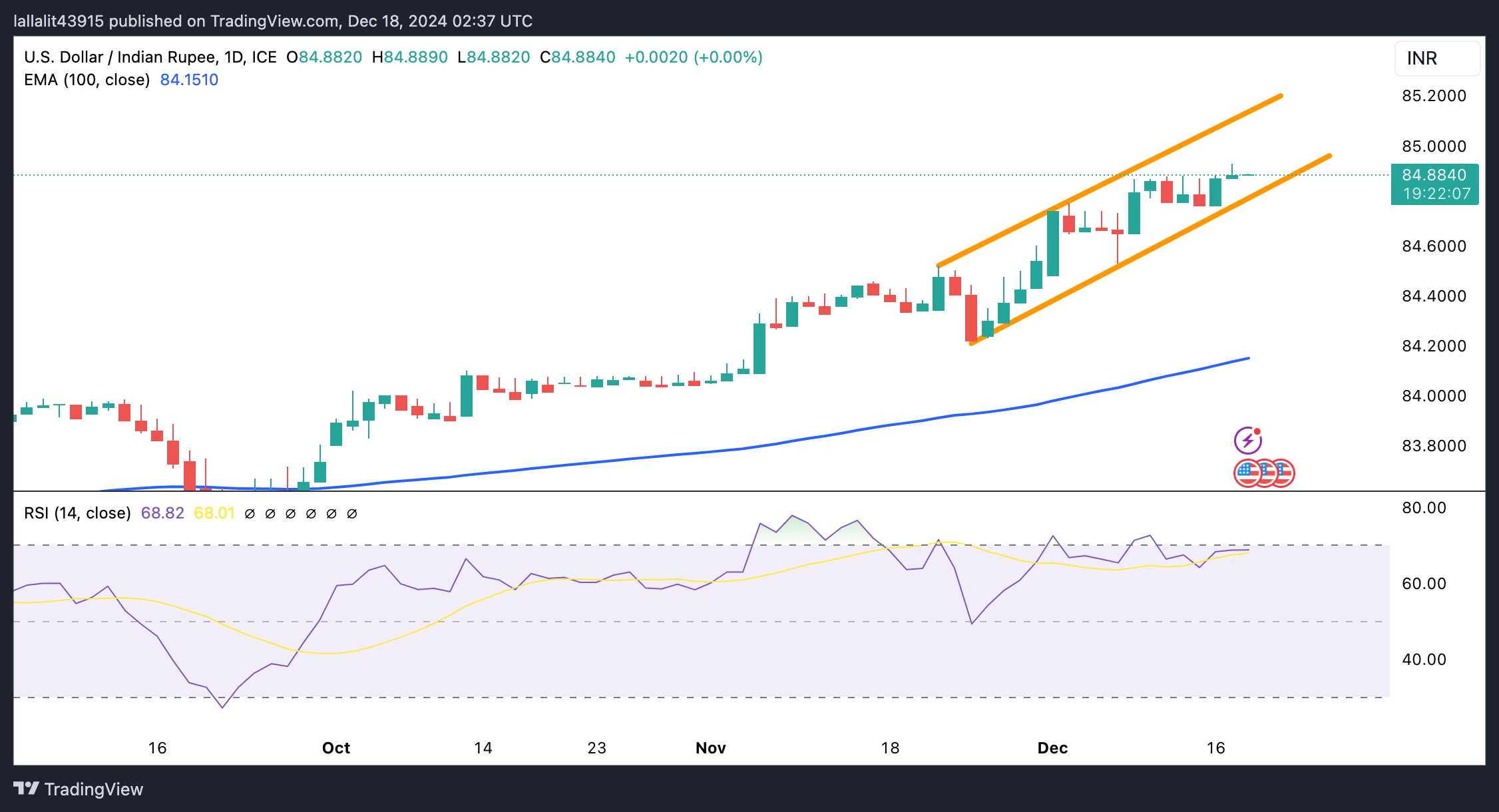
USD/INR keeps the bullish vibe in the longer term
The Indian Rupee trades flat on the day. The strong bullish outlook of the USD/INR pair remains in play, characterised by the price holding above the key 100-day Exponential Moving Average (EMA) on the daily timeframe. The upward momentum is supported by the 14-day Relative Strength Index (RSI), which is located above the midline near 68.15, suggesting that the further upside looks favourable.
The first upside barrier for USD/INR emerges near the ascending trend channel and the psychological level of 85.00. Sustained trading above this level could draw in buyers and push the pair to 85.50.
On the flip side, the lower boundary of the trend channel of 84.80 acts as an initial support level for the pair. Bearish candlesticks that could lead to a potential retest of the low of November 25 at 84.22. A breach of the mentioned level could expose 84.15, the 100-day EMA.
Indian Rupee FAQs
The Indian Rupee (INR) is one of the most sensitive currencies to external factors. The price of Crude Oil (the country is highly dependent on imported Oil), the value of the US Dollar – most trade is conducted in USD – and the level of foreign investment, are all influential. Direct intervention by the Reserve Bank of India (RBI) in FX markets to keep the exchange rate stable, as well as the level of interest rates set by the RBI, are further major influencing factors on the Rupee.
The Reserve Bank of India (RBI) actively intervenes in forex markets to maintain a stable exchange rate, to help facilitate trade. In addition, the RBI tries to maintain the inflation rate at its 4% target by adjusting interest rates. Higher interest rates usually strengthen the Rupee. This is due to the role of the ‘carry trade’ in which investors borrow in countries with lower interest rates so as to place their money in countries’ offering relatively higher interest rates and profit from the difference.
Macroeconomic factors that influence the value of the Rupee include inflation, interest rates, the economic growth rate (GDP), the balance of trade, and inflows from foreign investment. A higher growth rate can lead to more overseas investment, pushing up demand for the Rupee. A less negative balance of trade will eventually lead to a stronger Rupee. Higher interest rates, especially real rates (interest rates less inflation) are also positive for the Rupee. A risk-on environment can lead to greater inflows of Foreign Direct and Indirect Investment (FDI and FII), which also benefit the Rupee.
Higher inflation, particularly, if it is comparatively higher than India’s peers, is generally negative for the currency as it reflects devaluation through oversupply. Inflation also increases the cost of exports, leading to more Rupees being sold to purchase foreign imports, which is Rupee-negative. At the same time, higher inflation usually leads to the Reserve Bank of India (RBI) raising interest rates and this can be positive for the Rupee, due to increased demand from international investors. The opposite effect is true of lower inflation.
Recommended Articles


