

EUR/USD recovers after US economic myth dented

Source Fxstreet
  • EUR/USD climbs above the key 1.0700 psychological level early on Wednesday. 
  • Weaker-than-expected US PMI data on Tuesday undermined the US Dollar and fueled the recovery. 
  • EUR/USD’s Bear Flag pattern deforms, bringing into doubt its validity. 

EUR/USD trades just shy of 1.0700 on Wednesday after weaker-than-expected private sector growth and US business activity dent the myth of US economic exceptionalism, weighing on the US Dollar (USD).

EUR/USD gains a further small bump after the release of positive German economic sentiment IFO survey data for April shows a greater-than-expected rise in the Business Climate (89.4) and Current Assessment (88.9) components, whilst Expectations increases to 89.9 in line with estimates. 

EUR/USD recovers on weaker-than-expected US data

EUR/USD broke above the top of its seven-day range early on Wednesday after the Greenback lost favor with traders. The Euro (EUR), meanwhile, maintained its value on the back of growth in the Services sector revealed in Tuesday’s better-than-expected HCOB Eurozone Services PMI data for April. 

In comparison, the PMI indexes from the US fell for both Services and Manufacturing in April, which took investors by surprise and suggested the economy is not coping as well as previously thought under the yoke of relatively high interest rates.

Stubborn price momentum in the services sector in both the US and Europe have delayed the time by which both the Federal Reserve (Fed) and European Central Bank (ECB) are expected to cut interest rates. Whilst ECB officials seem fairly united in wanting to cut the ECB’s base lending rate in June, Fed officials have become increasingly vague about when they might consider cutting interest rates. 

Since the expectation of lower interest rates depreciates a currency, the lack of commitment of Fed officials compared to their ECB colleagues has been the main catalyst behind the US Dollar’s outperformance over recent weeks, and EUR/USD’s bearish momentum.  

The higher-than-expected preliminary Services PMI data in the Eurozone revealed on Tuesday, however, introduces some doubt into confidence that the ECB will in fact go ahead with rate cuts in June. 

On Wednesday, ECB governing council member and Bundesbank President Joachim Nagel reflected this doubt, saying “Services inflation remains high, driven by continued strong wage growth,” and because of this he was not convinced inflation was falling in a sustainable manner and, therefore, could not “pre-commit to a particular rate path.”

It means more weight will be given to the defining data point for the decision, which is – according to the ECB President Christine Lagarde – first quarter Eurozone wage growth data. 

EUR/USD traders will now assess commentary from ECB officials on Wednesday. Meanwhile in the US, Durable Goods data will pad out the portrait of how well “Captain American Economy” is doing when it is released during the US session. 

Technical Analysis: EUR/USD pierces top of short-term range

EUR/USD breaks out of the box-like range it had been trading in for the last seven days and pierces above the key 1.0700 level to bring into doubt the durability of the short-term downtrend. 

It is now less certain EUR/USD is forming a Bear Flag price pattern as had previously been assumed. The pattern has quite bearish connotations with a potential downside target in the 1.0400s, so if it fails to activate the pair could reverse on the disappointment, with some short-covering adding fuel to the recovery. 

EUR/USD 4-hour Chart
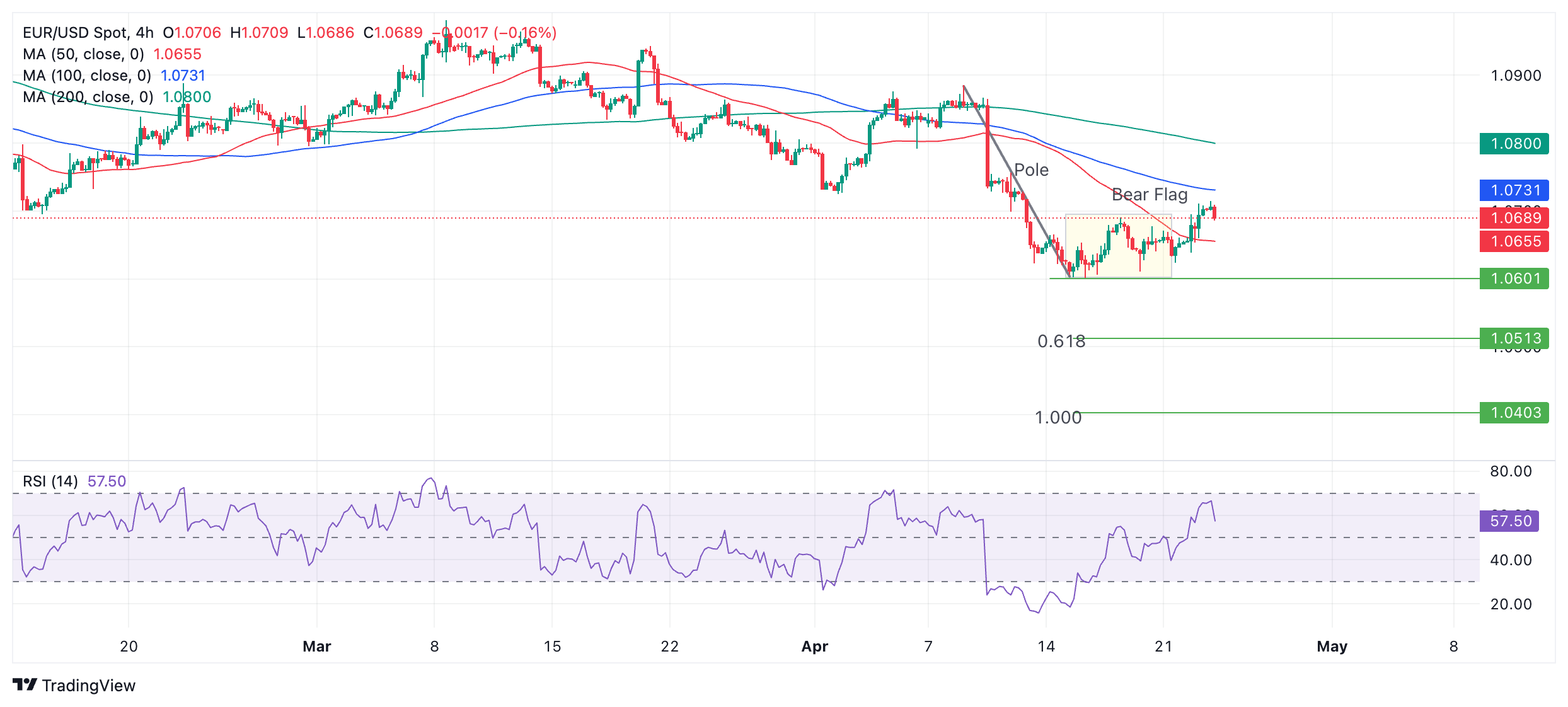
With the short-term downtrend in doubt more upside is possible, with the next target at resistance from the previous lower high providing an initial target at 1.0758. After that, the 50-day and 200-day Simple Moving Averages (SMA) provide resistance at 1.0807 on the daily chart (not shown).

A break below the 1.0601 April 16 low, however, would prove the Bear Flag hypothesis valid in the end and signal the start of a decline. 

According to technical lore, the expected move out of a Bear Flag usually equals the length of the “pole” or steep decline preceding the box-like formation of the flag square, or a Fibonacci ratio of the pole. 

The Fibonacci 0.618 ratio of the pole extrapolated lower provides the most reliable conservative target. This gives a price objective at 1.0503.  After that, the next concrete target is at 1.0446 – the October 2023 low. A fall of equal length to the pole would take EUR/USD  down to 1.0403. 

Economic Indicator

IFO – Business Climate

This German business sentiment index released by the CESifo Group is closely watched as an early indicator of current conditions and business expectations in Germany. The Institute surveys more than 7,000 enterprises on their assessment of the business situation and their short-term planning. The positive economic growth anticipates bullish movements for the EUR, while a low reading is seen as negative (or bearish).

Read more.

Last release: Wed Apr 24, 2024 08:00

Frequency: Monthly

Actual: 89.4

Consensus: 88.9

Previous: 87.8

Source: IFO Institute


Disclaimer: For information purposes only. Past performance is not indicative of future results.
placeholder
Bitcoin CME gaps at $35,000, $27,000 and $21,000, which one gets filled first?Prioritize filling the $27,000 gap and even try higher.
Author  FXStreet
Aug 22, 2023
Prioritize filling the $27,000 gap and even try higher.
placeholder
Bitcoin briefly loses 2025 gains as crypto plunges over the weekend.Bitcoin experienced a sharp decline this weekend, briefly erasing its 2025 gains and dipping below its year-opening value of $93,507. The cryptocurrency fell to a low of $93,029 on Sunday, representing a 25% drop from its all-time high in October. Although it has rebounded slightly to around $94,209, the pressures on the market remain significant. The downturn occurred despite the reopening of the U.S. government on Thursday, which many had hoped would provide essential support for crypto markets. This year initially appeared promising for cryptocurrencies, particularly after the inauguration of President Donald Trump, who has established the most pro-crypto administration thus far. However, ongoing political tensions—including Trump's tariff strategies and the recent government shutdown, lasting a historic 43 days—have contributed to several rapid price pullbacks for Bitcoin throughout the year. Market dynamics are also being influenced by Bitcoin whales—investors holding large amounts of Bitcoin—who have been offloading portions of their assets, consequently stalling price rallies even as positive regulatory developments emerge. Despite these sell-offs, analysts from Glassnode argue that this behavior aligns with typical patterns seen among long-term investors during the concluding stages of bull markets, suggesting it is not indicative of a mass exodus. Notably, Bitcoin is not alone in its struggles, as Ethereum and Solana have also recorded declines of 7.95% and 28.3%, respectively, since the start of the year, while numerous altcoins have faced even steeper losses. Looking ahead, questions linger regarding the viability of the four-year cycle thesis, particularly given the increasing institutional support and regulatory frameworks now in place in the crypto landscape. Matt Hougan, chief investment officer at Bitwise, remains optimistic, suggesting a potential Bitcoin resurgence in 2026 driven by the “debasement trade” thesis and a broader trend toward increased adoption of stablecoins, tokenization, and decentralized finance. Hougan emphasized the soundness of the underlying fundamentals, pointing to a positive outlook for the sector in the longer term.
Author  Mitrade
Nov 17, 2025
Bitcoin experienced a sharp decline this weekend, briefly erasing its 2025 gains and dipping below its year-opening value of $93,507. The cryptocurrency fell to a low of $93,029 on Sunday, representing a 25% drop from its all-time high in October. Although it has rebounded slightly to around $94,209, the pressures on the market remain significant. The downturn occurred despite the reopening of the U.S. government on Thursday, which many had hoped would provide essential support for crypto markets. This year initially appeared promising for cryptocurrencies, particularly after the inauguration of President Donald Trump, who has established the most pro-crypto administration thus far. However, ongoing political tensions—including Trump's tariff strategies and the recent government shutdown, lasting a historic 43 days—have contributed to several rapid price pullbacks for Bitcoin throughout the year. Market dynamics are also being influenced by Bitcoin whales—investors holding large amounts of Bitcoin—who have been offloading portions of their assets, consequently stalling price rallies even as positive regulatory developments emerge. Despite these sell-offs, analysts from Glassnode argue that this behavior aligns with typical patterns seen among long-term investors during the concluding stages of bull markets, suggesting it is not indicative of a mass exodus. Notably, Bitcoin is not alone in its struggles, as Ethereum and Solana have also recorded declines of 7.95% and 28.3%, respectively, since the start of the year, while numerous altcoins have faced even steeper losses. Looking ahead, questions linger regarding the viability of the four-year cycle thesis, particularly given the increasing institutional support and regulatory frameworks now in place in the crypto landscape. Matt Hougan, chief investment officer at Bitwise, remains optimistic, suggesting a potential Bitcoin resurgence in 2026 driven by the “debasement trade” thesis and a broader trend toward increased adoption of stablecoins, tokenization, and decentralized finance. Hougan emphasized the soundness of the underlying fundamentals, pointing to a positive outlook for the sector in the longer term.
placeholder
ECB Policy Outlook for 2026: What It Could Mean for the Euro’s Next MoveWith the ECB likely holding rates steady at 2.15% and the Fed potentially extending cuts into 2026, EUR/USD may test 1.20 if Eurozone growth proves resilient, but weaker growth and an ECB pivot could pull the pair back toward 1.13 and potentially 1.10.
Author  Mitrade
Dec 26, 2025
With the ECB likely holding rates steady at 2.15% and the Fed potentially extending cuts into 2026, EUR/USD may test 1.20 if Eurozone growth proves resilient, but weaker growth and an ECB pivot could pull the pair back toward 1.13 and potentially 1.10.
placeholder
Gold Price Forecast: XAU/USD opens lower around $4,450 on fears of widening Iran conflictsGold price (XAU/USD) opens over 1% lower to near $4,445.00 on Monday, as oil prices have rallied further on fears of further widening of conflicts in the Middle East. WTI Oil price is up almost 3% above $102.50 in the opening trade, increasing fears of higher inflation expectations globally.
Author  FXStreet
Mar 30, Mon
Gold price (XAU/USD) opens over 1% lower to near $4,445.00 on Monday, as oil prices have rallied further on fears of further widening of conflicts in the Middle East. WTI Oil price is up almost 3% above $102.50 in the opening trade, increasing fears of higher inflation expectations globally.
placeholder
Silver Price Forecast: XAG/USD falls to near $72.00 amid fading safe-haven demandSilver price (XAG/USD) continues to lose ground after registering tiny losses in the previous day, trading around $72.90 during the Asian hours on Thursday. The safe-haven demand for the precious metal fades amid rising optimism over Middle East peace.
Author  FXStreet
Apr 02, Thu
Silver price (XAG/USD) continues to lose ground after registering tiny losses in the previous day, trading around $72.90 during the Asian hours on Thursday. The safe-haven demand for the precious metal fades amid rising optimism over Middle East peace.
Related Instrument
goTop
quote