

GBP/USD slides for third day as firm US jobs data lifts Dollar
- GBP/USD extends losses as jobless claims and lower layoffs signal a healthier US labor market.
- Stronger US data curbs Fed easing bets, supporting the Dollar and pressuring G10 currencies.
- Markets await US NFPs and UK GDP clues to reassess Sterling’s medium-term outlook.
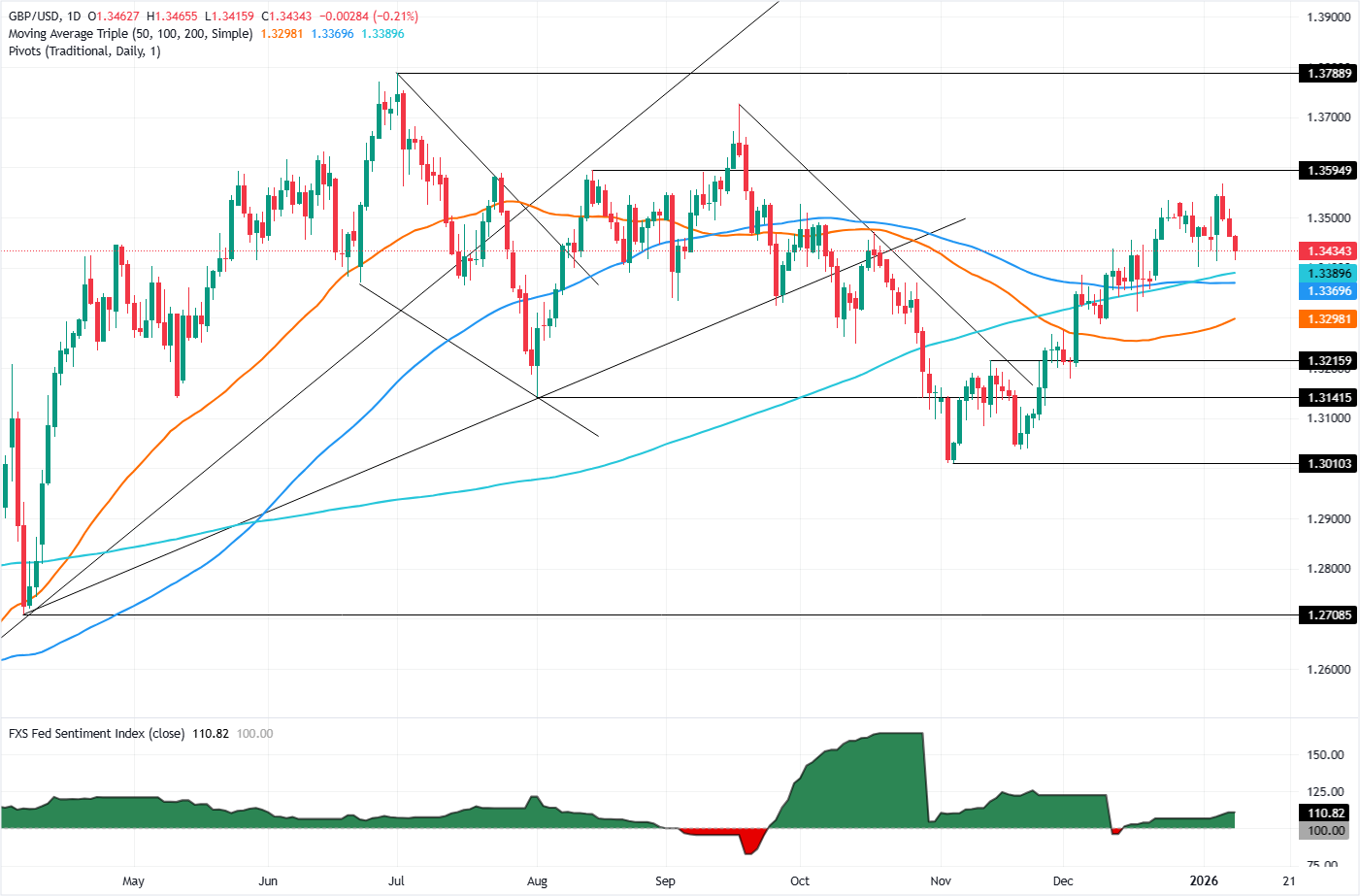
The Pound Sterling falls for the third straight day, down some 0.10% as US jobs data has revealed that the labor market is healthier than expected, weighing on expectations of Fed rate cuts ahead in the year. At the time of writing, the GBP/USD trades at 1.3444 after reaching a daily high of 1.3465.
Sterling weakens as resilient US labor indicators dampen Fed cut speculation
Economic data in the US capped the US Dollar losses yet weighed on G10 FX currencies. US jobless claims data for the week ending January 3 was below estimates of 210K, came at 208K, above the previous week 199K. The data was solid and it could be a prelude of Friday’s Nonfarm Payrolls for December, with analysts projecting that the economy added 60K jobs, below the previous print of 64K.
Earlier, the Challenger Job Cuts in December revealed that companies shed 35,553jobs, nearly half of November’s 71,321. Andy Challenger, the Chief Revenue Officer for Challenger, Gray & Christmas wrote that “The year closed with the fewest announced layoff plans all year. While December is typically slow, this coupled with higher hiring plans, is a positive sign after a year of high job cutting plans.”
Other data revealed that the US trade deficit narrowed from $-48.1 billion to $-29.4 billion in October, exceeding estimates of a widening of $-58.9 billion, on a sharp pullback in imports, notably pharmaceuticals.
Across the pond, some analysts expect that the UK economy will fare better than expected in 2026. The first signs would be available next week, with the release of Gross Domestic Product (GDP) and employment figures.
Jane Foley, head of forex strategy at Rabobank noted “If we look at the performance of the pound right at the start of the year, it’s doing really quite well even though there wasn’t an awful lot of data and I think that is still a response to the fact that ahead of the budget the market had built up an awful lot of short positions.”
Ahead this week, the UK economic docket is absent, while in the US, traders will eye December’s jobs report, Consumer Sentiment, housing data and speeches by Fed officials.
GBP/USD Price Analysis: Technical outlook
The GBP/USD remains neutral biased, though a daily close below the 20-day SMA at 1.3442, could exacerbate a test of 1.3400. On further weakness, key support levels emerge like the 200-day SMA at 1.3382, followed by the 100-day SMA At 1.3369 and 1.3300.
Conversely, if the pair reclaims 1.3450, buyers could be poised to push prices above 1.3500, followed by the January 7 high of 1.3517.
Pound Sterling Price This Month
The table below shows the percentage change of British Pound (GBP) against listed major currencies this month. British Pound was the strongest against the Canadian Dollar.
| USD | EUR | GBP | JPY | CAD | AUD | NZD | CHF | |
|---|---|---|---|---|---|---|---|---|
| USD | 0.81% | 0.33% | 0.28% | 1.20% | -0.27% | 0.72% | 0.89% | |
| EUR | -0.81% | -0.52% | -0.46% | 0.47% | -0.69% | -0.01% | 0.15% | |
| GBP | -0.33% | 0.52% | 0.06% | 1.00% | -0.17% | 0.51% | 0.68% | |
| JPY | -0.28% | 0.46% | -0.06% | 0.82% | -0.45% | -0.04% | 0.71% | |
| CAD | -1.20% | -0.47% | -1.00% | -0.82% | -1.26% | -0.86% | -0.31% | |
| AUD | 0.27% | 0.69% | 0.17% | 0.45% | 1.26% | 0.68% | 0.85% | |
| NZD | -0.72% | 0.01% | -0.51% | 0.04% | 0.86% | -0.68% | 0.17% | |
| CHF | -0.89% | -0.15% | -0.68% | -0.71% | 0.31% | -0.85% | -0.17% |
The heat map shows percentage changes of major currencies against each other. The base currency is picked from the left column, while the quote currency is picked from the top row. For example, if you pick the British Pound from the left column and move along the horizontal line to the US Dollar, the percentage change displayed in the box will represent GBP (base)/USD (quote).
Recommended Articles


