

EUR/USD slides for third day as strong US data lifts Dollar
- EUR/USD extends losses as ISM Services PMI and improving US hiring reinforce Dollar demand.
- Eurozone inflation hits the ECB’s 2% target, reducing urgency for policy shifts and weighing on the Euro.
- Traders await Eurozone sentiment data and US Job Cuts, Jobless Claims for fresh directional signals.
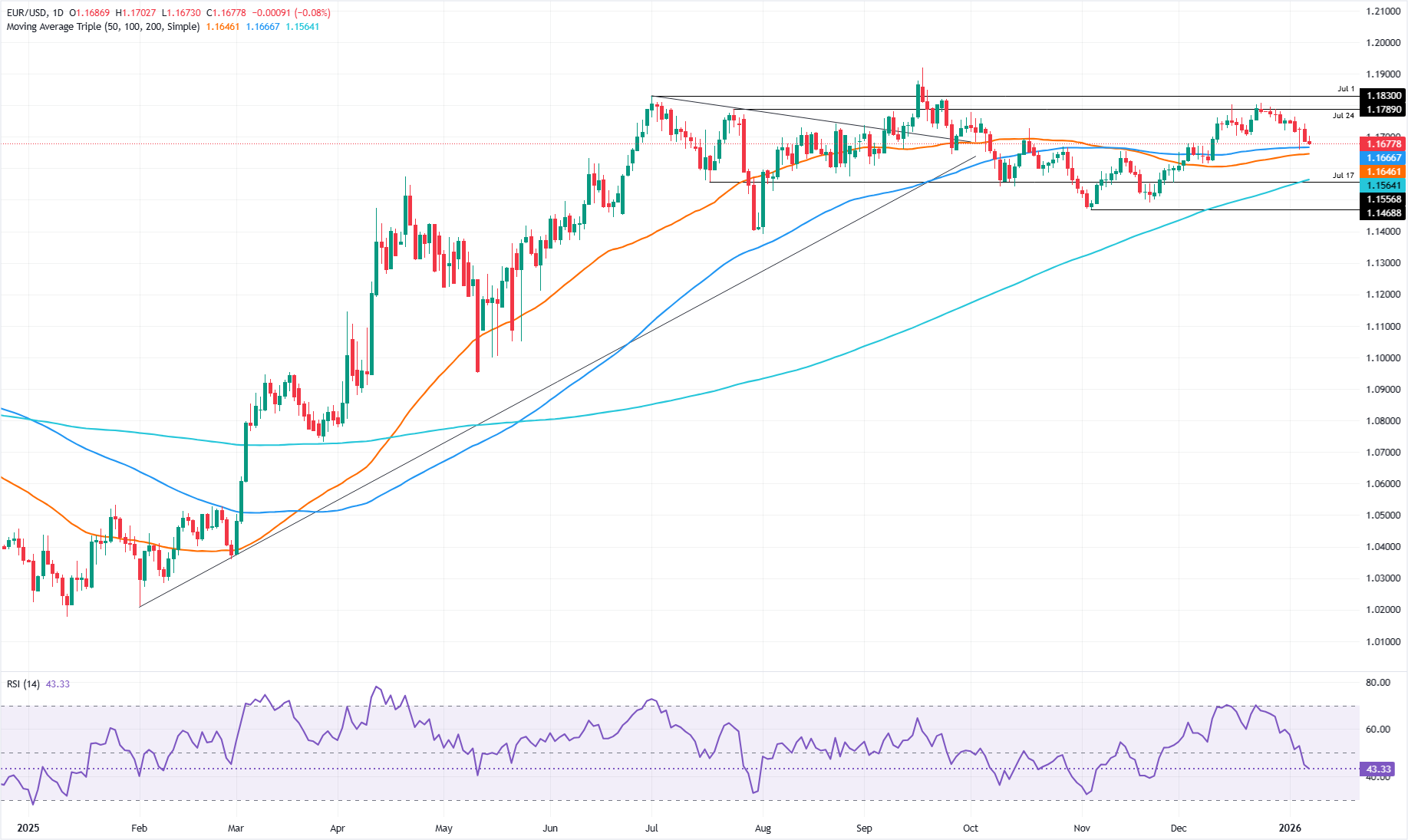
EUR/USD extends its losses for the third straight day in the week, down some 0.10% as the Greenback appreciates on strong Purchasing Managers Index (PMI) report by the ISM, along with a solid jobs report. Meanwhile, inflation decelerated in the Eurozone, remaining near the European Central Bank’s target and weighed on the shared currency. The pair trades at 1.1677, poised to close on a daily basis below 1.1700.
Euro weakens below 1.1700 as upbeat US PMIs and firm jobs data overshadow soft Eurozone figures
The Dollar was favored after the ISM Services PMI print for December, crushed estimates and indicated that business activity in the services sector rose. Job openings declined according to the Department of Labor, but an earlier report showed that hiring at US companies grew modestly in December and improved from November’s report.
In Europe, the Harmonized Index of Consumer Prices (HICP) in the bloc hit the ECB’s 2% goal on an annual basis, while underlying HCIP remained slightly high. This and disappointing German Retail Sales in November, pressured the Euro, who fell to new two-day lows of 1.1672.
On the US data, the US Dollar appreciated as revealed by the US Dollar Index (DXY). The DXY, which measures the buck’s performance against six currencies, edged up 0.14% at 98.73, a headwind for the EUR/USD.
Meanwhile, traders focus shifts on further data releases. In Europe, traders will eye the Eurozone Consumer Confidence, Business Climate, Economic Sentiment and the Producer Price Index. Across the pond, the US schedule will feature the December’s Challenger Job Cuts and Initial Jobless Claims for the week ending January 3.
Daily digest market movers: Stellar US services PMI, drives Euro lower
- The Institute for Supply Management reported that the ISM Services PMI surged in December, signaling strengthening activity across the services sector. The index jumped from 52.6 to 54.4, beating expectations of 52.3. Within the report, the Employment subcomponent returned to expansion, rising from 48.9 to 52.0, a sign of relief for Federal Reserve officials. Meanwhile Prices Paid eased modestly from 65.4 to 64.3, hinting at some moderation in cost pressures despite solid demand.
- At the same time, the US Department of Labor released the November JOLTS report, showing job openings declined to 7.146 million from 7.449 million in October, pointing to a gradual cooling in labor demand.
- Earlier, the ADP Employment Change report showed private payrolls increased by 41,000 in December, below forecasts of 47,000, but a notable improvement from November’s 29,000 job losses, suggesting tentative stabilization in hiring toward year-end.
- In Europe, the EU HICP rose by 2% YoY in December, as expected, slower than 2.1% in November. On a monthly basis, inflationary pressures grew by 0.2% after deflating 0.3% in the previous month.
Technical outlook: EUR/USD dives below 1.1700 as RSI turns bearish
The EUR/USD technical picture continued to deteriorate ending Wednesday’s session below the 1.1700 figure. Bears had taken over bulls as depicted by the Relative Strength Index (RSI) which crossed below the 50-neutral line, an indication that sellers are in charge.
On the downside, the first key support is the 100-day Simple Moving Average (SMA) at 1.1663, followed by the 50- and the 200-day SMAs, each at 1.1640 and 1.1561, respectively.
For a bullish resumption, bulls must clear the 20-day Simple Moving Average (SMA) at 1.1733, ahead of 1.1750, which would clear the path towards 1.1800.
Euro FAQs
The Euro is the currency for the 20 European Union countries that belong to the Eurozone. It is the second most heavily traded currency in the world behind the US Dollar. In 2022, it accounted for 31% of all foreign exchange transactions, with an average daily turnover of over $2.2 trillion a day. EUR/USD is the most heavily traded currency pair in the world, accounting for an estimated 30% off all transactions, followed by EUR/JPY (4%), EUR/GBP (3%) and EUR/AUD (2%).
The European Central Bank (ECB) in Frankfurt, Germany, is the reserve bank for the Eurozone. The ECB sets interest rates and manages monetary policy. The ECB’s primary mandate is to maintain price stability, which means either controlling inflation or stimulating growth. Its primary tool is the raising or lowering of interest rates. Relatively high interest rates – or the expectation of higher rates – will usually benefit the Euro and vice versa. The ECB Governing Council makes monetary policy decisions at meetings held eight times a year. Decisions are made by heads of the Eurozone national banks and six permanent members, including the President of the ECB, Christine Lagarde.
Eurozone inflation data, measured by the Harmonized Index of Consumer Prices (HICP), is an important econometric for the Euro. If inflation rises more than expected, especially if above the ECB’s 2% target, it obliges the ECB to raise interest rates to bring it back under control. Relatively high interest rates compared to its counterparts will usually benefit the Euro, as it makes the region more attractive as a place for global investors to park their money.
Data releases gauge the health of the economy and can impact on the Euro. Indicators such as GDP, Manufacturing and Services PMIs, employment, and consumer sentiment surveys can all influence the direction of the single currency. A strong economy is good for the Euro. Not only does it attract more foreign investment but it may encourage the ECB to put up interest rates, which will directly strengthen the Euro. Otherwise, if economic data is weak, the Euro is likely to fall. Economic data for the four largest economies in the euro area (Germany, France, Italy and Spain) are especially significant, as they account for 75% of the Eurozone’s economy.
Another significant data release for the Euro is the Trade Balance. This indicator measures the difference between what a country earns from its exports and what it spends on imports over a given period. If a country produces highly sought after exports then its currency will gain in value purely from the extra demand created from foreign buyers seeking to purchase these goods. Therefore, a positive net Trade Balance strengthens a currency and vice versa for a negative balance.
Recommended Articles


