


GBP/JPY Price Forecast: Buyers remain in control despite near-term consolidation
- GBP/JPY edges lower on Wednesday but holds near multi-year highs.
- Price action continues to hold above rising moving averages on the daily chart.
- Momentum cools from overbought levels, though buyers remain in control.
The British Pound (GBP) ticks lower against the Japanese Yen (JPY) on Wednesday, extending losses for a second straight day. At the time of writing, GBP/JPY trades around the 211.00 psychological mark, down nearly 0.20%.
The pullback has so far remained contained, with the wide UK–Japan interest-rate differential continuing to underpin the cross near levels last seen in 2008. GBP/JPY climbed nearly 7% last year, underpinned by lingering fiscal concerns in Japan and the Bank of Japan’s (BoJ) cautious approach to policy normalisation, which has kept the Yen on the defensive.
Meanwhile, the Bank of England’s (BoE) gradual easing cycle has allowed the Pound to preserve its relative yield advantage, sustaining underlying demand for the cross.
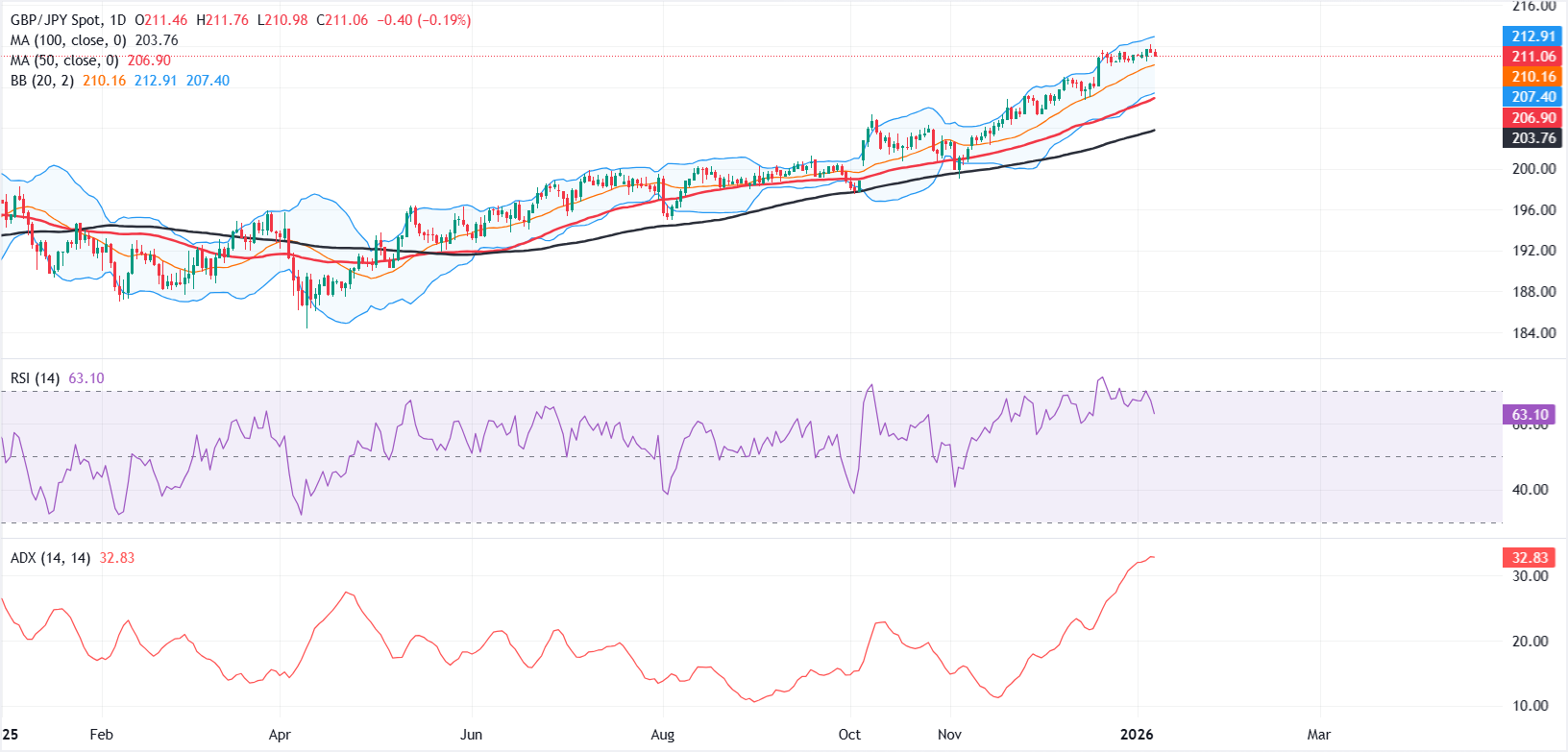
From a technical perspective, GBP/JPY continues to trade within a well-defined uptrend, with the daily chart showing a clear sequence of higher highs and higher lows, reinforcing the broader bullish structure.
The 20-day Simple Moving Average (SMA), which also forms the middle Bollinger Band, continues to slope higher, with the pair holding above it and preserving a constructive near-term tone.
Momentum remains supportive, though signs of moderation are emerging. The Relative Strength Index (RSI) stands near 63.7, holding well above the neutral 50 mark, suggesting buyers remain in control despite easing from overbought levels. The Average Directional Index (ADX) at 32.83 reflects a firm trend environment, suggesting dips could remain contained.
On the upside, immediate resistance aligns with the upper band near 212.90. A daily close above the upper band would open room for an extension of the rally.
On the downside, initial support is seen around the middle band near 210.15, with a deeper pullback likely to find interest closer to the lower band in the 207.40 region.
Japanese Yen FAQs
The Japanese Yen (JPY) is one of the world’s most traded currencies. Its value is broadly determined by the performance of the Japanese economy, but more specifically by the Bank of Japan’s policy, the differential between Japanese and US bond yields, or risk sentiment among traders, among other factors.
One of the Bank of Japan’s mandates is currency control, so its moves are key for the Yen. The BoJ has directly intervened in currency markets sometimes, generally to lower the value of the Yen, although it refrains from doing it often due to political concerns of its main trading partners. The BoJ ultra-loose monetary policy between 2013 and 2024 caused the Yen to depreciate against its main currency peers due to an increasing policy divergence between the Bank of Japan and other main central banks. More recently, the gradually unwinding of this ultra-loose policy has given some support to the Yen.
Over the last decade, the BoJ’s stance of sticking to ultra-loose monetary policy has led to a widening policy divergence with other central banks, particularly with the US Federal Reserve. This supported a widening of the differential between the 10-year US and Japanese bonds, which favored the US Dollar against the Japanese Yen. The BoJ decision in 2024 to gradually abandon the ultra-loose policy, coupled with interest-rate cuts in other major central banks, is narrowing this differential.
The Japanese Yen is often seen as a safe-haven investment. This means that in times of market stress, investors are more likely to put their money in the Japanese currency due to its supposed reliability and stability. Turbulent times are likely to strengthen the Yen’s value against other currencies seen as more risky to invest in.
Recommended Articles


