

Japanese Yen rises amid BoJ rate hike bets; USD/JPY slides below mid-155.00s
- The Japanese Yen kicks off the new week on a positive note amid rising BoJ rate hike bets.
- A softer risk tone further benefits the safe-haven JPY, while a dovish Fed weighs on the USD.
- Traders keenly await this week’s important US macro releases and the BoJ policy meeting.
The Japanese Yen (JPY) attracts fresh buyers at the start of a new week as traders keenly await the highly-anticipated Bank of Japan (BoJ) rate decision on Friday. Market expectations for an imminent BoJ rate hike in December have risen recently amid a shift in rhetoric from Governor Kazuo Ueda. Moreover, inflation in Japan remains above the BoJ's 2% target, which, along with an improvement in the business confidence among major Japanese manufacturers, backs the case for further policy tightening. This, along with a weaker risk tone, underpins the safe-haven JPY.
However, worries about Japan's deteriorating fiscal condition, amid Prime Minister Sanae Takaichi's massive spending plan, might hold back the JPY bulls from placing fresh bets. The US Dollar (USD), on the other hand, languishes near a two-month low, touched last Thursday, in the wake of rising bets for two more rate cuts by the US Federal Reserve (Fed). This marks a significant divergence compared to hawkish BoJ expectations, which, in turn, drags the USD/JPY pair back below mid-155.00s during the Asian session and backs the case for a further depreciating move.
Japanese Yen bulls have the upper hand amid firming BoJ rate hike expectations
- According to the Bank of Japan's quarterly Tankan survey released earlier this Monday, the business confidence index at large manufacturers in Japan rose to 15 in the fourth quarter of 2025 from 14.0 in the previous quarter. Further details revealed that the large Manufacturing Outlook arrived at 15.0 vs 12.0 prior.
- Commenting on the Tankan survey, a senior BoJ official said that Japanese firms cited easing uncertainty around US trade policy and resilient demand in high-tech sectors as key factors supporting business sentiment. Firms cited pass-through of costs and robust demand as factors brightening the business outlook.
- Moreover, BoJ Governor Kazuo Ueda recently said that the central bank is getting closer to attaining its inflation target. This reaffirms market bets for an imminent BoJ interest rate hike at the end of the December 18-19 policy meeting and backs the case for further policy tightening going into 2026.
- Moreover, reports suggest that top officials in Prime Minister Sanae Takaichi’s cabinet are unlikely to oppose a BoJ rate hike. Traders, however, seem reluctant to place bullish bets around the Japanese Yen and opt to wait for more cues about the BoJ's future policy path before positioning for further gains.
- Hence, the focus will remain glued to Ueda’s post-meeting press conference on Friday. In the meantime, Takaichi's massive spending plan has exacerbated concerns about Japan's public finances amid sluggish economic growth, which, in turn, is seen as another factor acting as a headwind for the JPY.
- The US Dollar, on the other hand, struggles to attract any meaningful buyers and languishes near a two-month low touched last Thursday amid dovish Federal Reserve expectations. The Fed signaled caution about further rate cuts, though traders are pricing in two more interest rate cuts next year.
- Meanwhile, US President Donald Trump said that he had narrowed the list of contenders to replace Jerome Powell as the next Fed chair and expects his nominee to deliver interest-rate cuts. The prospect of a Trump-aligned Fed chair keeps the USD bulls on the defensive and caps the USD/JPY pair.
- Traders also seem reluctant ahead of this week's important US macro releases – including the delayed Nonfarm Payrolls (NFP) report for October on Tuesday and the latest inflation figures on Thursday. In the meantime, the divergent BoJ-Fed outlooks might continue to support the lower-yielding JPY.
USD/JPY seems vulnerable while below the 100-hour SMA hurdle near the 156.00 mark
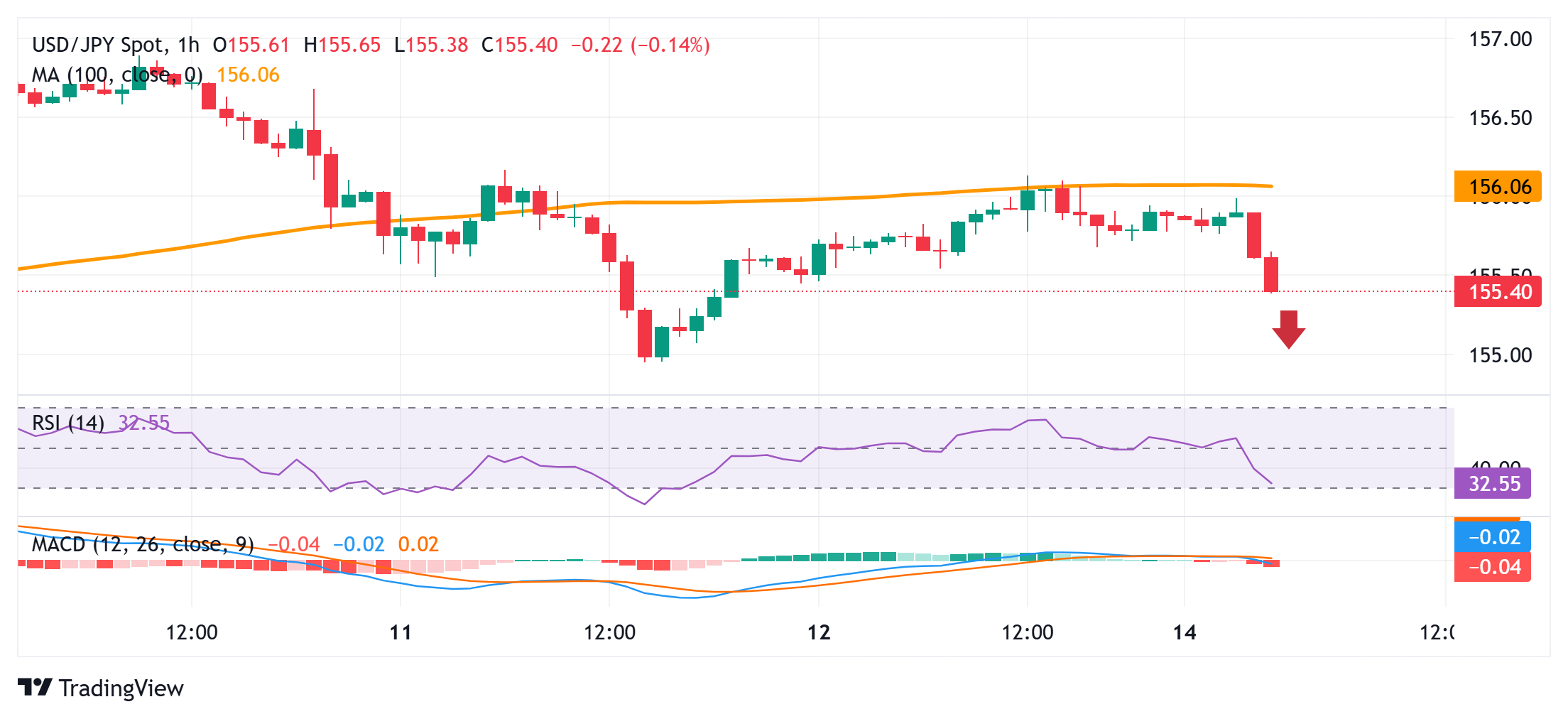
From a technical perspective, the USD/JPY pair has been struggling to move back above the 100-hour Simple Moving Average (SMA), and the subsequent slide favors bearish traders. However, positive oscillators on the daily chart suggest that any further decline is more likely to find decent support near the 155.00 psychological mark. A convincing break below the latter would turn spot prices vulnerable to accelerate the fall towards the monthly low, around the 154.35 area, en route to the 154.00 mark.
On the flip side, the 100-hour SMA, currently pegged at the 156.00 round figure, might continue to act as an immediate hurdle. Some follow-through buying beyond Friday's swing high, around the 156.10-156.15 region, might trigger a short-covering move and lift the USD/JPY pair to the 157.00 neighborhood. A sustained strength beyond the latter should pave the way for additional gains towards the 157.45 intermediate hurdle en route to a multi-month top, around the 158.00 neighborhood, touched in November.
Japanese Yen FAQs
The Japanese Yen (JPY) is one of the world’s most traded currencies. Its value is broadly determined by the performance of the Japanese economy, but more specifically by the Bank of Japan’s policy, the differential between Japanese and US bond yields, or risk sentiment among traders, among other factors.
One of the Bank of Japan’s mandates is currency control, so its moves are key for the Yen. The BoJ has directly intervened in currency markets sometimes, generally to lower the value of the Yen, although it refrains from doing it often due to political concerns of its main trading partners. The BoJ ultra-loose monetary policy between 2013 and 2024 caused the Yen to depreciate against its main currency peers due to an increasing policy divergence between the Bank of Japan and other main central banks. More recently, the gradually unwinding of this ultra-loose policy has given some support to the Yen.
Over the last decade, the BoJ’s stance of sticking to ultra-loose monetary policy has led to a widening policy divergence with other central banks, particularly with the US Federal Reserve. This supported a widening of the differential between the 10-year US and Japanese bonds, which favored the US Dollar against the Japanese Yen. The BoJ decision in 2024 to gradually abandon the ultra-loose policy, coupled with interest-rate cuts in other major central banks, is narrowing this differential.
The Japanese Yen is often seen as a safe-haven investment. This means that in times of market stress, investors are more likely to put their money in the Japanese currency due to its supposed reliability and stability. Turbulent times are likely to strengthen the Yen’s value against other currencies seen as more risky to invest in.
Recommended Articles


