New Zealand Dollar weakens further amid negative fundamentals

Mitrade
coverImg
Source: DepositPhotos
  • The New Zealand Dollar extends its downtrend in most pairs as broadly weak fundamentals exert pressure. 


  • RBNZ governor Orr says the bank is “laser-focused” on beating inflation. 


  • Technically, price could be about to correct higher within a persistent downtrend. 


The New Zealand Dollar (NZD) edges lower in its most heavily-traded pairs on Wednesday following the trend of the previous weeks as bearish fundamentals, including an overall negative outlook for growth, continue to weigh. 


Recent comments from the Reserve Bank of New Zealand (RBNZ) Governor Adrian Orr failed to give the Kiwi much support, despite the prospect of the RBNZ maintaining relatively high interest rates. Orr stressed the importance of battling too-high inflation in a speech on Tuesday. 


Normally higher interest rates help a currency as they attract more foreign capital inflows but in the case of New Zealand this does not appear to be the case. It is possible this is because the high inflation is accompanied by weak growth after the economy fell into a technical recession in the fourth quarter of 2023.  


New Zealand Dollar in downtrend as negative fundamentals weigh


The New Zealand Dollar is under pressure. The latest figures from Statistics New Zealand showed the New Zealand economy contracted by 0.1% in Q4 of 2023 following a 0.3% contraction in Q3. 


At the same time, headline inflation remained relatively high at 4.7% during the same reporting period, although it showed a slowdown from the 5.6% recorded in Q3. 


Normally weak growth would call for lower interest rates. However, the Reserve Bank of New Zealand (RBNZ) cannot cut interest rates because of too-high inflation.


Elevated price growth is partly a result of structural issues such as a tight labor market, which in turn keeps wage inflation high. 


In his speech on Tuesday, Governor Orr said the RBNZ remains “laser-focused on its job to control inflation.” 


“We're now in a much happier space, where most central banks feel we're back on top of inflation, [but we are] not there yet,” he added. 


Technical Analysis: New Zealand Dollar could undergo a correction


NZD/USD is falling in the final wave C of a bearish three-wave pattern, known as a Measured Move. This type of pattern is made up of three waves, usually labeled ABC. 

The end of wave C can be calculated because it is often the same length or a 0.618 Fibonacci ratio of wave A. According to that method of forecasting, wave C still has a way to go before completing. 
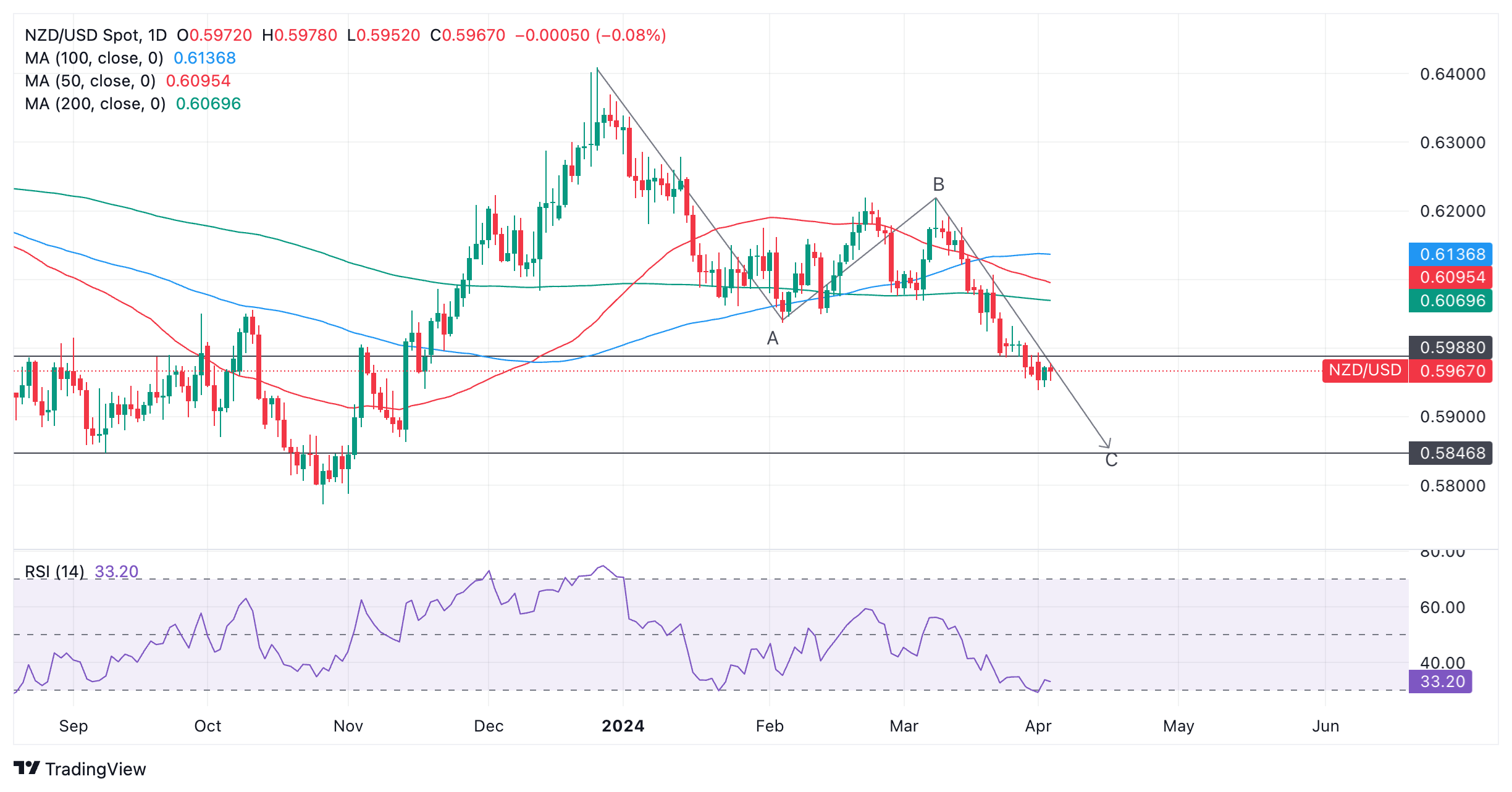

 New Zealand Dollar versus US Dollar: Daily chart


Assuming the pattern unfolds as expected, NZD/USD is likely to fall to a target at roughly 0.5847, corresponding to the end of wave C. It has already met the conservative target measured using the 0.618 Fibonacci ratio of wave A, at 0.5988. 


The bearish outlook is complicated by The Relative Strength Index (RSI) momentum indicator, however, which briefly dipped into oversold territory on Monday and then recovered on Tuesday. The entry and then exit from oversold levels is a buy signal. It recommends that short sellers should close their bets and open longs. It suggests the possibility of a correction evolving. 


It is therefore quite possible NZD/USD could undergo some upside before eventually continuing lower in line with the dominant downtrend, towards the target generated by the Measured Move. 


Read more

  • Gold Price Forecast: Gold Rebounds Above $4,200, Can Falling Oil Prices Drive Another Rally?
  • WTI slips below $90.50 as Trump signals no pre-election strike on Iran
  • * The content presented above, whether from a third party or not, is considered as general advice only.  This article should not be construed as containing investment advice, investment recommendations, an offer of or solicitation for any transactions in financial instruments.

    goTop
    quote
    Related Articles
    placeholder
    United States Dollar Index sits near March 2025 highs, above 102.00 ahead of US NFPThe US Dollar Index (DXY), which tracks the Greenback against a basket of currencies, attracts buyers for the fifth straight day and climbs back above the 102.00 mark during the Asian session on Friday.
    Author  FXStreet
    Oct 02, Fri
    The US Dollar Index (DXY), which tracks the Greenback against a basket of currencies, attracts buyers for the fifth straight day and climbs back above the 102.00 mark during the Asian session on Friday.
    placeholder
    US September Nonfarm Payrolls Preview: Job Growth May Cool, How Will US Stocks, Dollar and Gold React?On Friday, October 2 (EDT), the U.S. will release its September nonfarm payrolls report, with markets focusing on whether job growth can sustain August's rebound and whether the data will
    Author  TradingKey
    Oct 01, Thu
    On Friday, October 2 (EDT), the U.S. will release its September nonfarm payrolls report, with markets focusing on whether job growth can sustain August's rebound and whether the data will
    placeholder
    【Daily Brief】30-year Treasury tops 5.59%, S&P 500 slips to 7,670 and gold holds $4,180 — PCE lands tonightThe 30-year Treasury yield closed at 5.59%, its highest since June 2002, and the Dow fell 131.59 points to 51,349.92. US consumer confidence dropped to 81.9, a 12-year low, and JOLTS job openings fell to 7.1 million. August PCE and Q3 GDP both land at 8:30am ET tonight.
    Author  Suzie
    Sep 30, Wed
    The 30-year Treasury yield closed at 5.59%, its highest since June 2002, and the Dow fell 131.59 points to 51,349.92. US consumer confidence dropped to 81.9, a 12-year low, and JOLTS job openings fell to 7.1 million. August PCE and Q3 GDP both land at 8:30am ET tonight.
    placeholder
    【Daily Brief】The dollar ground higher for six days — and the AUD fell 2% in the very week the RBA hiked to a 15-year highThe dollar index held above 101 while the Australian dollar slid to a two-month low of 0.6976, a 2.02% six-session loss, even though the RBA raised rates to 4.60% and Australian CPI printed 4.0%. The yen is the only major currency gaining, ahead of Japan's monthly intervention tally at 7pm JST.
    Author  Irene Q.
    Sep 30, Wed
    The dollar index held above 101 while the Australian dollar slid to a two-month low of 0.6976, a 2.02% six-session loss, even though the RBA raised rates to 4.60% and Australian CPI printed 4.0%. The yen is the only major currency gaining, ahead of Japan's monthly intervention tally at 7pm JST.
    placeholder
    October hike odds climb toward 60% as Goldman and BofA both flip — what Warsh's "dose of accommodation" really changedRate futures now price roughly 55% to 62% for a 25bp hike at the October 27-28 FOMC, up from about 30% before Chair Warsh's post-meeting framing that the Fed is merely "removing some accommodation." Goldman Sachs has added an October hike to its forecast and Bank of America now sees moves in both October and December. Here is the repricing, the language behind it, and the two data points that decide it.
    Author  Irene Q.
    Sep 23, Wed
    Rate futures now price roughly 55% to 62% for a 25bp hike at the October 27-28 FOMC, up from about 30% before Chair Warsh's post-meeting framing that the Fed is merely "removing some accommodation." Goldman Sachs has added an October hike to its forecast and Bank of America now sees moves in both October and December. Here is the repricing, the language behind it, and the two data points that decide it.
    Live Quotes
    Name / SymbolChart% Change / Price
    NZDUSD
    NZDUSD
    0.00%0.00

    USD Related Articles

    • Financial Markets 2026: Volatility Catalysts in Gold, Silver, Oil, and Blue-Chip Stocks—A CFD Trader's Outlook
    • Best Currency Pairs To Trade 2026: Guide to Choosing Currency Pairs
    • Trading Chart Patterns:Ultimate Guide to Price Action
    • Australian Dollar Forecast In 2024/2025/2026: Should I Buy AUD/USD Or Other AUD Currency Pairs?
    • AUD/USD holds above 0.6500, eyes on RBA Minutes

    Click to view more