


USD/JPY Price Analysis: Recovers and hovers around 154.00


■ USD/JPY finishes unchanged, recovering from daily low of 151.94.
■ Technical outlook indicates bearish bias with RSI nearing oversold levels.
■ Key levels: bearish continuation below 153.00, support at 151.94, bullish control above 156.00.
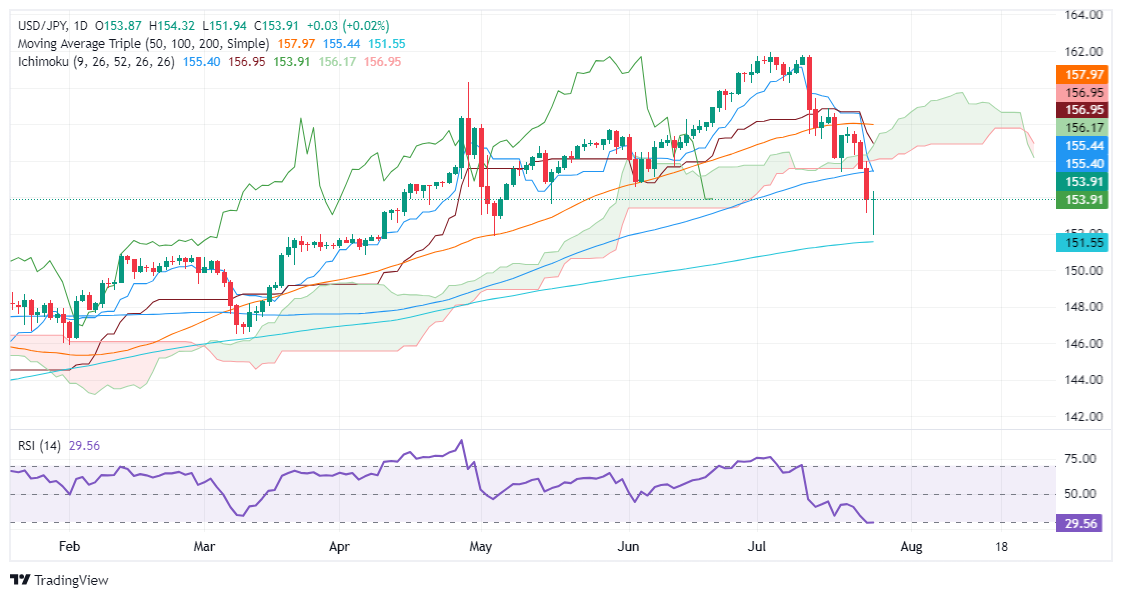
The USD/JPY trimmed some of its earlier losses and finished Thursday’s session virtually unchanged, trading at 153.93 after hitting a daily low of 151.94. The release of better-than-expected US GDP figures for the second quarter of 2024 sponsored the Greenback’s recovery versus the Japanese Yen.
USD/JPY Price Analysis: Technical outlook
The USD/JPY remained bearishly biased once it decisively breached the Ichimoku Cloud (Kumo), which exacerbated the pair’s drop to lower prices. Sellers are gathering momentum, as shown by the Relative Strength Index (RSI), which turned bearish and stands near the oversold level.
For a bearish continuation, sellers must push the USD/JPY pair below the 153.00 figure. Once done, the next support would be the July 25 low of 151.94, followed by the 151.00 mark.
Conversely, if USD/JPY buyers want to regain control, they must reclaim the 156.00 figure so that they can lift prices above the Kumo.
USD/JPY Price Action – Daily Chart
Read more
* The content presented above, whether from a third party or not, is considered as general advice only. This article should not be construed as containing investment advice, investment recommendations, an offer of or solicitation for any transactions in financial instruments.


