


Japanese Yen retreats against USD amid some repositioning ahead of US NFP

The Japanese Yen touched a nearly two-month high against the US Dollar on Friday.
Repositioning ahead of the US NFP triggers intraday short covering around USD/JPY.
The narrowing US-Japan rate differential should limit losses for the lower-yielding JPY.
The Japanese Yen (JPY) prolongs its uptrend for the fourth successive day and advances to a nearly two-month high against its American counterpart during the Asian session on Friday. The recent hawkish signals from the Bank of Japan (BoJ) lift market bets on further interest rate hikes. The resultant narrowing of the rate differential between the BoJ and other major central banks, including the Federal Reserve (Fed), turns out to be a key factor that continues to underpin the lower-yielding JPY.
Apart from this, the recent US Dollar (USD) sharp pullback from the vicinity of over a two-year high drags the USD/JPY pair below the 151.00 mark for the first time since December 10. That said, the uncertainty over US President Donald Trump's tariff policies keeps a lid on any further gains for the JPY. Furthermore, traders now seem reluctant and opt to move to the sidelines ahead of the US Nonfarm Payrolls (NFP) report, which assists the currency pair to rebound around 70 pips from the daily low.
Japanese Yen bulls have the upper hand amid rising bets on more BoJ rate hikes
Kazuhiro Masaki, Director General of the Bank of Japan's monetary affairs department, said on Thursday that the central bank will continue to raise interest rates if underlying inflation accelerates toward its 2% target as projected.
Japan's Economy Minister Ryosei Akazawa told the parliament that the government's focus would be to eradicate a deflationary mindset with a goal to boost minimum wages and take measures to encourage firms to raise wages.
This comes on top of the hawkish BoJ Summary of Opinions released on Monday, which showed that policymakers discussed the likelihood of raising interest rates further at the January meeting and continued to boost the Japanese Yen.
Adding to this, data released this week showed that Japan’s inflation-adjusted real wages rose 0.6% year-on-year in December, marking the second consecutive monthly gain and backing the case for further tightening by the BoJ.
The yield on Japan’s 10-year government bond remains near a 14-year high, while the benchmark 10-year US Treasury yield hangs near its lowest level since December amid expectations that the Federal Reserve would stick to its easing bias.
US Treasury Secretary Scott Bessent said on Thursday that President Donald Trump's administration was not particularly concerned about the Fed's trajectory on interest rates and that the focus is on bringing down 10-year Treasury yields.
Chicago Fed President Austan Goolsbee noted that the appearance that inflation has stalled is largely due to base effects and that the central bank needs to be mindful of overheating and deterioration, but things are largely going well.
Separately, Dallas Fed President Lorie Logan said that inflation progress has been significant, but the US labor market remains far too firm to push the central bank into rate cuts any time soon. This, however, does little to impress the US Dollar bulls.
That said, traders opt to lighten their bets and move to the sidelines ahead of the release of the US Nonfarm Payrolls (NFP) report, prompting an aggressive intraday short-covering move around the USD/JPY pair on Friday.
USD/JPY is likely to attract fresh sellers at higher levels amid a bearish technical setup
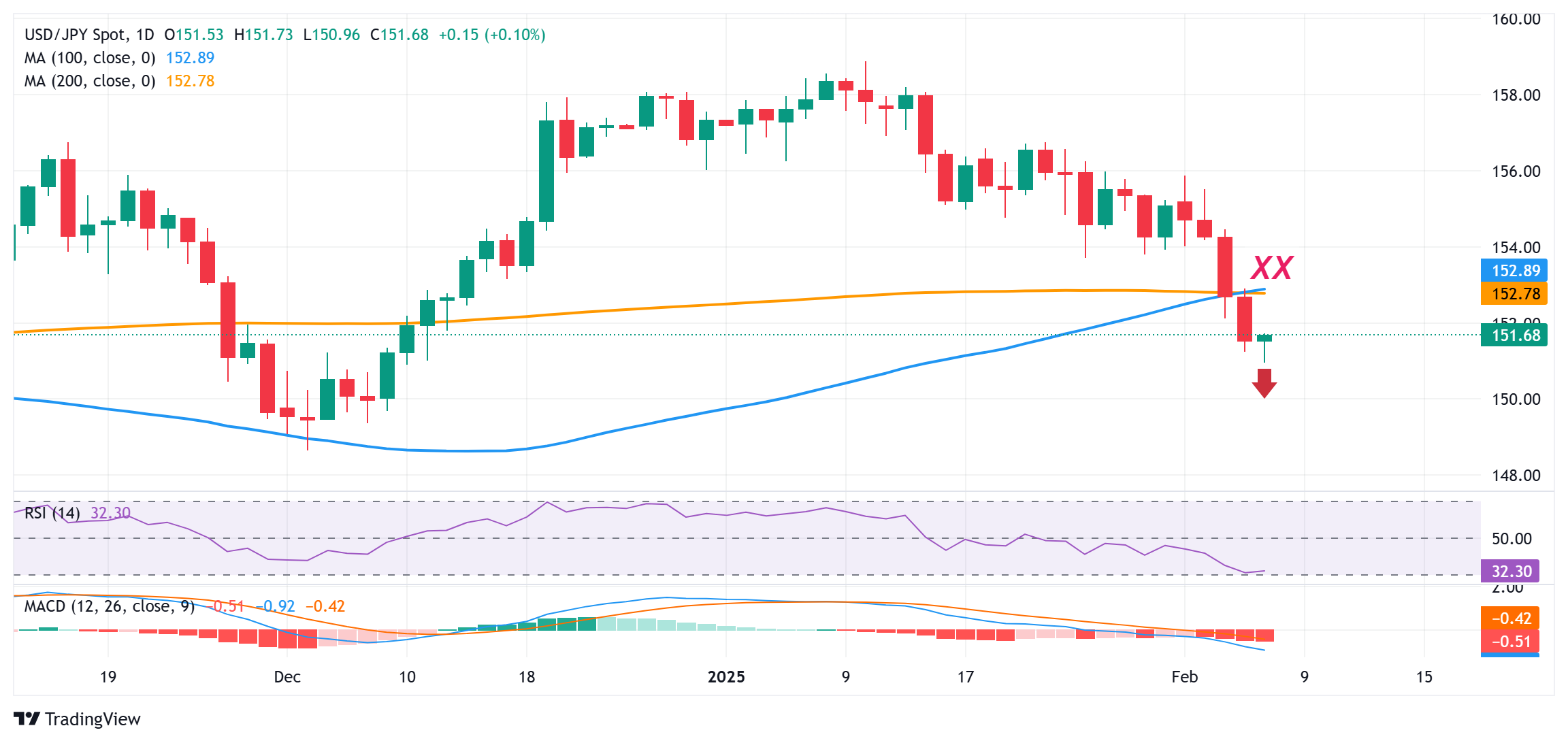
From a technical perspective, this week's breakdown below the 152.50-152.45 confluence – comprising the 100- and the 200-day Simple Moving Averages (SMAs) was seen as a key trigger for bearish traders. Moreover, oscillators on the daily chart are holding deep in negative territory and are still away from being in the oversold zone. This, in turn, suggests that the path of least resistance for the USD/JPY pair remains to the downside. Hence, any subsequent move up could be seen as a selling opportunity and remain capped near the 152.00 mark. Some follow-through buying, however, could lift spot prices further toward the next relevant hurdle near the 152.50-152.45 support-turned-resistance en route to the 153.00 round figure.
On the flip side, the 151.00 mark now seems to have emerged as an immediate support. A sustained break and acceptance below the said handle could drag the USD/JPY pair further towards 150.55-150.50 support. The downward trajectory could extend further towards the 150.00 psychological mark, below which spot prices could slide to the 149.60 horizontal support before aiming to test the 149.00 mark and the December swing low, around the 148.65 region.
Read more
* The content presented above, whether from a third party or not, is considered as general advice only. This article should not be construed as containing investment advice, investment recommendations, an offer of or solicitation for any transactions in financial instruments.


