

Oil holds gains as increasing geopolitical tensions offset US Dollar strength

Mitrade
coverImg
Source: DepositPhotos
  • WTI trades back above $85 after whipsawing around it this week.


  • Oil price rises near 1% despite EIA calls for a negative outlook on Oil demand.


  • The US Dollar Index surges close to 106.00 and sets forth a fresh five-month high.


Oil prices are jumping higher again on Friday after the small 0.75% decline from Thursday. The move comes as commodities are soaring again fueled by geopolitical tensions and despite the fact that the US Dollar is stretching higher for a fourth straight day in a row this week. Meanwhile, the International Energy Agency (IEA) has cut its Oil demand forecast for this year and the next one, anticipating slower growth in 2025, due to a lacklustre economic outlook and the increasing market share of electric vehicles in the global car market


The US Dollar meanwhile is printing a staggering 1.8% rally in the US Dollar Index (DXY) after markets are increasingly expecting a bigger interest-rate differential between the Federal Reserve (Fed) and other central banks. This rate differential is separating the countries (and ergo the local currency) where central banks are in dire need to cut against countries from those countries where cuts are currently not needed. Robust US economic data points to the US as the leader of the countries where rate cuts under current conditions are not needed at all. 


Crude Oil (WTI) trades at $85.63 and Brent Crude at $90.19 at the time of writing.


Oil news and market movers: IEA against OPEC


  • The outlook for Oil demand from OPEC and IEA diverge substantially. While the IEA is calling for less demand in 2024 and 2025, OPEC on Thursday said it is watching summer demand very closely as it would not be able to handle any unforeseen uptick in demand.


  • Furthermore in the IEA report from this Friday: more than 3 million barrels per day will be added coming from non-OPEC projects, with Brazil as the biggest contributor.


  • OPEC output increased by 110,000 barrels per day against February’s data. Saudi Arabia and Kuwait accounted for the small uptick, according to Bloomberg. 


Oil Technical Analysis: Non-OPEC inflow 


Oil prices remain elevated with tensions in the Middle East nearing a new dynamic. After Iran vowed to retaliate against Israel or any US asset in the region, tensions are getting high as such an attack could drag the whole region back into a long drawn-out dispute with the risk of Oil delivery disruptions. Meanwhile, the bearish IEA report said that Brazil soon will add substantially more non-OPEC Oil to the markets. Although Brazil was set to join OPEC from the beginning of this year, that inauguration still needs to happen. 


If the high of last week at $87.12 gets broken, the $90 handle should come into grasp. One small barrier in the way is $89.64, the peak from October 20. In case of further escalating tensions in the Middle East, expect even $94 to become a possibility, and a fresh 18-month high could be on the cards. 


On the downside, $83.34 is the first level to have a look for after a very clean break and test for support on April 1 and 2. Should it not hold, $80.63 is the next best candidate as a pivotal supportive level. A touch softer, the convergence with the 55-day and the 200-day Simple Moving Averages (SMAs) at $79.32 should halt any further downturn. 
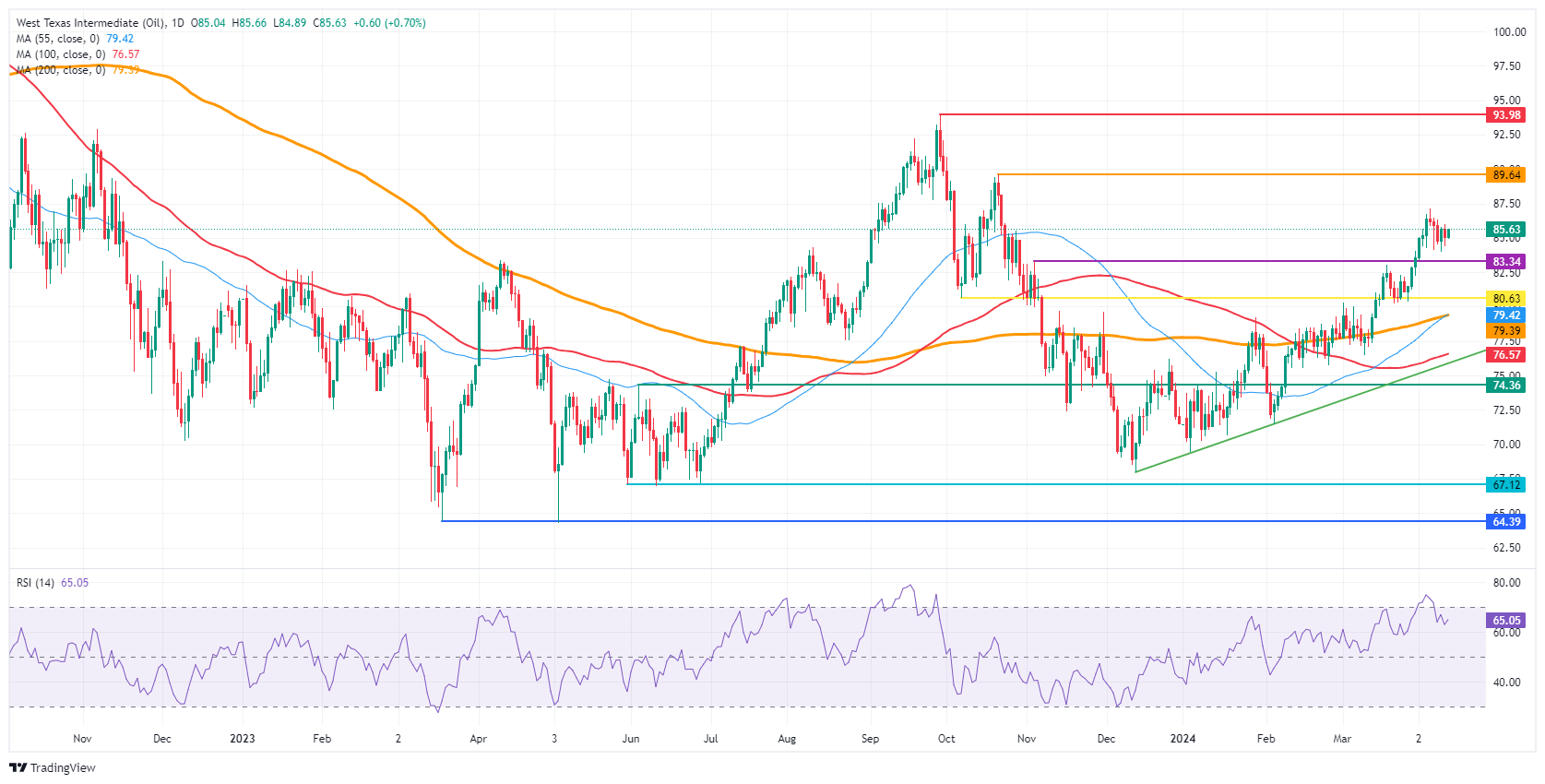

US WTI Crude Oil: Daily Chart

US WTI Crude Oil: Daily Chart, Source: TradingView.


Read more

  • Gold Price Forecast: Gold Returns to $4,200 Ahead of US September CPI, Can the Rally Continue?
  • * The content presented above, whether from a third party or not, is considered as general advice only.  This article should not be construed as containing investment advice, investment recommendations, an offer of or solicitation for any transactions in financial instruments.

    goTop
    quote
    Related Articles
    placeholder
    WTI holds gains above $92.00 on persistent Middle East supply risksWest Texas Intermediate (WTI), the US crude oil benchmark, is trading around $92.05 during the early Asian trading hours on Tuesday. WTI price edges higher after a deadly attack on Saudi Arabia’s airport in Riyadh.
    Author  FXStreet
    14 hours ago
    West Texas Intermediate (WTI), the US crude oil benchmark, is trading around $92.05 during the early Asian trading hours on Tuesday. WTI price edges higher after a deadly attack on Saudi Arabia’s airport in Riyadh.
    placeholder
    Brent swings $105.63 to $102.33 as Gulf risk meets an 'energy ceasefire' — can $100 hold into CPI?Brent spiked to $105.63 in Asian trade on fresh Middle East supply incidents, then reversed to $102.33 after the US announced a Russia-Ukraine 'energy ceasefire' and 300,000+ tonnes of Russian diesel headed to global markets; WTI fell through $90. Here are the drivers, the levels and the scenarios into Wednesday's US CPI.
    Author  Irene Q.
    Yesterday 05: 47
    Brent spiked to $105.63 in Asian trade on fresh Middle East supply incidents, then reversed to $102.33 after the US announced a Russia-Ukraine 'energy ceasefire' and 300,000+ tonnes of Russian diesel headed to global markets; WTI fell through $90. Here are the drivers, the levels and the scenarios into Wednesday's US CPI.
    placeholder
    WTI declines to near $90.00 despite escalating Middle East conflict, supply risksWest Texas Intermediate (WTI) declines after two days of gains, trading around $90.00 per barrel during Asian hours on Monday.
    Author  FXStreet
    Yesterday 01: 20
    West Texas Intermediate (WTI) declines after two days of gains, trading around $90.00 per barrel during Asian hours on Monday.
    placeholder
    Hurricane Isaias has shut in a quarter of Gulf oil output — can WTI clear $92 before Thursday's EIA report?WTI trades at $90.80 after rebounding roughly 3% from Wednesday's $87.96 low as Hurricane Isaias — the Atlantic season's first — forces producers to shut in about 25% of US Gulf of Mexico output. Brent holds at $103.41. The first official read on the disruption arrives with the EIA weekly petroleum report on Thursday 15 October — here are the key levels and both scenarios.
    Author  Irene Q.
    Oct 09, Fri
    WTI trades at $90.80 after rebounding roughly 3% from Wednesday's $87.96 low as Hurricane Isaias — the Atlantic season's first — forces producers to shut in about 25% of US Gulf of Mexico output. Brent holds at $103.41. The first official read on the disruption arrives with the EIA weekly petroleum report on Thursday 15 October — here are the key levels and both scenarios.
    placeholder
    【Daily Brief】Gold rebounds 1% off a two-month low, Nasdaq drops 1.25% and yields ease — the storm premium keeps WTI near $91Gold trades at $4,174 after rebounding from Wednesday's $4,090 two-month low, the Nasdaq fell 1.25% while the Dow edged higher, and the 10-year Treasury eased to 5.23% from the week's highs. Hurricane Isaias keeps about 25% of Gulf output shut in with WTI near $91, and bitcoin holds below $82,000. The next scheduled tests are the EIA report on 15 October and the FOMC on 27-28 October.
    Author  Irene Q.
    Oct 09, Fri
    Gold trades at $4,174 after rebounding from Wednesday's $4,090 two-month low, the Nasdaq fell 1.25% while the Dow edged higher, and the 10-year Treasury eased to 5.23% from the week's highs. Hurricane Isaias keeps about 25% of Gulf output shut in with WTI near $91, and bitcoin holds below $82,000. The next scheduled tests are the EIA report on 15 October and the FOMC on 27-28 October.
    Live Quotes
    Name / SymbolChart% Change / Price
    USOIL
    USOIL
    0.00%0.00
    UKOIL
    UKOIL
    0.00%0.00

    Oil Related Articles

    • Best Oil Trading Platforms in 2026: A Complete Guide for Retail Traders
    • Should I Invest in Oil Right Now? The 2026 Oil Price Forecast
    • Crude Oil Trading: How To Invest In WTI/Brent Oil?
    • WTI Moves Upward Near $75.50 on Dovish Fed Outlook, Maersk, CMA CGM Return to Red Sea

    Click to view more