


Gold price stands firm near record high; overbought RSI warrants caution for bulls


Gold price attracts buyers for the fourth straight day amid worries about Trump’s tariffs.
Bets for more Fed rate cuts and inflation concerns further benefit the XAU/USD pair.
Rebounding US bond yields and a modest USD uptick might cap gains for the commodity.
Gold price (XAU/USD) trades with a positive bias around the $2,820 region during the Asian session on Tuesday and remains close to the all-time peak touched the previous day. Investors remain concerned about the potential economic fallout from US President Donald Trump's trade tariffs, which is seen driving flows towards the safe-haven bullion for the fourth straight day. Furthermore, expectations that Trump's protectionist policies would result in higher US inflation further benefit the precious metal's status as a hedge against rising prices.
Apart from this, bets that the Federal Reserve (Fed) will lower borrowing costs twice by the end of this year suggest that the path of least resistance for the non-yielding Gold price remains to the upside. Meanwhile, Trump's decision to temporarily pause tariffs on Mexico and Canada, after striking a border security deal with both nations, boosts investors’ confidence. This is evident from a generally positive tone around the equity markets. The risk-on flow pushes the US Treasury bond yields higher and might cap the upside for the precious metal.
Gold price continues to attract haven flows on the back of trade war fears
US President Donald Trump's tariff plans continue to fuel concerns about a global trade war and its impact on the economy, lifting the safe haven Gold price to a fresh all-time peak on Monday.
The Institute for Supply Management's (ISM) Manufacturing Purchasing Managers' Index climbed from 49.3 in the previous month to 50.9 in January, beating expectations for a reading of 49.8.
Additionally, the Prices Paid Index—which measures inflation—rose to 54.9 from 52.5, while the Employment Index increased to 50.3 from 45.4, and the New Orders Index improved to 55.1.
This comes on top of speculations that Trump's trade tariffs could push up inflation and give the Federal Reserve less impetus to cut interest rates further, which underpins the US Dollar.
The view was echoed by comments from Chicago Fed President Austan Goolsbee, who warned that uncertainty over Trump’s policies could delay the central bank’s plans to cut interest rates.
Separately, Atlanta Fed President Raphael Bostic noted on Monday that although the US labor market remains surprisingly resilient, tariff threats throw a wrench in outlook expectations.
Trump's policies could push up inflation, which, along with expectations for further policy easing by the Federal Reserve, turn out to be another factor benefiting the non-yielding yellow metal.
Trump temporarily paused tariffs on Mexico and Canada after striking a border security deal, which boosts investors' confidence and might cap any further move-up for the safe-haven XAU/USD.
The US Dollar attracts some dip-buyers following the previous day's turnaround from the vicinity of over a two-year high and might hold back bulls from placing fresh bets around the commodity.
Tuesday's US economic docket features the release of Job Openings and Labor Turnover Survey (JOLTS) and Factory Orders data, which might provide some impetus to the USD and the Gold price.
Gold price needs to consolidate recent strong gains before the next leg up
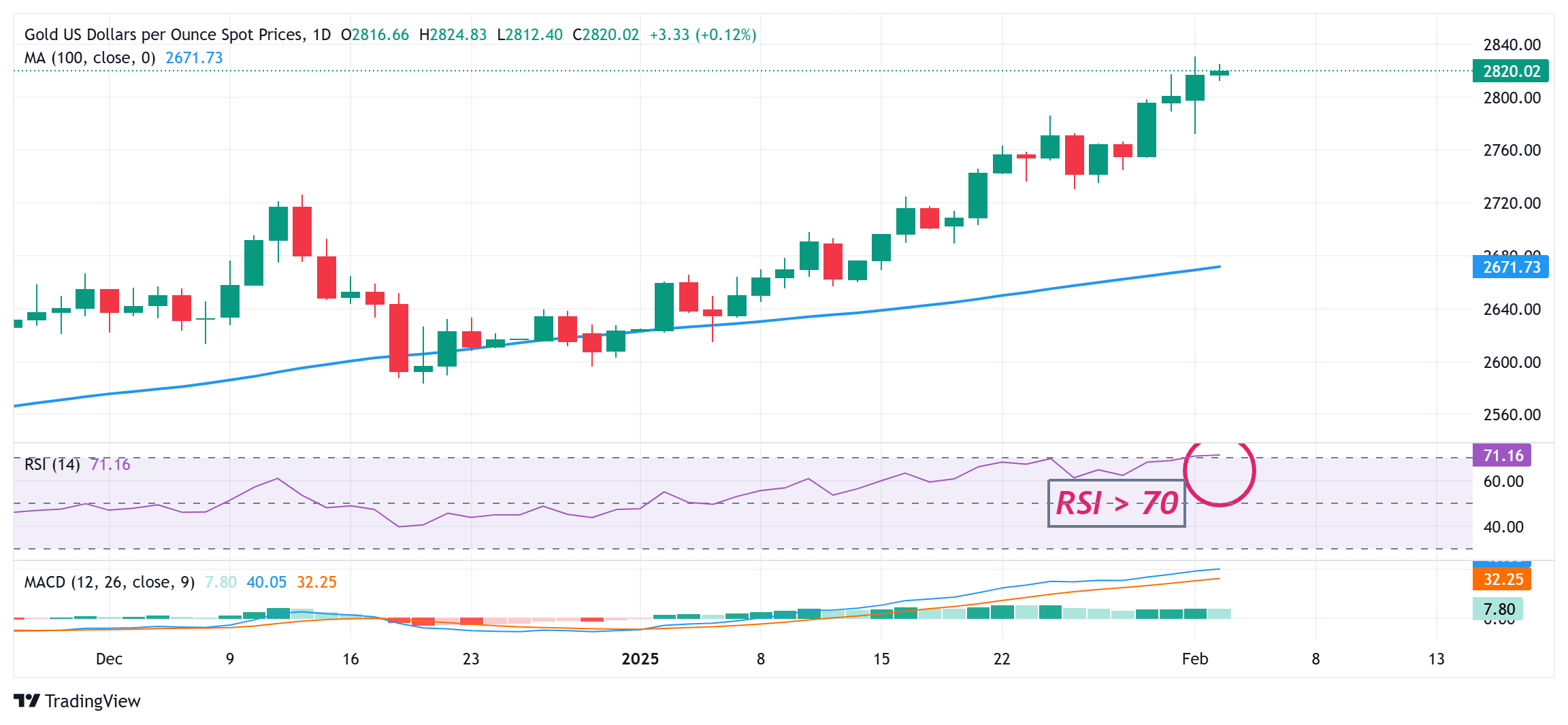
From a technical perspective, the Relative Strength Index (RSI) is already flashing slightly overbought conditions on the daily chart. This makes it prudent to wait for some near-term consolidation or a modest pullback before the next leg up. That said, any corrective slide below the $2,800 immediate support might still be seen as a buying opportunity and remain limited near the $2,773-2,772 horizontal resistance breakpoint. Some follow-through selling, however, could pave the way for a further decline towards the $2,755 zone en route to the $2,725-2,720 region and the $2,700 mark.
On the flip side, bulls are likely to pause near the $2,830 area, or the record peak touched on Monday. Some follow-through buying, however, will set the stage for an extension of a well-established trend witnessed from the December swing low, around the $2,583 region.
Gold FAQs
Gold has played a key role in human’s history as it has been widely used as a store of value and medium of exchange. Currently, apart from its shine and usage for jewelry, the precious metal is widely seen as a safe-haven asset, meaning that it is considered a good investment during turbulent times. Gold is also widely seen as a hedge against inflation and against depreciating currencies as it doesn’t rely on any specific issuer or government.
Central banks are the biggest Gold holders. In their aim to support their currencies in turbulent times, central banks tend to diversify their reserves and buy Gold to improve the perceived strength of the economy and the currency. High Gold reserves can be a source of trust for a country’s solvency. Central banks added 1,136 tonnes of Gold worth around $70 billion to their reserves in 2022, according to data from the World Gold Council. This is the highest yearly purchase since records began. Central banks from emerging economies such as China, India and Turkey are quickly increasing their Gold reserves.
Gold has an inverse correlation with the US Dollar and US Treasuries, which are both major reserve and safe-haven assets. When the Dollar depreciates, Gold tends to rise, enabling investors and central banks to diversify their assets in turbulent times. Gold is also inversely correlated with risk assets. A rally in the stock market tends to weaken Gold price, while sell-offs in riskier markets tend to favor the precious metal.
The price can move due to a wide range of factors. Geopolitical instability or fears of a deep recession can quickly make Gold price escalate due to its safe-haven status. As a yield-less asset, Gold tends to rise with lower interest rates, while higher cost of money usually weighs down on the yellow metal. Still, most moves depend on how the US Dollar (USD) behaves as the asset is priced in dollars (XAU/USD). A strong Dollar tends to keep the price of Gold controlled, whereas a weaker Dollar is likely to push Gold prices up.
Tariffs FAQs
Tariffs are customs duties levied on certain merchandise imports or a category of products. Tariffs are designed to help local producers and manufacturers be more competitive in the market by providing a price advantage over similar goods that can be imported. Tariffs are widely used as tools of protectionism, along with trade barriers and import quotas.
Although tariffs and taxes both generate government revenue to fund public goods and services, they have several distinctions. Tariffs are prepaid at the port of entry, while taxes are paid at the time of purchase. Taxes are imposed on individual taxpayers and businesses, while tariffs are paid by importers.
There are two schools of thought among economists regarding the usage of tariffs. While some argue that tariffs are necessary to protect domestic industries and address trade imbalances, others see them as a harmful tool that could potentially drive prices higher over the long term and lead to a damaging trade war by encouraging tit-for-tat tariffs.
During the run-up to the presidential election in November 2024, Donald Trump made it clear that he intends to use tariffs to support the US economy and American producers. In 2024, Mexico, China and Canada accounted for 42% of total US imports. In this period, Mexico stood out as the top exporter with $466.6 billion, according to the US Census Bureau. Hence, Trump wants to focus on these three nations when imposing tariffs. He also plans to use the revenue generated through tariffs to lower personal income taxes.
Read more
* The content presented above, whether from a third party or not, is considered as general advice only. This article should not be construed as containing investment advice, investment recommendations, an offer of or solicitation for any transactions in financial instruments.


