


Gold price edges lower on rebounding US bond yields; downside seems limited

Gold price attracts some sellers amid a modest rebound in the US bond yields.
Geopolitical risks and trade war fears could help limit losses for the XAU/USD.
The USD bulls remain on the sidelines ahead of the key US NFP report on Friday.
Gold price (XAU/USD) drifts lower during the Asian session on Thursday, albeit it remains confined in a familiar range held over the past week or so amid mixed fundamental cues. The overnight hawkish remarks by FOMC members, including Federal Reserve (Fed) Chair Jerome Powell, reaffirmed expectations that the US central bank will take a cautious stance on cutting rates. This assists the US Treasury bond yields to rebound slightly from their lowest closing levels in more than a month and turns out to be a key factor undermining the non-yielding yellow metal.
Apart from this, the prevalent risk-on environment is seen exerting some downward pressure on the safe-haven Gold price. That said, persistent geopolitical tensions stemming from the worsening Russia-Ukraine conflict and concerns about US President-elect Donald Trump's tariff plans could act as a tailwind for the XAU/USD.
Furthermore, the lack of any meaningful US Dollar (USD) buying should contribute to limiting losses for the commodity. Traders might also opt to wait for the release of the US Nonfarm Payrolls (NFP) report on Friday before placing directional bets.
Gold price lacks a firm near-term direction as traders await more cues about Fed’s rate-cut path
The Federal Reserve's Beige Book showed on Wednesday that US economic activity expanded slightly in most regions since early October, with inflation rising at a modest pace and businesses expressing optimism about the future.
St. Louis Fed President Alberto Musalem said that it may be appropriate to pause interest-rate cuts as soon as the December meeting as the risks of lowering borrowing costs too quickly are greater than those of easing too little.
Fed Chair Jerome Powell acknowledged that the US economy is in very good shape and is definitely stronger than expected and that the central bank can take a little more cautious approach cutting interest rates toward neutral.
Separately, San Francisco Fed President Mary Daly said there is no sense of urgency to lower interest rates and that a lot more work needs to be done to deliver on the 2% inflation target and durable economic growth.
Furthermore, speculations that US President-elect Donald Trump's policies will reignite inflation suggest that the Fed might stop cutting rates or possibly raise them again, triggering a modest bounce in the US bond yields.
The yield on the benchmark 10-year US government bond rebounds after registering its lowest closing level since October 21, which, in turn, is seen exerting some downward pressure on the non-yielding Gold price on Thursday.
Meanwhile, the US Dollar, so far, has been struggling to gain any meaningful traction and might act as a tailwind for the XAU/USD amid concerns that Trump's trade tariffs could trigger the second wave of global trade wars.
Traders now look forward to the release of the usual US Weekly Initial Jobless Claims for some impetus later this Thursday. The focus, however, remains glued to the closely watched US Nonfarm Payrolls (NFP) report on Friday.
Gold price technical setup favors bearish traders and supports prospects for deeper losses
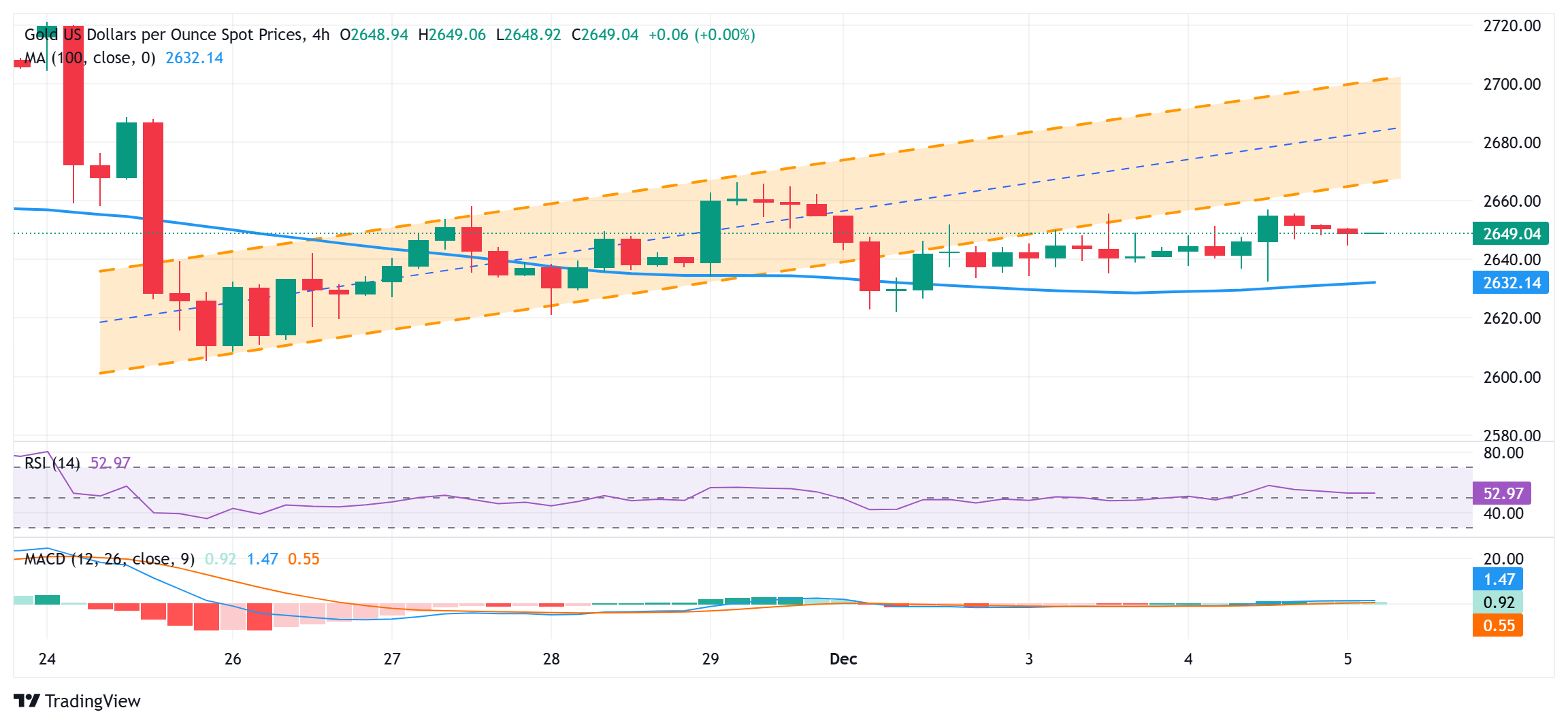
From a technical perspective, this week's breakdown below a multi-day-old ascending channel was seen as a key trigger for bearish traders. That said, neutral oscillators on daily/4-hour charts make it prudent to wait for some follow-through selling below the recent trading range support, around the $2,630 area, before positioning for further losses. The subsequent downfall has the potential to drag the Gold price below the weekly swing low, around the $2,622-2,621 region, towards the $2,600 mark. The downward trajectory could extend further towards the 100-day Simple Moving Average (SMA), currently pegged near the $2,581 area, en route to the November monthly trough, around the $2,537-2,536 region.
On the flip side, the $2,655 area might continue to act as an immediate barrier ahead of last Friday's swing high, around the $2,666 region. Some follow-through buying, leading to a subsequent strength beyond the $2,677-2,678 hurdle, should allow the Gold price to aim to reclaim the $2,700 round figure. Any further move up, however, is likely to confront stiff resistance near the $2,721-2,722 supply zone, which if cleared decisively might shift the bias in favor of bulls and pave the way for some meaningful appreciating move in the near term.
Gold FAQs
Gold has played a key role in human’s history as it has been widely used as a store of value and medium of exchange. Currently, apart from its shine and usage for jewelry, the precious metal is widely seen as a safe-haven asset, meaning that it is considered a good investment during turbulent times. Gold is also widely seen as a hedge against inflation and against depreciating currencies as it doesn’t rely on any specific issuer or government.
Central banks are the biggest Gold holders. In their aim to support their currencies in turbulent times, central banks tend to diversify their reserves and buy Gold to improve the perceived strength of the economy and the currency. High Gold reserves can be a source of trust for a country’s solvency. Central banks added 1,136 tonnes of Gold worth around $70 billion to their reserves in 2022, according to data from the World Gold Council. This is the highest yearly purchase since records began. Central banks from emerging economies such as China, India and Turkey are quickly increasing their Gold reserves.
Gold has an inverse correlation with the US Dollar and US Treasuries, which are both major reserve and safe-haven assets. When the Dollar depreciates, Gold tends to rise, enabling investors and central banks to diversify their assets in turbulent times. Gold is also inversely correlated with risk assets. A rally in the stock market tends to weaken Gold price, while sell-offs in riskier markets tend to favor the precious metal.
The price can move due to a wide range of factors. Geopolitical instability or fears of a deep recession can quickly make Gold price escalate due to its safe-haven status. As a yield-less asset, Gold tends to rise with lower interest rates, while higher cost of money usually weighs down on the yellow metal. Still, most moves depend on how the US Dollar (USD) behaves as the asset is priced in dollars (XAU/USD). A strong Dollar tends to keep the price of Gold controlled, whereas a weaker Dollar is likely to push Gold prices up.
Read more
* The content presented above, whether from a third party or not, is considered as general advice only. This article should not be construed as containing investment advice, investment recommendations, an offer of or solicitation for any transactions in financial instruments.


