


Gold price remains heavily offered amid renewed USD buying interest


Gold price meets with heavy supply on Monday and snaps a four-day winning streak.
Rebounding US bond yields help revive the USD demand and weigh on the commodity.
Trade war concerns and geopolitical risks do little to lend support to the XAU/USD.
Gold price attracts heavy selling at the start of a new week/month and drops to the $2,623-2,622 area during the Asian session, snapping a four-day winning streak amid a goodish pickup in the US Dollar (USD) demand. Expectations that US President-elect Donald Trump's tariff plans could reignite inflationary pressures and limit the scope for the Federal Reserve (Fed) to cut interest rates trigger a fresh leg up in the US Treasury bond yields. This, in turn, assists the USD to stage a solid bounce from a nearly three-week low touched on Friday and turns out to be a key factor driving flows away from the non-yielding yellow metal.
The markets, however, are still pricing in a greater chance that the US central bank will lower borrowing costs later this month. This, along with persistent geopolitical risks stemming from the protracted Russia-Ukraine war and conflicts in the Middle East, helps limit losses for the safe-haven Gold price. Traders also seem reluctant and opt to wait for this week's important US macro releases, including the closely watched Nonfarm Payrolls (NFP) report, for cues about the Fed's rate-cut path. This, in turn, will play a key role in influencing the USD price dynamics and determining the next leg of a directional move for the XAU/USD.
Gold price is pressured by rising US bond yields and a strong pickup in the USD demand
The US Dollar staged a goodish recovery from its lowest level since November 12 touched last Friday amid a fresh leg up in the US Treasury bond yields and weighs on the Gold price at the start of a new week/month.
Investors seem convinced that US President-elect Donald Trump's tariff plans could trigger the second wave of trade wars and push consumer prices higher, forcing the Federal Reserve to stop cutting rates.
In a critical post over the weekend, Trump threatened a 100% tariff on BRICS nations – Brazil, Russia, India, China, and South Africa – if they replace the USD with another currency for international transactions.
Ukrainian President Volodymyr Zelenskyy has stated that he is willing to give up occupied Ukrainian territory to Russia, albeit with some conditions, in order to reach a ceasefire agreement and achieve peace.
Russian and Syrian jets have carried out a series of air strikes on Syrian rebels led by the jihadi group Hayat Tahrir al-Sham, who took over most of Aleppo in a shock offensive on Saturday and entered the city of Hama.
China’s official Manufacturing Purchasing Managers' Index (PMI) edged up to 50.3 in November from 50.2, while the NBS Non-Manufacturing PMI eased to 50.0 during the reported month from October’s 50.2.
China's Caixin Manufacturing Purchasing Managers' Index (PMI) jumped to 51.5 in November after recording 50.3 in October amid hopes that the government will introduce more stimulus to bolster domestic demand.
This week's important US macroeconomic releases, starting with the ISM Manufacturing PMI later this Monday, will be looked for interest rate cuts, which, in turn, will drive the USD and the non-yielding XAU/USD.
Gold price seems vulnerable; one-week-old ascending channel breakdown in play
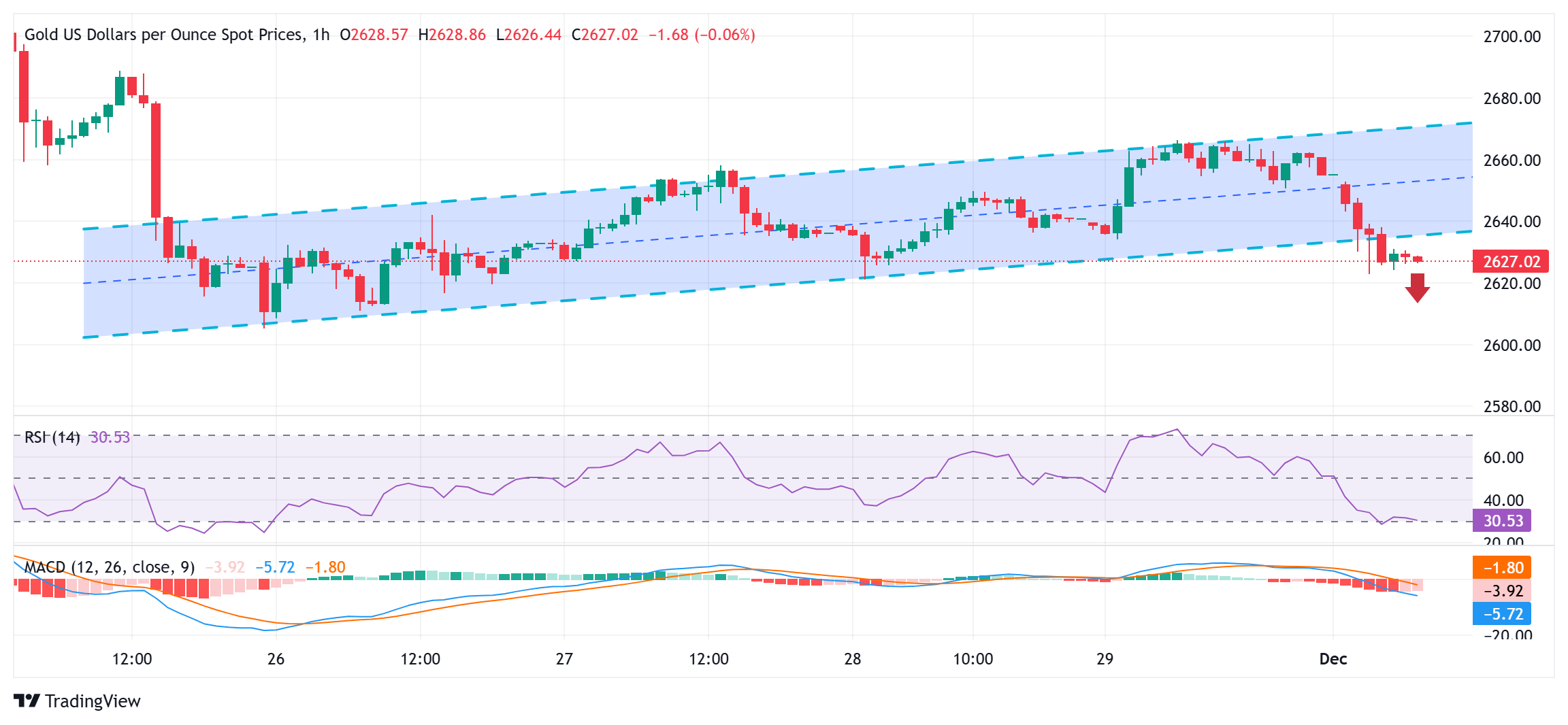
From a technical perspective, an intraday slide below the lower boundary of a nearly one-week-old descending channel could be seen as a key trigger for bearish traders. Moreover, oscillators on daily/4-hour charts have again started gaining negative traction and suggest that the path of least resistance for the Gold price is to the downside. Hence, a subsequent fall back towards last week's swing low, around the $2,605 region, looks like a distinct possibility. Some follow-through selling below the $2,600 mark would expose the 100-day Simple Moving Average (SMA), currently pegged near the $2,575 region.
On the flip side, the ascending trend-channel support breakpoint, around the $2,642-2,643 area, might now act as an immediate hurdle ahead of the $2,652 static resistance and last Friday's swing high, around the $2,665 region. Some follow-through buying should allow the Gold price to reclaim the $2,700 round-figure mark and extend the positive move further towards the $2,721-2,722 supply zone. The latter should act as a pivotal point, which if cleared decisively will suggest that the recent corrective decline from the all-time peak touched in October has run its course and pave the way for a further appreciating move.
Gold FAQs
Gold has played a key role in human’s history as it has been widely used as a store of value and medium of exchange. Currently, apart from its shine and usage for jewelry, the precious metal is widely seen as a safe-haven asset, meaning that it is considered a good investment during turbulent times. Gold is also widely seen as a hedge against inflation and against depreciating currencies as it doesn’t rely on any specific issuer or government.
Central banks are the biggest Gold holders. In their aim to support their currencies in turbulent times, central banks tend to diversify their reserves and buy Gold to improve the perceived strength of the economy and the currency. High Gold reserves can be a source of trust for a country’s solvency. Central banks added 1,136 tonnes of Gold worth around $70 billion to their reserves in 2022, according to data from the World Gold Council. This is the highest yearly purchase since records began. Central banks from emerging economies such as China, India and Turkey are quickly increasing their Gold reserves.
Gold has an inverse correlation with the US Dollar and US Treasuries, which are both major reserve and safe-haven assets. When the Dollar depreciates, Gold tends to rise, enabling investors and central banks to diversify their assets in turbulent times. Gold is also inversely correlated with risk assets. A rally in the stock market tends to weaken Gold price, while sell-offs in riskier markets tend to favor the precious metal.
The price can move due to a wide range of factors. Geopolitical instability or fears of a deep recession can quickly make Gold price escalate due to its safe-haven status. As a yield-less asset, Gold tends to rise with lower interest rates, while higher cost of money usually weighs down on the yellow metal. Still, most moves depend on how the US Dollar (USD) behaves as the asset is priced in dollars (XAU/USD). A strong Dollar tends to keep the price of Gold controlled, whereas a weaker Dollar is likely to push Gold prices up.
Read more
* The content presented above, whether from a third party or not, is considered as general advice only. This article should not be construed as containing investment advice, investment recommendations, an offer of or solicitation for any transactions in financial instruments.


