


VTI vs. QQQ: Here's the ETF I'd Personally Buy and Hold for Decades
Key Points
The Invesco QQQ Trust is one of the best ETFs to invest in major tech names and AI stocks.
Vanguard research predicts that U.S. small caps and value stocks could outperform U.S. large caps and growth stocks in the next 10 to 30 years.
The Vanguard Morningstar Total Stock Market ETF offers a more diversified portfolio than QQQ, which could help investors capture gains from future non-tech winners in the AI economy.
- 10 stocks we like better than Vanguard Morningstar Total Stock Market ETF ›
When it comes to investing, it's often said that "past performance does not guarantee future results." Just because a stock or exchange-traded fund (ETF) has performed well in the past doesn't mean it will be the best investment going forward. Investing is about the future. People constantly make decisions about where to put their money to work based on what they think will happen next, not what already happened.
The tech-heavy Nasdaq-100 index is a good example. It has been one of the best investments of the past 10 to 15 years. During the past 10 years, the Invesco QQQ Trust (NASDAQ: QQQ), an ETF that tracks the Nasdaq-100, has delivered an average annual total return of 20.5%. "The Qs" ETF has strongly outperformed the S&P 500 (SNPINDEX: ^GSPC) during that time.
Missed Nvidia in 2009? This Rare Signal Is Flashing Again. In 2009, a "Double Down" signal flashed for a little-known chipmaker called Nvidia. For the first time in years, that same "Total Conviction" signal is flashing for a company 1/100th the size of Nvidia. Continue »
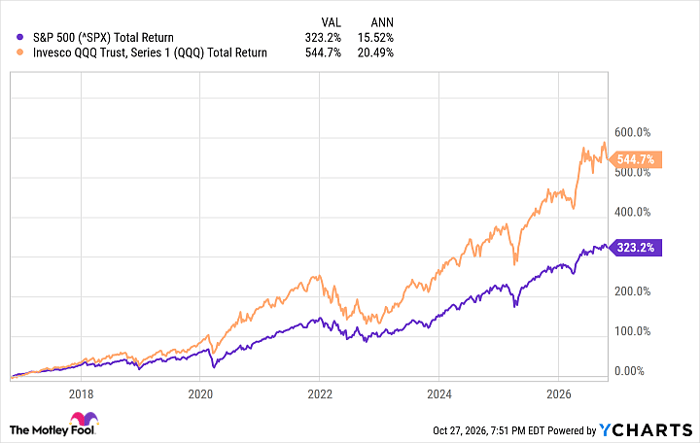
Data by YCharts.
The past performance of this Nasdaq-100 ETF has been phenomenal, right? Here's the thing: I'm concerned about future returns. When I consider new investments, I plan for the long run -- like 20 years or longer. I believe it's unlikely that U.S. tech stocks will maintain their recent track record of outperformance. There's another ETF that I like better than QQQ for the next few decades.
Let's look at why I'm investing in the Vanguard Morningstar Total Stock Market ETF (NYSEMKT: VTI) -- not QQQ -- for decades to come.

Image source: Getty Images.
Why buy VTI instead of QQQ? Slower growth for growth stocks
If you believe that today's biggest winners of the artificial intelligence (AI) boom are likely to keep winning for years to come, then you might want to buy the Invesco QQQ Trust. That tech ETF gives you a targeted way to own the biggest, most profitable tech companies.
But I'm not convinced that those 100 major tech names will be the best stocks to own for the next few decades. Recent Vanguard research projects that the ultimate winners of AI might not be today's AI stocks. As Vanguard's global head of capital market research, Qian Wang, said in a recent interview: "If AI truly transforms the economy, the ultimate winners may be the AI's end users that improve productivity without bearing the upfront investment."
In other words, it might not be the tech companies that are building AI tools today (and spending hundreds of billions of dollars on AI data centers) that deliver the biggest stock market returns tomorrow. Instead, it might be smaller companies, value-stock companies, and less tech-intensive industries that win the most from AI. The best investments today might be stocks and sectors that have been overlooked or underpriced while most investors focused all their energy on tech.
Vanguard's outlook for financial markets expects that U.S. small-cap stocks and value stocks will outperform U.S. large-cap and growth stocks for the next 10 years and 30 years. I want to own all those types of stocks, not just tech. The Vanguard Morningstar Total Stock Market ETF lets me do that.
Data by YCharts.
VTI: Thousands of stocks of all sizes, 9.57% annualized returns for 25 years
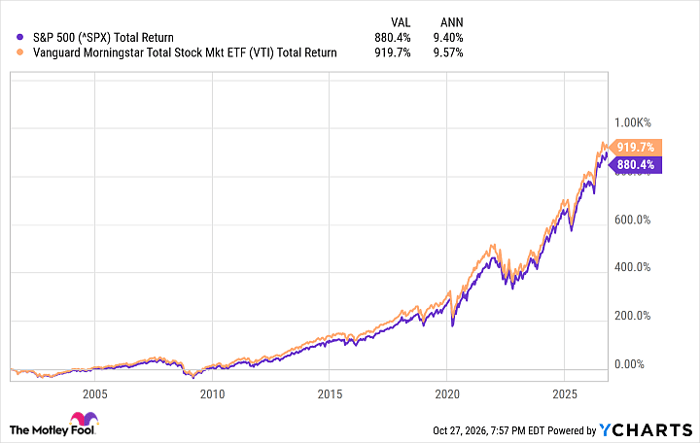
The Vanguard Morningstar Total Stock Market ETF (VTI) offers what might be the most diversified way to own "all the stocks" in the U.S. stock market. It holds 3,519 stocks, including small caps and mid-caps. VTI has been around since its inception in May 2001, and it's delivered 9.57% average annual returns over the past 25 years (compared to the S&P 500's 9.4% annual average gains). That's an impressive return that is enough to build serious wealth for long-term investors.
Even if VTI doesn't beat QQQ in the future, this exceptionally well-diversified ETF is worth owning. I'm going to keep buying it.
Should you buy stock in Vanguard Morningstar Total Stock Market ETF right now?
Before you buy stock in Vanguard Morningstar Total Stock Market ETF, consider this:
The Motley Fool Stock Advisor analyst team just identified what they believe are the 10 best stocks for investors to buy now… and Vanguard Morningstar Total Stock Market ETF wasn’t one of them. The 10 stocks that made the cut could produce monster returns in the coming years.
Consider when Netflix made this list on December 17, 2004... if you invested $1,000 at the time of our recommendation, you’d have $337,166!* Or when Nvidia made this list on April 15, 2005... if you invested $1,000 at the time of our recommendation, you’d have $1,339,143!*
Now, it’s worth noting Stock Advisor’s total average return is 904% — a market-crushing outperformance compared to 213% for the S&P 500. Don't miss the latest top 10 list, available with Stock Advisor, and join an investing community built by individual investors for individual investors.
See the 10 stocks »
*Stock Advisor returns as of October 29, 2026.
Ben Gran has positions in Vanguard Morningstar Total Stock Market ETF. The Motley Fool has no position in any of the stocks mentioned. The Motley Fool has a disclosure policy.
Recommended Articles


