


Alphabet Stock Forecast: GOOGL Drops 10% After Hours as Cash Burn Overshadows Cloud's 103% Growth
TradingKey - Alphabet (NASDAQ: GOOGL) fell about 10% after hours on Wednesday, October 28, to around $292.50, after its third-quarter report missed estimates for both revenue and earnings. The stock had closed the regular session at $324.89, up 1.34%, and touched about $290 after the release.
Google Cloud revenue more than doubled, yet the stock fell because Alphabet burned cash for a second straight quarter and said capex, its spending on data centers, chips and equipment, will "increase significantly" in 2027. Investors now want to know when that spending turns into cash.
Q3 Results: A Miss on Both Lines
Revenue rose 25% to $127.58 billion, just short of the roughly $127.9 billion analysts expected. EPS fell to $2.12 from $2.87 a year earlier, far below the $3.01 estimate.
An $8.7 billion paper loss on equity investments, meaning a drop in the value of stakes it still holds, cut 55 cents from EPS. Even without it, EPS of about $2.67 would have missed. Operating income rose 30% to $40.6 billion, but the operating margin, the share of revenue left after operating costs, slipped to 31.8% from 34% in Q2.
Google Cloud More Than Doubled
Cloud revenue jumped 103% to $30.7 billion, faster than 82% in Q2. Its operating income more than tripled to $11.1 billion, lifting its margin to 36.2% from 23.7% a year ago. Cloud now produces more than a quarter of Alphabet's operating income, making it a second major profit source. Its backlog, contracted revenue not yet booked, rose to $561 billion from $514 billion in Q2.
Search Growth Slowed
Search and other revenue grew 12% to $63.35 billion, down from 17% in Q2, and YouTube ads grew 9% to $11.21 billion, down from 13%. CEO Sundar Pichai said searches grew at their fastest pace in five years, yet revenue slowed. That gap revives the worry that AI answers could weigh on Search ads, Alphabet's biggest revenue source.
Capex Now Exceeds Operating Cash Flow
Capex hit a record $51.4 billion, more than double the $24.0 billion a year earlier. Operating cash flow was $42.3 billion, so free cash flow, the cash left after capital spending, came in at negative $9.1 billion, after negative $5.9 billion in Q2.
Alphabet kept its 2026 capex guide at $195 billion to $205 billion. CFO Anat Ashkenazi said the 2027 details will come on the Q4 call, and Motley Fool puts next year's figure near $300 billion.
Outside Money Is Funding the Buildout
Alphabet raised $12.4 billion from new shares and $28.7 billion from bonds, meaning borrowed money, in Q3. That followed a June equity raise that included $10 billion from Berkshire Hathaway. It bought back no stock, versus $11.5 billion a year earlier, so its share count is now rising.
Meta priced $37.5 billion of new stock and preferred shares on October 27 for the same reason. Microsoft, which also reported Wednesday, rose nearly 3% after hours. In my view, investors now judge AI spenders on cash flow as much as on demand.
What to Watch Next
Amazon reports after the close on Thursday, October 29, giving another read on AI spending. For Alphabet, the next test is the formal 2027 capex guide.
Alphabet Technical Analysis: After-Hours Drop Puts GOOGL Below $316.84 Support
The 4-hour chart shows the damage. Before the report, buyers stepped in at $316.84 after the October 21 break below a triangle, a narrowing price pattern, and GOOGL closed just under $326.80. That is the 23.6% Fibonacci level, meaning the stock had recovered 23.6% of its drop from the recent high. If the after-hours drop holds at the open, price will gap below $316.84 and $310.55 and sit far under both moving averages, which track the average price over a set period.
RSI, a momentum gauge that runs from 0 to 100, had recovered to about 39 at the close after dipping below 30, the oversold line, and a gap this size would likely push it back there.
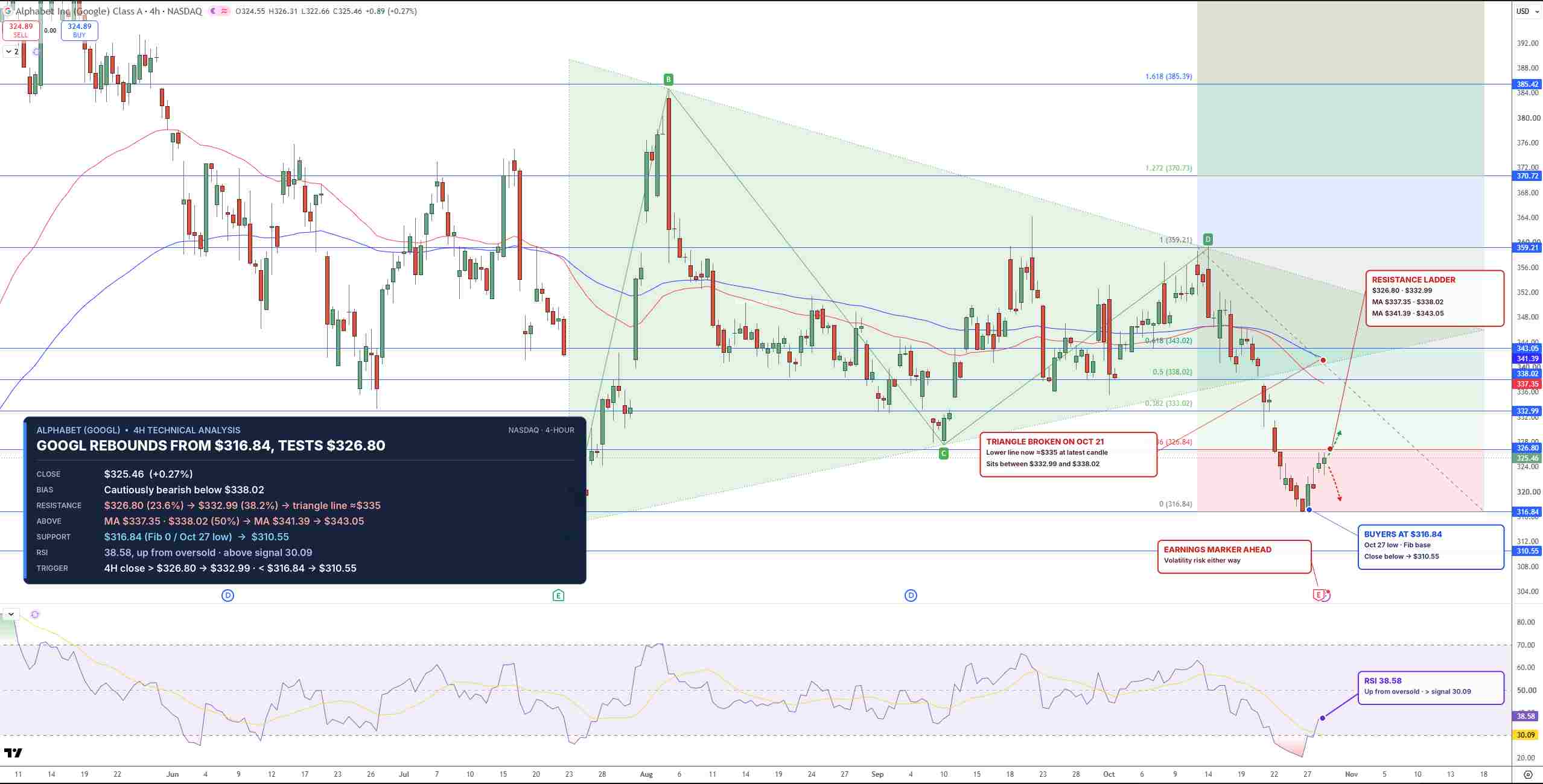
GOOGL Price Chart - Source: Tradingview
Broken support often turns into resistance, where selling stops rallies, so $310.55 and $316.84 become the first hurdles. GOOGL needs a 4-hour close back above $316.84 to repair the damage, which would reopen $326.80. On the downside, the after-hours low near $290 is the first test, and a break below it opens the way toward the $264.28 52-week low.
I'm bearish while GOOGL stays below $316.84, though an oversold bounce toward $310.55 is possible after such a large gap.
Key Levels
- Last close: $324.89, up 1.34% on October 28 (about $292.50 after hours)
- Support: $290, $264.28
- Resistance: $310.55, $316.84, $326.80, $337.35 to $341.39
- RSI: 38.58 at the close, before the after-hours drop
- Bullish trigger: 4-hour close above $316.84
- Bearish trigger: 4-hour close below $290
FAQs
Why did Alphabet stock fall after earnings?
Alphabet fell about 10% after hours because it missed revenue and EPS estimates, posted negative free cash flow of $9.1 billion and said capex will increase significantly in 2027, outweighing Cloud's 103% growth.
What is the Alphabet stock forecast now?
The bias is bearish below $316.84 on the 4-hour chart. A 4-hour close below $290 would open the way toward the $264.28 52-week low, while a close back above $316.84 would reopen $326.80.
Bottom Line
Cloud is delivering the growth investors wanted, but Alphabet now spends more cash than it brings in, and 2027 capex is set to rise further. The level that matters is $316.84, where buyers held before the report. I expect GOOGL to stay under pressure below it, and only a 4-hour close back above that level would suggest the drop went too far.
Recommended Articles


