


Nvidia Looks Cheap. Here's 1 Reason I'd Still Be Cautious.
Key Points
Nvidia's price-to-earnings ratio is still nearly average for the S&P 500 despite its huge revenue growth.
Most of the chipmaker's revenue comes from just a few sources.
The state of the AI industry today bears a concerning resemblance to how the tech sector looked just before the dot-com boom transitioned into the dot-com bust.
- 10 stocks we like better than Nvidia ›
Much, if not most, of the credit for the current artificial intelligence (AI) boom belongs to Nvidia (NASDAQ: NVDA). Since the stock hit a cyclical low a little bit more than four years ago, it has risen by more than 1,700%, driven higher by the tech sector's insatiable demand for its graphics processing units -- the accelerators that power most AI data centers.
Despite that remarkable stock price increase, Nvidia trades now at a price-to-earnings (P/E) ratio of 27. That's just above the current S&P 500 average of 26. Given that it is still delivering annual revenue growth that is often in the triple-digit percentages, that factor in itself may persuade investors to buy the stock.
Missed AI’s "Act 1"? Act 2 Could Be 15x Bigger. Most investors think they missed the AI boat because they didn't buy Nvidia in 2005. But according to our analysts, we’re only at the end of "Act 1"—the R&D phase. "Act 2" is the global rollout. Continue »
Nonetheless, investors may want to take a more cautious approach. Here's why.
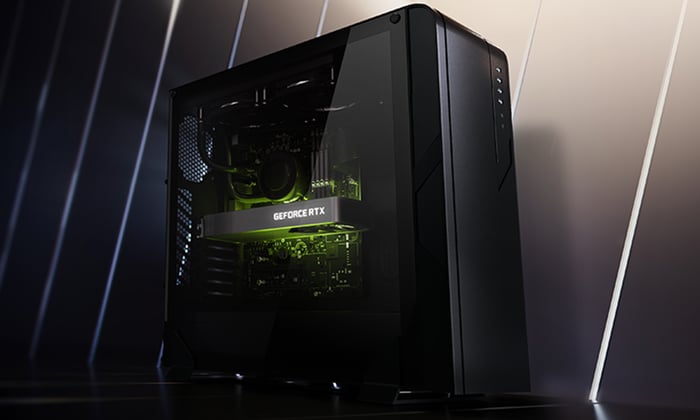
Image source: Nvidia.
Nvidia's unprecedented growth
As companies grow larger, they must produce larger volumes of absolute growth to achieve the same percentage rates of increase. Thus, growth expectations for companies tend to fall (in percentage terms) as market caps reach into the trillions.
Despite its $5.3 trillion market cap, Nvidia has been defying the math. In its fiscal 2027 second quarter (which ended July 26), its $96.2 billion in quarterly revenue increased by 106%.
That was not a fluke. Revenue rose by 65% in fiscal 2026, and analysts forecast a 91% increase in fiscal 2027.
Additionally, Nvidia has been delivering this growth without the need for the type of massive capital expenditures that have weighed on the stocks of hyperscalers like Amazon. Over its past four quarters, Nvidia spent just $7.4 billion in capex, far below the $108 billion Amazon spent in its past four quarters.
Why the growth might be concerning
However, the chip stock's low P/E ratio may indicate that investors are increasingly skeptical over the nature of its growth.
Nvidia noted in its August 10-Q report to the Securities and Exchange Commission that just five customers accounted for 70% of its accounts receivable balance. That lack of revenue diversification contributed to my decision to change my view on Nvidia stock from a buy to a hold.
Meanwhile, Nvidia faces charges that it's engaging in circular financing, as its sales often come from companies where Nvidia is investing capital, and to which it offers credit support, such as loan guarantees, to drive sales.
Nvidia has given such support to what is arguably the most prominent neocloud, CoreWeave. Nvidia owns shares of CoreWeave, and the graphics processing units (GPUs) it sells to CoreWeave are used to back CoreWeave's debt. Nvidia has also agreed that if CoreWeave has any data center capacity that's going unsold, it will buy that capacity.
Nvidia provides similar types of support to OpenAI and Anthropic. It owns stakes in both AI labs and, in OpenAI's case, provides it with capital to fund its build-outs.
Investors have to wonder how much revenue growth Nvidia would generate if it were not supplying this kind of financial help to its customers.
Long-time investors might remember how circular financing deals during the dot-com boom contributed to the demise of Nortel and Lucent. Those companies had to write off billions of dollars in loans after the companies they'd been lending to declared bankruptcy. The same thing happened to Cisco, and although it survived, its stock struggled for decades until the recent data center construction boom revived its sales growth.
The boom in AI-related capex has also spurred massive borrowing. Even Amazon, which routinely generated tens of billions of dollars in annual free cash flow in past years, has had to resort to borrowing to bankroll its infrastructure spending.
Its worth remembering that a period of rising interest rates helped end the dot-com boom. Today, the AI boom is in danger of meeting a similar fate as interest rates again tick higher.
Admittedly, AI is likely here to stay, and as the leading AI accelerator company, Nvidia is unlikely to suffer to the same extent that Cisco did. Investors just need to remember that history often repeats itself, and if its customer-financing approach comes back to haunt it, that could bring significant pain to shareholders.
Nvidia stock is likely a hold
Investors should refrain from adding shares of Nvidia to their portfolios despite its rapid growth and relatively low valuation.
True, the company helped spur an AI growth revolution, and even if a bust happens, its AI accelerators could continue to drive revenues for years to come.
Nonetheless, it is increasingly apparent that most of its rapid growth has come from just a few sources, and those sources may depend on Nvidia's own support to swing their purchases. As the dot-com era ended, such an approach led to a significant slowdown for Cisco, and amid rising interest rates, I've turned more cautious on Nvidia.
Ultimately, Nvidia should continue to bolster AI growth, but given the danger that its financing approach could lead to an industry slowdown, now may not be the best time to buy more shares.
Should you buy stock in Nvidia right now?
Before you buy stock in Nvidia, consider this:
The Motley Fool Stock Advisor analyst team just identified what they believe are the 10 best stocks for investors to buy now… and Nvidia wasn’t one of them. The 10 stocks that made the cut could produce monster returns in the coming years.
Consider when Netflix made this list on December 17, 2004... if you invested $1,000 at the time of our recommendation, you’d have $337,166!* Or when Nvidia made this list on April 15, 2005... if you invested $1,000 at the time of our recommendation, you’d have $1,339,143!*
Now, it’s worth noting Stock Advisor’s total average return is 904% — a market-crushing outperformance compared to 213% for the S&P 500. Don't miss the latest top 10 list, available with Stock Advisor, and join an investing community built by individual investors for individual investors.
See the 10 stocks »
*Stock Advisor returns as of October 29, 2026.
Will Healy has no position in any of the stocks mentioned. The Motley Fool has positions in and recommends Amazon, Cisco Systems, and Nvidia. The Motley Fool has a disclosure policy.
Recommended Articles


