


5 Quantum Computing Stocks Investors Should Be Watching in 2027
Key Points
Government support will be a major swing factor, and several of these companies are counting on funding agreements that have not yet closed.
The quantum technology field is getting crowded fast, and companies' valuations are running far ahead of the revenue they actually book.
Quantum cybersecurity and sensing may become the first profitable uses of quantum technology, while commercially viable quantum computing waits for the error correction problem to be solved.
- 10 stocks we like better than Infleqtion ›
For many years, quantum computing was little more than a weird, niche lab project that investors read about, but that relatively few bought into. 2026 changed that. A wave of companies went public through mergers and listings, and names most people ignored a year ago now carry market values in the billions. Some of them build actual quantum computers. Others make the lasers, chips, and security tools that those machines need.
Here are five I think deserve a spot on your quantum computing stock list heading into 2027, with what each company is doing and where the trouble spots are.
Missed AI’s "Act 1"? Act 2 Could Be 15x Bigger. Most investors think they missed the AI boat because they didn't buy Nvidia in 2005. But according to our analysts, we’re only at the end of "Act 1"—the R&D phase. "Act 2" is the global rollout. Continue »
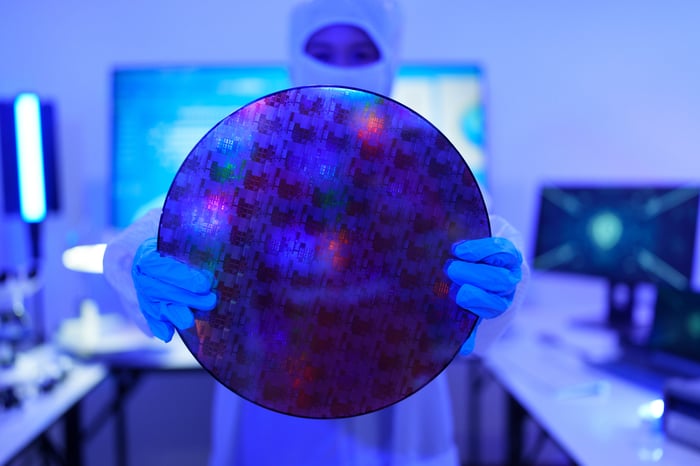
Image source: Getty Images.
1. Quantum Computing
Quantum Computing Inc. (NASDAQ: QUBT) started as a small software operation, but it's a much different business now. Through a series of acquisitions, including Luminar Semiconductor, it runs its own chip manufacturing and offers foundry services for thin-film lithium niobate chips. Those chips transmit data via pulses of light rather than electricity, which increases signal speed and generates less heat. As of its last quarterly report, the company had about $1.3 billion in cash and investments on its books, which gives it some room to keep buying.
The concern for investors is that most of its growth has come from those acquisitions. First-quarter revenue jumped from $39,000 to $3.7 million, a rise the company tied to its purchase of Luminar Semiconductor, and it has spent about $180 million in cash on acquisitions so far this year. The question is how well all of these acquired businesses will fit together and whether customers will pay for the result.
2. Infleqtion
Infleqtion (NYSE: INFQ) joined the stock market in February via a merger with a Churchill Capital SPAC, raising more than $550 million in the process. Its approach to the key question of how to create qubits -- the basic units of information in a quantum computer -- is relatively uncommon. It's using neutral atom qubits -- each one made of a single atom held in place and manipulated with lasers. The company has said it expects to demonstrate a quantum computer with 30 logical qubits this year.Each logical qubit is built from many physical ones (a necessity for robust error correction and prevention), and that is where the field gets hard, per Post Quantum.
However, the sensing business Infleqtion is building is the piece of the company I find more interesting. In April, it made its precision timing product, built in partnership with Safran, available to defense, telecom, and infrastructure customers. It also holds more than $20 million in contracted NASA funding for its gravity gradiometer work. That means it's booking revenues from hardware that its customers can use now while it continues to work on developing its larger computers.
3. Xanadu
Xanadu (NASDAQ: XNDU) went public in March through a merger with Crane Harbor Acquisition Corp., a deal which brought in about $302 million. It describes itself as the first publicly traded pure-play photonic quantum computing company. Its plan depends on up to about $285 million in funding from the governments of Canada and Ontario. These agreements are still under negotiation. Whether they close will shape how much the company can spend before it has to go back to the equity market again to raise funds. Its shares have fallen from a 52-week high above $40 to the mid-single digits, a reminder of how quickly sentiment can turn for newly public companies booking little revenue and consistent bottom-line losses.
4. IQM
Finland-based IQM Quantum Computers (NASDAQ: IQMX) began trading on July 2 after its merger with Real Asset Acquisition Corp., a SPAC deal that valued the company around $1.9 billion. It is the first European quantum computer maker on a major U.S. exchange.
I think its best argument is political. European governments have made technological sovereignty a stated priority, and that includes quantum tech. France's defense procurement agency is running a competition among five European hardware makers, per Post Quantum. That gives a company like IQM a path to home-market customers, though no European Union rule yet requires buyers to favor European vendors. But IQM faces rivals with deeper pockets, so 2027 could be rocky before it becomes positive.
5. SEALSQ
Switzerland-based SEALSQ (NASDAQ: LAES) does not build quantum computers. It makes security chips designed to resist attacks from future quantum computers, a category often called post-quantum security. This is the less glamorous side of the theme and, to my eye, the nearer-term one. France and the United States have moved toward post-quantum standards, so chipmakers need products now. For the first three quarters of 2026, the company reported total revenue of $16.3 million, up 65% year over year, and a pipeline of more than $200 million through 2029. As of Sept. 30, it had about $463 million in cash and equivalents on the books. The risk is that its revenues remain small, and it's dependent on government and enterprise timelines that tend to slip. Make investing decisions regarding this small-cap with a skeptical mind.
What to watch in 2027
Several checkpoints should tell you more than any stock chart. Watch whether Xanadu's government funding deals close, whether Infleqtion hits its logical qubit target, whether Quantum Computing Inc. turns its acquisitions into revenue, whether IQM grows its customer base, and whether SEALSQ converts its pipeline into signed contracts. These are small, lesser-known quantum companies, and they trade on narrative as much as on results, so expect large swings in both directions, and invest accordingly.
Should you buy stock in Infleqtion right now?
Before you buy stock in Infleqtion, consider this:
The Motley Fool Stock Advisor analyst team just identified what they believe are the 10 best stocks for investors to buy now… and Infleqtion wasn’t one of them. The 10 stocks that made the cut could produce monster returns in the coming years.
Consider when Netflix made this list on December 17, 2004... if you invested $1,000 at the time of our recommendation, you’d have $337,166!* Or when Nvidia made this list on April 15, 2005... if you invested $1,000 at the time of our recommendation, you’d have $1,339,143!*
Now, it’s worth noting Stock Advisor’s total average return is 904% — a market-crushing outperformance compared to 213% for the S&P 500. Don't miss the latest top 10 list, available with Stock Advisor, and join an investing community built by individual investors for individual investors.
See the 10 stocks »
*Stock Advisor returns as of October 29, 2026.
Micah Zimmerman has no position in any of the stocks mentioned. The Motley Fool has no position in any of the stocks mentioned. The Motley Fool has a disclosure policy.
Recommended Articles


