


Microsoft Stock Price Forecast: Stock Nears $550 After Earnings Beat, Next Target Expected to Reach $600
TradingKey - On October 29, Microsoft (MSFT) saw its stock price move significantly higher in after-hours trading following the release of its earnings report. Microsoft shares closed at $531.01 on October 28, down slightly by 0.06%, but surged over 3% in after-hours trading after the earnings release, briefly approaching $550, just shy of its all-time high of $555.45.
Why Is Microsoft Stock Rising?
According to the latest financial report, for the first quarter of fiscal year 2027 ended September 30, 2026, Microsoft reported revenue of $92.28 billion, up 19% year-over-year and beating market expectations of around $90.6 billion; operating income reached $45.9 billion, a year-over-year increase of 21%. GAAP net income was $36.6 billion, up 32% year-over-year, with diluted earnings per share of $4.92. Excluding the impact of the OpenAI investment, adjusted EPS was $4.89, also topping market expectations of approximately $4.73.
In terms of cloud computing, it remained the primary driver of growth this quarter. Microsoft Cloud revenue reached $63.9 billion, up 30% year-over-year; Azure revenue rose 48% year-over-year to $33.17 billion, exceeding both market expectations of $32.84 billion and the company's prior growth guidance. Microsoft's commercial remaining performance obligation (RPO) surged 73% year-over-year to $677 billion, indicating that the volume of signed enterprise customer contracts not yet recognized as revenue continues to expand.
Regarding cash flow, capital expenditures in the first fiscal quarter reached $45.2 billion, up from $34.9 billion in the same period last year, but below the company's prior expectation of around $50 billion. Microsoft stated that this was mainly related to delays in the delivery of some third-party computing capacity and does not mean the company is scaling back its AI infrastructure investment plans. Meanwhile, the company's free cash flow for the quarter reached $18.6 billion, significantly higher than market expectations of about $8.5 billion.
The financial report indicates that Microsoft remains in a high capital expenditure phase, but Azure revenue growth and cash flow have not shown significant signs of deterioration for now. Particularly as investors have recently focused more on the return on AI investments for Big Tech, Microsoft's Azure and free cash flow figures for this quarter provided key support for the stock's post-earnings rise.
Meanwhile, next-quarter guidance further supported the stock's rally. Microsoft expects second-quarter Azure revenue to grow 49% to 50% year-over-year, higher than market expectations of around 47.6%; the company projects total quarterly revenue of $96.0 billion to $97.1 billion, also above market forecasts of approximately $95.6 billion.
Microsoft Stock Price Technical Analysis
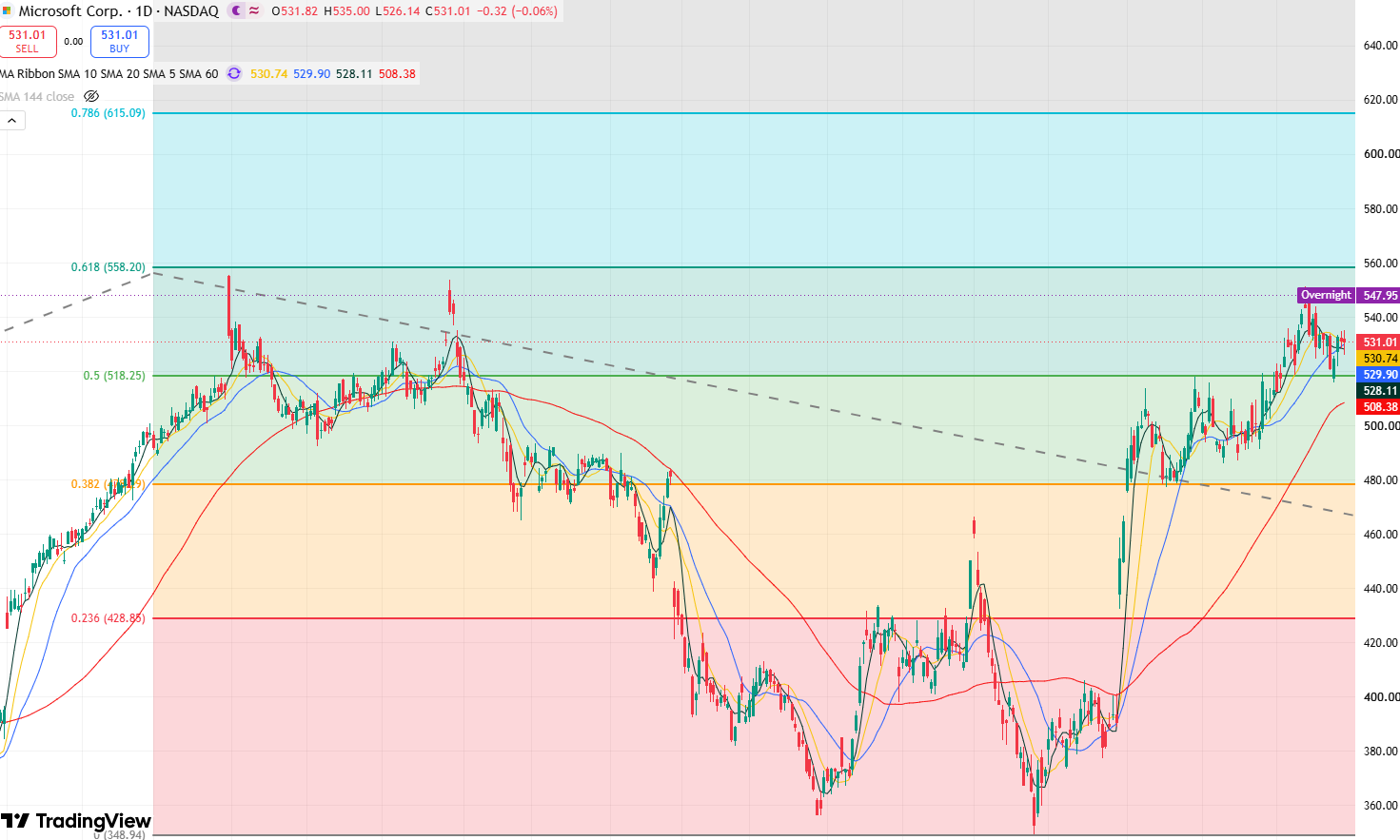
Microsoft stock price daily chart, Source: TradingView
Looking at the daily chart of Microsoft's stock price, the trend over the past four months shows a clear and strong upward trajectory. Although the stock recently pulled back after testing the $550 resistance level, it rebounded after retreating to support near $518. Boosted by positive earnings, the stock touched near $550 again, significantly strengthening short-term bullish momentum.
Currently, if the stock price can sustain yesterday's after-hours trend at today's open, it will continue to test $550-$555.45 to the upside. If the stock can effectively break through and hold above its previous all-time high of $555.45, it will further open up upside potential toward $600-$615.
Conversely, if the stock continues to face pressure below $550-$555.45, it may continue to pull back downward. The primary downside support to monitor is near $518. If it continues downward, the stock may test support at the 60-day moving average near $500. If this level fails to hold, the stock could fall further toward the support level around $480.
Recommended Articles


