




Amazon has joined the $3 trillion club — is AWS finally proving the AI spend is working?

Amazon shares have pushed the company past a US$3 trillion market valuation for the first time ever after its second-quarter results gave investors the clearest sign yet that its vast AI infrastructure spending is translating into demand.
Quarterly revenue rose 20% to US$200.6 billion, taking Amazon past the US$200 billion mark for the first time. Operating income climbed 43% to US$27.5 billion. The standout result came from Amazon Web Services (AWS), where revenue rose 36.7% to US$42.2 billion, its fastest growth in 18 quarters.
For Australian traders watching US technology shares, the more important development is what sits behind that acceleration. AWS’s contract backlog reached US$496 billion, while Amazon said its AI services and custom-chip businesses had each passed a US$25 billion annual revenue run rate.
Amazon has responded by raising expected 2026 capital expenditure to US$220 billion, up from US$200 billion previously. Management says it still cannot meet all customer demand this year, with most AWS capacity for 2027 already reserved and substantial 2028 capacity also committed.
The market is now reassessing Amazon less as an online retailer with a cloud division and more as a major provider of the computing infrastructure required for the AI buildout.
AWS demand has changed the argument around Amazon’s AI spending
Big Tech’s AI spending has been a source of investor concern because data centres, servers and chips require enormous upfront investment. Amazon’s quarter did not remove that risk, but it gave the market more evidence that customers are prepared to pay for the capacity being built.
Contracts for Difference (CFDs) allow traders to take a view on Amazon’s share-price movements without owning the underlying shares. A long position may suit a view that cloud demand and AI revenue will keep supporting the re-rating, while a short position may suit a view that spending, valuation or profit-taking will outweigh the strong results.
The figures explain why Amazon’s share price reacted so strongly. They also explain why the next move may not be straightforward.
“Trade Amazon share-price movements with Mitrade ”
Why Amazon’s results still leave room for sharp share-price moves
AWS is growing faster, but Amazon is committing more cash than ever to keep that growth going. The next test is whether revenue and operating profit can continue to rise quickly enough to justify the cost of building capacity years before it opens.
The AI spend is real, not just a future plan: Amazon expects US$220 billion of capital expenditure this year, largely for data centres, chips and related infrastructure.
Free cash flow has turned negative: Trailing 12-month free cash flow was an outflow of US$7.6 billion, compared with an inflow of US$18.2 billion a year earlier. That shift reflects the scale of investment required.
The headline net-income number needs context: Net income reached US$62.6 billion, but included US$53.4 billion of non-operating income, primarily linked to Amazon’s investment in Anthropic. Operating income gives a cleaner read on the underlying business.
Backlog is encouraging, but capacity must be delivered: The US$496 billion backlog shows demand, yet Amazon must build and bring data centres online efficiently before that demand can become reported revenue.
Competition has not disappeared: Microsoft and Alphabet have also reported strong cloud growth and are spending heavily on AI infrastructure. AWS must maintain its momentum as customers compare cloud providers, models and custom-chip options.
For Australian traders, this makes Amazon more than a simple post-earnings momentum story. The share price may respond sharply to evidence that AWS is converting booked demand into revenue and margins, or to any sign that the spending cycle is outrunning returns.
How Mitrade helps traders respond to Amazon earnings volatility
Mitrade’s Amazon CFDs let traders focus on the market’s reaction to AWS growth, AI spending and future guidance without needing to buy the underlying US shares.
Take a view in either direction: Traders can go long if they expect AWS growth and AI demand to support AMZN shares, or short if they expect the capex burden or valuation concerns to trigger a pullback.
Respond to the whole Amazon story: A CFD position can reflect the combined market reaction to AWS, advertising, retail margins, free cash flow and investment plans rather than treating one headline metric in isolation.
Set risk before key updates: Stop-loss, take-profit and pending-order tools can help traders define a plan ahead of US inflation data, cloud-industry results or Amazon’s next earnings report.
Avoid converting a market view into share ownership: CFDs provide exposure to price movements without the capital required to purchase Amazon shares outright.
Amazon has provided powerful evidence that demand exists. The harder question is whether investors will continue rewarding the cost of supplying it.
“Trade Amazon share-price movements with Mitrade ”
What could drive the next move?
Several factors could determine whether Amazon’s post-results rally extends or starts to lose momentum.
AWS growth and margins: Investors will look for proof that AWS can sustain its faster growth rate while retaining the high profitability that makes it central to Amazon’s valuation.
Capital-spending updates: Any further lift in the US$220 billion spending forecast, or signs that data-centre costs are rising faster than expected, could revive concerns around cash flow.
AI and custom-chip adoption: Progress with Trainium, Bedrock and large customer commitments will help show whether Amazon’s AI revenue can keep expanding beyond its current run rate.
The US cloud-computing race: Results and guidance from Microsoft, Alphabet and other AI-infrastructure providers can influence expectations for AWS market share and pricing power.
Consumer and advertising demand: Amazon’s retail and advertising businesses remain important sources of revenue and profit, particularly if cloud-growth expectations become more demanding.
Broader technology-market sentiment: A rise in bond yields, a rotation away from growth shares, or concern over AI valuations can pressure AMZN even if Amazon’s underlying results remain strong.
Amazon’s next move may depend on whether the market continues to see US$220 billion of spending as a constraint on cash flow or as the price of meeting demand that competitors cannot yet satisfy.
Trade Amazon CFDs with Mitrade
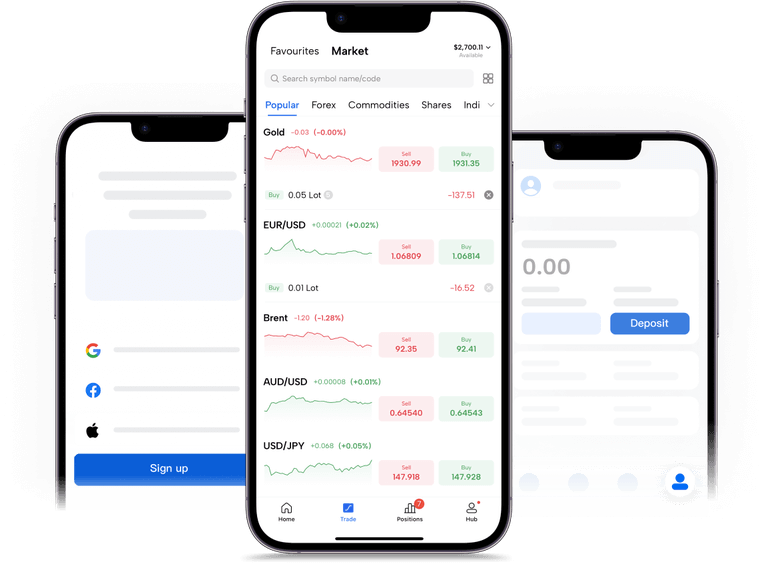
For traders following Amazon’s AI and cloud-driven growth story, Mitrade provides practical tools for responding to AMZN share-price movements:
Amazon share CFDs without owning the underlying stock
Long and short positions in rising or falling markets
Charts, pending orders, stop-losses and take-profit tools
An AUD-denominated account, with margin and profit or loss shown in Australian dollars
Mobile access for following US earnings and cloud-industry news
ASIC regulation and a free $50,000 demo account for practising before trading with real capital
CFDs are complex instruments and carry a high risk of losing money rapidly due to leverage. Traders should ensure they understand how CFDs work and consider whether they can afford the high risk of losing their money.
Start trading Amazon in three simple steps
Open an account: Register through the Mitrade homepage or use the fast sign-up process with an existing Google or Facebook account.
Fund in Australian dollars: Deposit initial margin using supported payment methods, including POLi or Visa/Mastercard.
Set a market view: Analyse Amazon’s chart, AWS updates and broader technology sentiment, set risk parameters and take a long or short CFD position.
Amazon’s results have changed the conversation around its AI spending, but the next test is whether the company can turn record demand into sustained cash flow and earnings growth. Open your Mitrade account today to be ready for the next major move.


1. Why is AWS so important to Amazon’s valuation?
AWS represented about 21% of Amazon’s quarterly sales but generated US$16.6 billion of its US$27.5 billion operating income. Its faster growth and higher margin mean changes in AWS demand can have an outsized effect on expectations for Amazon’s earnings.
2. How can traders manage risk when trading Amazon CFDs around earnings?
Amazon shares can move sharply when AWS growth, capital spending or guidance surprises the market. Mitrade traders can set stop-loss and take-profit levels before opening a position, helping define the potential downside and target ahead of volatile US trading sessions. However, fast market moves can still increase losses.
3. Can Australian traders take a position on Amazon without buying US shares?
Mitrade’s Amazon CFDs allow traders to take a long or short view on AMZN price movements without owning the underlying shares. The account can be funded in Australian dollars, with margin and profit or loss displayed in AUD.
Disclaimer: The content presented above, whether from a third party or not, is considered as general advice only. CFD trading involves significant risk of loss. Past performance does not guarantee future results. This article serves informational purposes only and does not constitute financial advice. Consider your risk tolerance before trading.


