




Best International Trading Platform Australia: 8 Best Brokers to Place Your Trades

The market for trading platforms in Australia has grown rapidly in the past decade, exceeding the $4 billion market according to the latest projections, primarily due to supportive regulations.
Traders in this country have access to some of the world’s best international trading platforms nowadays, as the Australian Securities and Investments Commission (ASIC) has issued licenses for these brokers that allow them to offer their services legally.
With such a diverse ecosystem of available apps, picking the right international trading platform could feel like an overwhelming task.
To help our readers in this endeavor, we came up with a list of the 8 best international trading platforms in Australia.
We focused primarily on five aspects for each of these brokers to rank them:
Confirming that they are regulated by ASIC.
Minimum deposit required to open an account.
The number of assets available for trading.
Commissions and fees.
Quick Comparison – Best International Trading Platforms in Australia (2026)
What to Look for in an International Trading Platform
Selecting a trading platform is a pretty important step for users who are getting started in their trading journey.
The assets that these platforms support, their fee structure, account types, and the tools they offer are some of the most relevant aspects to assess when deciding which of these providers is the best to open an account with.
Here’s a summary of what a new user should evaluate before depositing their money:
Regulatory status: ASIC is Australia’s financial regulator. They issue a permit called the Australian Financial Services License (AFSL) to authorize operators within the country to offer access to the financial markets. ASIC ensures that these companies comply with its strict regulatory framework, which includes maintaining segregated accounts, implementing negative balance protections, and more.
Fees and spreads: Most international trading platforms charge either a fixed or percentage-based fee per trade or collect money from bid/ask spreads. Depending on users’ preferences, this could be a key factor that influences their decision to go with one provider or the other.
Asset portfolio: The selection of trading assets offered by each platform is another element to keep in mind, as traders tend to focus on specific instruments like forex pairs (e.g., EUR/USD) or commodities (e.g., Gold).
Trading Interfaces: Web-based apps, desktop and mobile interfaces, and advanced terminals are the most common access points offered by international trading platforms in Australia. Experienced traders tend to choose the most advanced systems to support their operations, while beginners should go with the most user-friendly interfaces.
Analytical Tools: The best international trading platforms offer top-notch resources like charting tools, asset screeners, lot size calculators, and other similar features to make things easier for traders and allow them to identify the best opportunities in the market.
“Trade Global Markets with an ASIC-regulated broker. Fast AUD funding via PayID. ”
8 Best International Trading Platforms in Australia
#1 – Mitrade
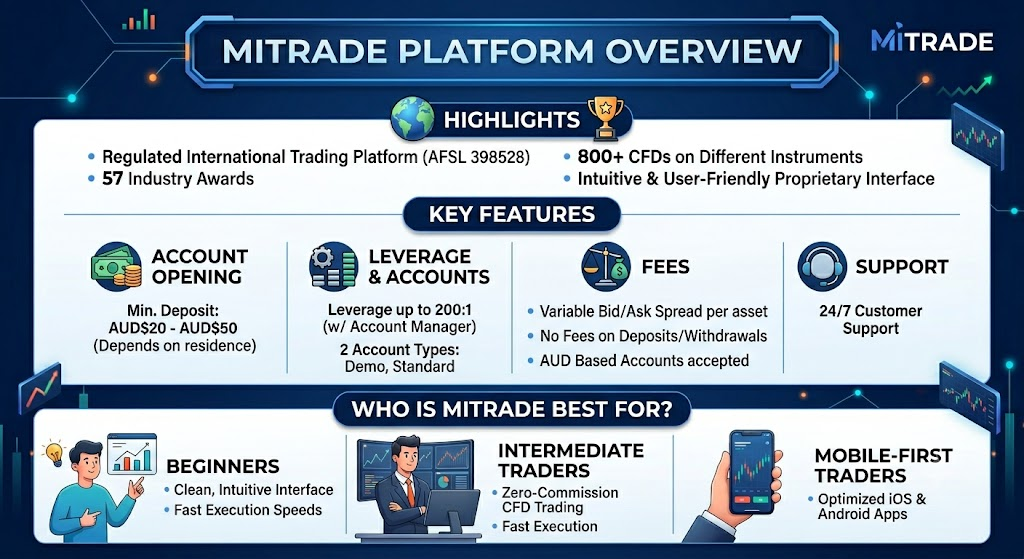
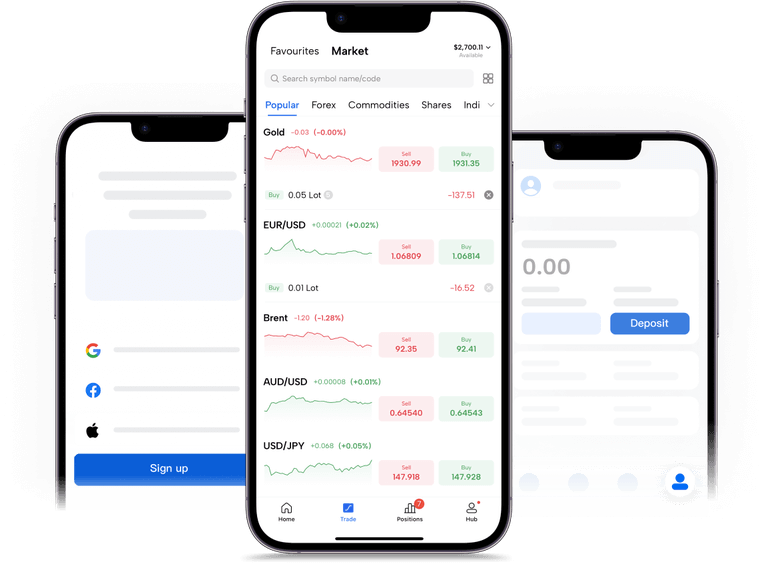
Mitrade offers one of the most intuitive and user-friendly trading platforms for Australian users. They developed a proprietary interface that simplifies the process of searching for assets by ticker symbol or category, estimating the right lot size, and executing a trade.
This is a regulated international trading platform (AFSL 398528) that has received 57 industry awards. Its asset portfolio includes over 800 different instruments that can be traded via contracts for difference (CFDs).
Key Features
Minimum deposit required to open an account: between AUD$20 and AUD$50, depending on the user’s country of residence.
Leverage ratios: up to 200:1 for users with a dedicated account manager.
Account types: Two (Demo and Standard).
Commissions & Fees: Mitrade collects a bid/ask spread that varies per asset.
Extra features: Mitrade supports 24/7 customer support, accepts deposits and accounts based in AUD, and does not charge any fees on deposits or withdrawals.
Who Is Mitrade Best For
Beginners who want a clean and highly intuitive trading interface without sacrificing transaction execution speeds.
Intermediate traders who enjoy zero-commission CFD trading with fast execution.
Mobile-first traders (iOS and Android apps).

 Enjoy simple and fast trading Flexible leverage options available Follow real-time trading strategies Demo account with $50,000 virtual funds

#2 – Pepperstone
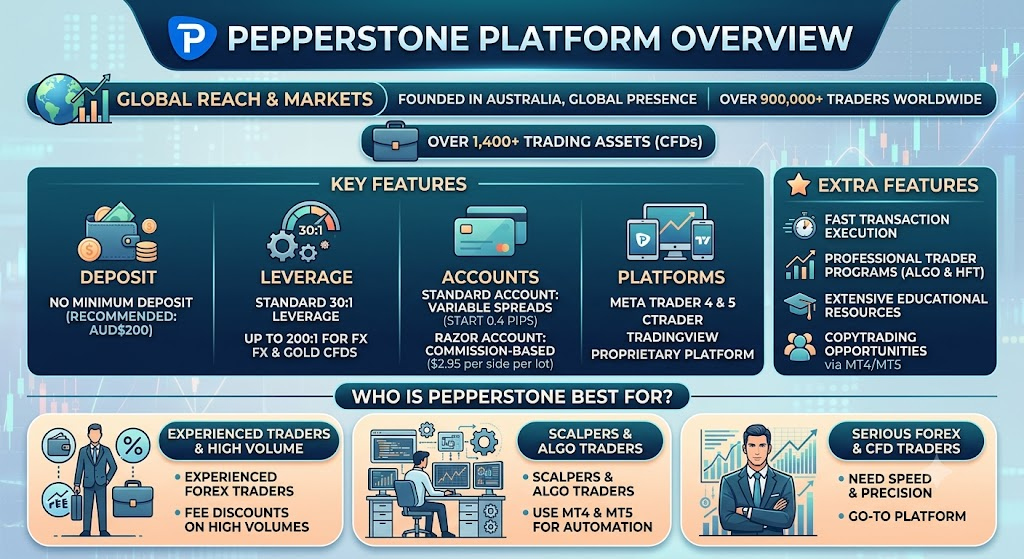
Pepperstone was founded in Australia, but it is now a large player in the international market, catering to more than 900,000 traders across the globe. It offers access to more than 1,400 trading assets through CFDs.
This broker supports trading via MetaTrader 4 and 5, cTrader, TradingView (via webhooks), and through a highly user-friendly proprietary trading platform as well.
Key Features
Minimum deposit required to open an account: No minimum deposit required, although Pepperstone recommends that traders start with at least AUD$ 200.
Leverage ratios: The usual 30:1 for most instruments. However, an expanded ratio of 200:1 is accessible for FX and gold CFDs.
Account types: Standard account (variable spreads starting at 0.4 pips) and Razor accounts featuring a flat commission of $2.95 per standard lot, per side.
Commissions & Fees:
Extra features: fast transaction execution speeds, special programs for professional traders (algorithmic traders and high-frequency traders), extensive library of educational resources, access to copytrading opportunities via MT4 and MT5.
Who Is Pepperstone Best For
Experienced forex traders and deep-pocketed players who benefit from their fee discounts on high trading volumes.
Scalpers and algo traders who use MT4 and MT5 to automate their executions.
The go-to platform for serious forex and CFD traders who need speed and precision above all else.
#3 – Interactive Brokers
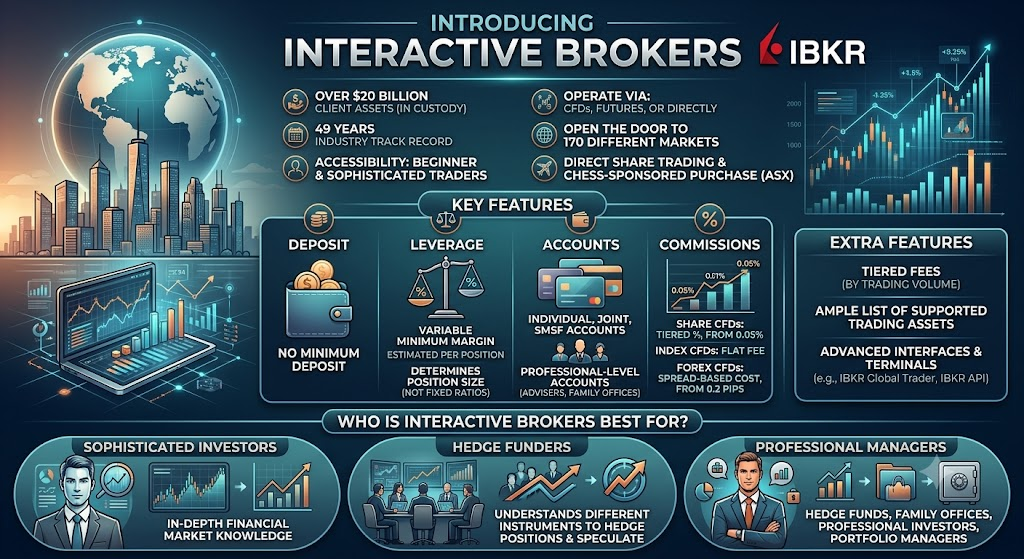
This is one of the largest international trading platforms that has set foot in Australia, with over $20 billion in client assets in its custody and 49 years of a positive track record in the industry.
Interactive Brokers offers access to virtually all financial instruments that both beginner and sophisticated traders would like to get their hands on. Traders can either operate with these assets via CFDs, futures, or directly, in some cases.
In total, this platform opens up the door to 170 different markets and supports direct share trading and CHESS-sponsored share purchases for ASX-listed assets.
Key Features
Minimum deposit required to open an account: Interactive Brokers does not demand a minimum deposit to open an account.
Leverage ratios: Interactive Brokers does not offer fixed leverage ratios per instrument. Instead, it estimates the minimum margin required to open a leveraged position and, based on that percentage, determines how large the trading position can be.
Account types: Interactive Brokers offers individual, joint, and SMSF accounts rather than specific account types for active traders. They also support professional-level accounts for advisers and family offices – among others.
Commissions & Fees: for Share CFDs, commissions are typically percentage-based, starting at 0.05% of the trade value. Meanwhile, Index CFDs can be traded at a flat fee while Forex CFDs feature a spread-based cost starting at 0.2 pips.
Extra features: Tiered fees based on trading volumes, ample list of supported trading assets, advanced trading interfaces and terminals (e.g.,f IBKR Global Trader, IBKR API).
Who Is Interactive Brokers Best For
Sophisticated investors with an in-depth knowledge of the financial markets.
Traders who understand the advantages of using different instruments to hedge their positions and speculate based on the latest price action.
Hedge funds, family offices, professional investors, and portfolio managers.
#4 – IG Markets
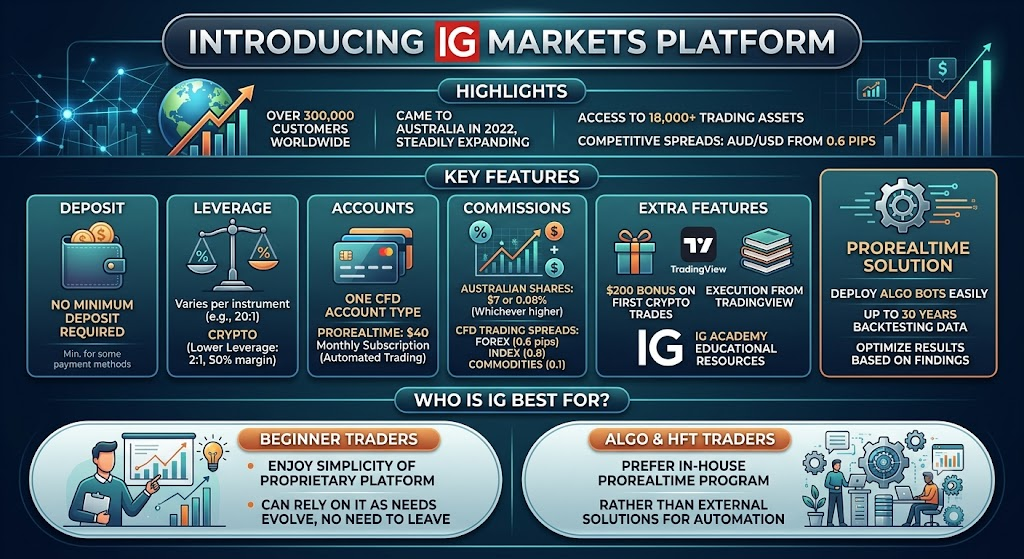
IG caters to over 300,000 customers and offers sophisticated back-end solutions for algo traders, alongside a robust proprietary trading platform and integrations with top-notch terminals and systems like MetaTrader.
They came to Australia in 2022, and have steadily expanded their footprint in this market. They offer access to more than 18,000 trading assets and competitive spreads starting at 0.6 pips for AUD/USD.
Its ProRealTime solution allows algo traders to deploy their bots easily, offering up to 30 years of backtesting data within their platform to help them optimize their results based on objective findings.
Key Features
Minimum deposit required to open an account: This broker does not require a minimum deposit to open an account. However, for some payment methods, there is a minimum required.
Leverage ratios: Leverage ratios vary per instrument, starting at around 20:1. However, cryptocurrencies tend to require a higher margin of around 50%, meaning a much lower leverage ratio of 2:1.
Account types: IG only offers one type of account for CFD trading. The spreads for forex pairs start at 0.60, while using the ProRealTime solution for automated trading carries a monthly subscription cost of $40.
Commissions & Fees: For Australian listed shares, IG charges $7 per trade or 0.08% of the total trade value, whichever is higher. Meanwhile, for CFD trading, spreads start at 0.6 pips for forex, 0.8 for index CFDs, and 0.1 pips for commodities.
Extra features: New users are eligible to get a $200 bonus on their first crypto trades. This broker supports transaction execution from within TradingView and offers access to an extensive library of educational resources through the IG Academy program.
Who Is IG Best For
Beginner traders who enjoy the simplicity of its proprietary trading platform, but can also rely on it as they grow and learn further about the market without being forced to leave the platform as their needs evolve.
Algo traders and high-frequency traders (HFTs) who may prefer to use their in-house ProRealTime program rather than relying on external solutions to automate their operations.
#5 – eToro
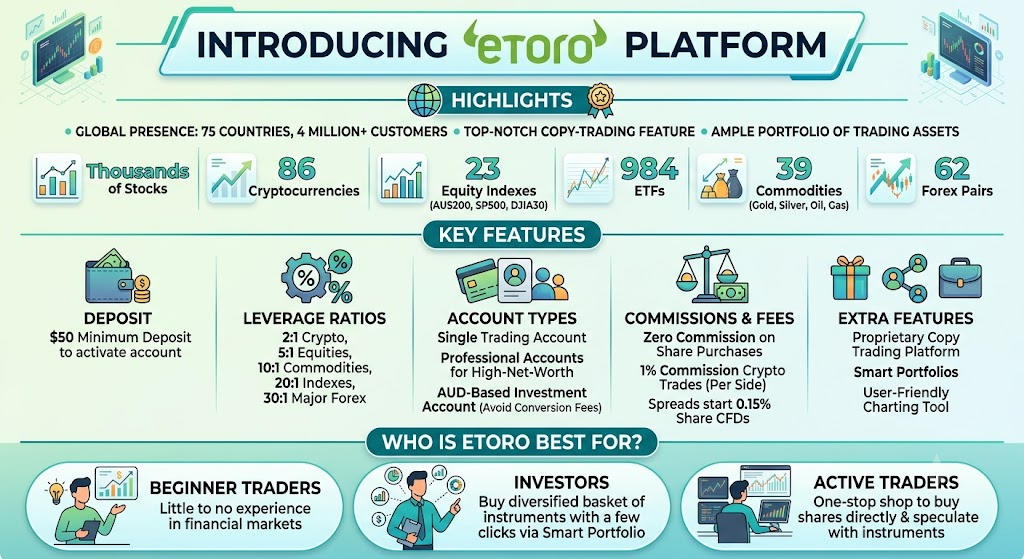
eToro has grown to become a powerful force in the international market, expanding its footprint to 75 different countries and now serving a customer base of more than 4 million investors and traders.
Its top-notch copy-trading feature has made it popular among retail investors who prefer to leave the hard work of researching and identifying the best opportunities in the market to professionals.
In addition, eToro offers an ample portfolio of trading assets that includes thousands of stocks, 86 cryptocurrencies, 23 equity indexes (including the AUS200, SP500, and DJIA30), 984 exchange-traded funds (ETFs), 39 commodities (gold, silver, oil, natural gas, and more), and 62 forex pairs.
Key Features
Minimum deposit required to open an account: eToro requires a $50 minimum deposit to activate an account.
Leverage ratios: Leverage ratios start at 2:1 for cryptocurrencies, 5:1 for equities, 10:1 for commodities, 20:1 for indexes, and 30:1 for major forex pairs (e.g., EUR/USD, AUD/USD).
Account types: For active trading, eToro only supports a single account type. However, they also offer professional accounts for high-net-worth individuals and an AUD-based investment account for direct share purchases in the local currency to avoid conversion fees.
Commissions & Fees: eToro offers zero commissions on share purchases, a 1% commission for crypto trades per side, and percentage-based spreads starting at 0.15% for share CFDs.
Extra features: A proprietary copy trading platform and a program called Smart Portfolios are available to make it easier for beginners to start placing their first trades and testing the market’s waters without having to create a strategy from scratch. A user-friendly charting tool is also available within its proprietary trading interface.
Who Is eToro Best For
Beginner traders with little to no experience in the financial markets.
Investors who would rather buy a diversified basket of instruments with just a few clicks through the Smart Portfolio program.
Active traders looking for a one-stop shop where they can both buy shares directly and speculate with certain instruments.
#6 – CMC Markets
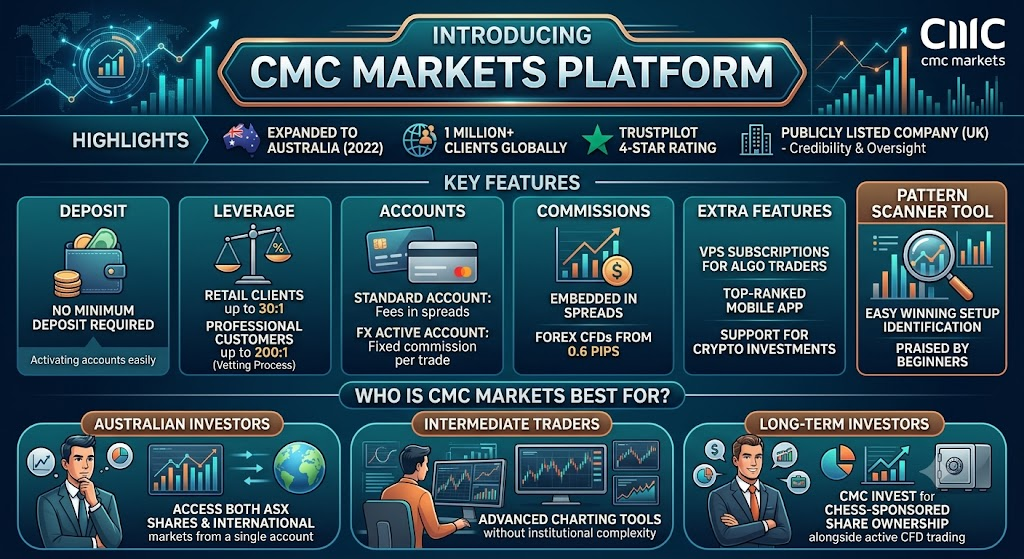
CMC Markets came to Australia in 2022, as part of its plans to expand its international footprint. Since then, it has become a relevant player in the CFD market, providing access to thousands of financial instruments through a user-friendly proprietary trading platform and third-party integrations.
Over 1 million clients currently use its solutions. One of CMC’s strengths comes from the fact that it is a publicly listed company in the United Kingdom, which boosts its credibility as the firm is subject to robust regulatory oversight both operationally and financially.
In addition, users have given its platform a 4-star rating on TrustPilot and have praised its pattern scanner tool for making it easier for beginners to identify winning setups.
Key Features
Minimum deposit required to open an account: No minimum deposit is required to activate an account.
Leverage ratios: Leverage ratios for retail clients go up to 30:1, while professional customers who go through the platform’s vetting process can access higher ratios of 200:1.
Account types: Users can choose between the Standard account (fees are charged via spreads) and the FX Active account, which charges a fixed commission per trade.
Commissions & Fees: Commissions and fees are embedded in each instrument’s bid/ask spread. For Forex CFDs, they start at 0.6 pips.
Extra features: VPS subscriptions are available for algo traders; its mobile trading platform is one of Australia’s top-ranked apps; top-notch customer support for crypto investments.
Who Is CMC Markets Best For
Australian investors who want to get access to both ASX shares and international CFD/forex markets from a single account.
Intermediate traders who want advanced charting tools without the complexity of institutional platforms.
Long-term investors who can use CMC Invest for CHESS-sponsored share ownership alongside active CFD trading for speculative bets.
#7 – IC Markets
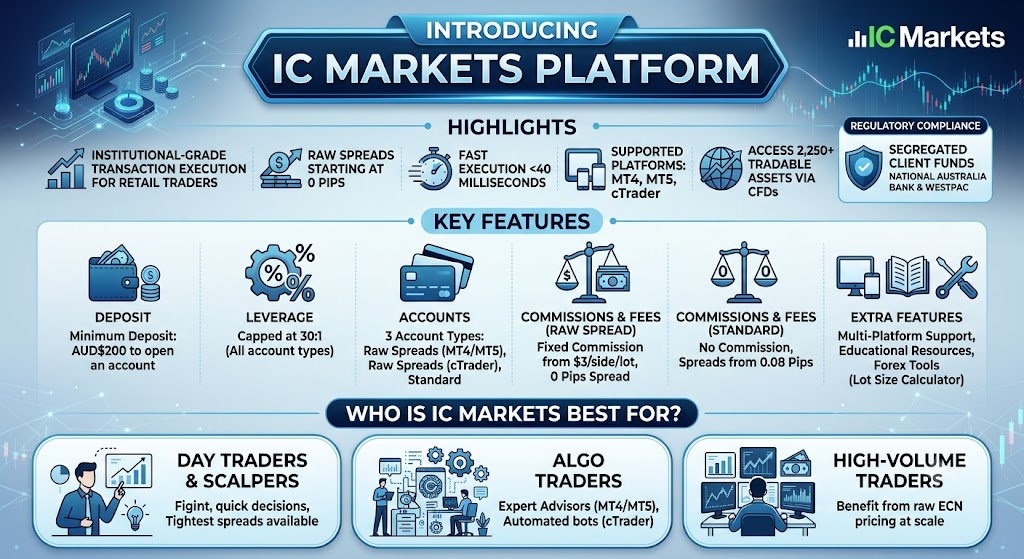
IC Markets is a highly competitive trading platform whose primary goal was to bring institutional-grade transaction execution to retail traders without increasing trading costs.
They have achieved that goal, as their raw spreads start at 0 pips while trades are executed in under 40 milliseconds. Their supported platforms include MT4, MT5, and cTrader.
IC Markets currently offers access to 2,250+ tradable assets via CFDs and complies with Australia’s strict operational standards by holding clients’ funds in segregated accounts at the National Australia Bank and Westpac.
Key Features
Minimum deposit required to open an account: A minimum deposit of AUD$200 is required to open an account.
Leverage ratios: Leverage ratios are capped at 30:1 for all types of accounts.
Account types: IC Markets offers three types of accounts, including two Raw Spreads accounts depending on which platform the trader chooses and a Standard account.
Commissions & Fees: The Raw Spread account charges a fixed commission starting at $3 per side per lot and 0 pips. Meanwhile, the Standard account charges no commissions, while spreads start at 0.08 pips.
Extra features: Multi-platform support, attractive educational resources, top-notch tools for forex traders like lot size calculators.
Who Is IC Markets Best For
Day traders and scalpers who need the absolute tightest spreads available.
Algo traders running Expert Advisors on MT4/MT5 or automated bots on cTrader.
High-volume traders who benefit most from raw ECN pricing at scale.
#8 – Totality (formerly Saxo Australia)
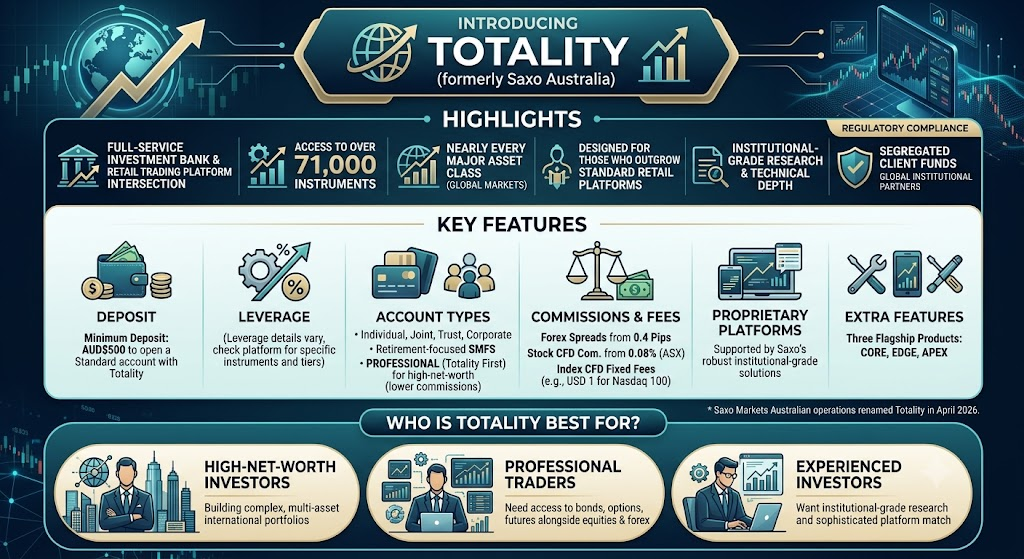
Saxo Markets occupies a unique position in the Australian market as it sits at the intersection of a full-service investment bank and a retail trading platform. In April 2026, the platform was renamed Totality.
Providing access to over 71,000 instruments, Totality supports nearly every major asset class across global markets. Its platform is designed for traders and investors who have genuinely outgrown standard retail platforms.
Its research materials and technical depth can be compared with institutional-grade tools, which makes it the platform of choice for high-net-worth individuals and professional Australian investors and traders.
Key Features
Minimum deposit required to open an account: A minimum deposit of AUD$500 is required to open a Standard account with Totatility.
Leverage ratios:
Account types: Totality supports Individual, Joint, Trust, and Corporate accounts. It also offers a retirement-focused SMFS account and a professional account called Totality First for high-net-worth individuals that features lower commissions and fees.
Commissions & Fees: The spread for forex spot pairs starts at 0.4 pips, while stock CFDs carry a percentage-based commission starting at 0.08% for ASX-listed shares. Trading Index CFDs generates a fixed fee denominated in the index’s base currency (e.g., USD 1 for the Nasdaq 100 Index).
Extra features: Totality’s trading platforms are proprietary and mostly supported by Saxo’s robust institutional-grade solutions. The platform offers three flagship products called Core, Edge, and Apex.
Who Is Totality Best For
High-net-worth investors building complex, multi-asset international portfolios.
Professional traders who need access to bonds, options, and futures alongside equities and forex.
Experienced investors who want institutional-grade research materials and a platform that matches their degree of sophistication.
How to Open an Account with an International Trading Platform in Australia?
Setting up an international trading account in Australia can be done without any paperwork involved. However, local laws are strict, and brokers have to follow a specific onboarding sequence to verify the user’s identity and ensure that they understand the risks involved, especially when it comes to CFD trading.
Here’s a step-by-step guide to opening and funding an account with an international trading platform:
1. Submit an Application and Select an Account Type
Head to the broker's website or app and fill out the digital application form. Users will be required to enter their contact information and choose an account type. Beginners usually opt for a Standard Account (spread-only), while active traders might choose a Raw/Razor Account (commission-based with tighter spreads).
2. Complete the Appropriateness Risk Assessment
Because many international platforms offer leveraged products like CFDs, ASIC regulations require them to evaluate the user’s financial literacy. New users will be asked a handful of quick multiple-choice questions regarding their trading experience, knowledge about topics like leverage and margin requirements, and risk tolerance to move forward in the registration process.
3. Identity Verification
To comply with Australian Anti-Money Laundering (AML) laws, each user must complete a Know Your Customer (KYC) check. They’ll need to upload clear digital photos of:
Primary ID: An Australian driver’s license or passport.
Proof of Address: A utility bill, phone bill, or bank statement issued within the last three months showing the user’s legal name and current address.
4. Fund The Account
Once the broker’s compliance team greenlights the account (which usually takes anywhere from a few minutes to one business day), the user is ready to deposit funds. Look for platforms that support instant and zero-fee local payment channels like PayID, POLi, or BPAY. Those are the best alternatives to avoid losing money on commissions and unnecessary payment processing costs.
1. Is it safe to use an international trading platform in Australia?
Yes, it is entirely safe as long as the platform holds an Australian Financial Services License (AFSL) and is overseen by ASIC. This ensures that the broker complies with local laws, including keeping investors’ capital protected in segregated bank accounts.
2. Do I have to pay taxes on profits made through international trading platforms?
Yes, any profits generated from trading international assets are generally subject to capital gains tax (CGT) or treated as ordinary income by the Australian Taxation Office (ATO). It is highly recommended to keep thorough records of all transactions for annual tax returns.
3. Can I trade global stocks directly from Australia?
Yes, top-tier international trading platforms like Interactive Brokers and eToro allow users to trade shares directly on major global exchanges like the NYSE and NASDAQ. Many of these brokers even offer $0 fees on international stocks, though users should be careful with currency conversion fees when depositing AUD to buy foreign assets.
4. What is the difference between direct share trading and CFD trading on these platforms?
Direct share trading means that the investor legally owns a fractional piece of the actual company and may receive dividends over time. In contrast, contracts for difference (CFDs) are derivatives that settle based on the difference between the entry and exit prices of each trading position.
Disclaimer: The content presented above, whether from a third party or not, is considered as general advice only. CFD trading involves significant risk of loss. Past performance does not guarantee future results. This article serves informational purposes only and does not constitute financial advice. Consider your risk tolerance before trading.


