




Here’s Why I’d Still Buy Nvidia Over AMD With or Without Jensen Huang at CEO.
Key Points
Nvidia is growing at a faster pace despite its larger size.
AMD is far more expensive than Nvidia is.
- 10 stocks we like better than Nvidia ›
Nvidia (NASDAQ:NVDA) and AMD (NASDAQ:AMD) are rivals. These companies compete in multiple industries, but none as big as data centers right now. Both AMD and Nvidia have strong product offerings. Still, Nvidia took an early lead due to having better software, and that was all it took for Nvidia's product lineup to become the go-to in the data center industry.
However, Nvidia's investment thesis recently hit a bump in the road due to issues involving co-founder and CEO Jensen Huang. Huang resigned due to misconduct issues, but was reinstated by the board a few days later.
Missed AI’s "Act 1"? Act 2 Could Be 15x Bigger. Most investors think they missed the AI boat because they didn't buy Nvidia in 2005. But according to our analysts, we’re only at the end of "Act 1"—the R&D phase. "Act 2" is the global rollout. Continue »
But Huang isn’t out of the woods yet, as he must testify before Congress about recent events. This could cause a distraction, and Nvidia's issues undoubtedly give AMD an advantage right now/
But I still don't think it's even close to enough to consider investing in AMD over Nvidia.

Jensen Huang. Image source: Getty Images.
Nvidia's data center business is larger and growing at a faster rate
The best way to compare these two stocks is to look at how their respective data center businesses are doing. This offers a more direct comparison and reveals to investors how each is doing in the most important sector.
AMD and Nvidia's third quarters don't end at the same time. AMD operates on a calendar-year fiscal schedule, with its Q3 ending on Sept. 30. Nvidia's is shifted 13 months forward, with its fiscal 2027 Q3 ending on Oct. 25, so a perfect comparison isn't possible. Still, it's the best investors have.
AMD's data center revenue grew in Q3 at a 97% pace to $8.5 billion. Those are strong results, but they fall well short of Nvidia's. During its fiscal 2027 third quarter, Nvidia's data center revenue totaled $107.6 billion, up 110% compared to a year ago. So, not only is Nvidia far larger, but it's also growing appreciably faster. Those two factors are rarely combined, which is what makes Nvidia so dominant.
However, all those results were obtained before the issues surrounding Huang and China export concerns came to light. While some may think this will affect Nvidia's growth and sales, I'm not sure it will. The reality is that the AI hyperscalers cannot get their hands on as much computing power as they want right now. So, regardless of who is selling the computing unit to them, they want it. As a result, AMD's and Nvidia's graphics processing units (GPUs) are practically selling themselves. This is a great place to be, and Nvidia will likely be able to ride out the status quo it established until the situation gets a bit more under control.
Right now, Nvidia is still winning and will likely do so for some time. What will happen a couple of years down the road is unknown, but with Huang keeping his role, the future is bright for Nvidia. However, that's not the only reason Nvidia is a buy over AMD.
Does AMD deserve to be valued at three times the level of Nvidia?
After Nvidia's heavy sell-off, the stock is very cheap right now. On the flip side, AMD's stock is a bit pricey after an impressive run in 2026.
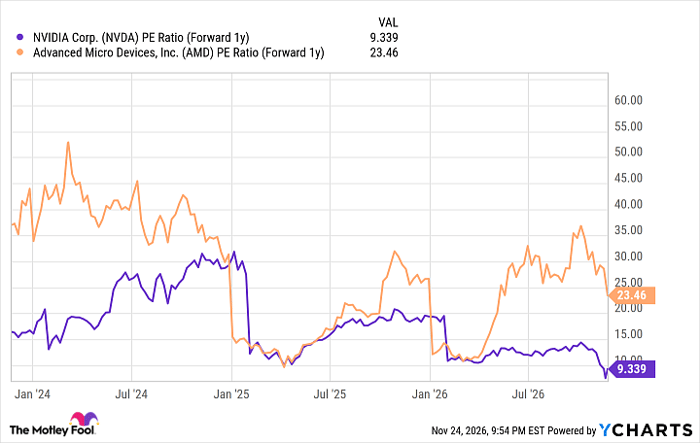
NVDA PE Ratio (Forward 1y) data by YCharts
With Nvidia trading at an incredibly cheap 9.3 times next year's earnings estimates, it's about two and a half times cheaper than AMD at around 23.5 times next year's earnings estimates. That's a gigantic mismatch, and it stems from skepticism about the AI build-out.
However, CFO Colette Kress eliminated that thought during Nvidia's most recent conference call when she increased the company’s guidance for revenue growth in fiscal 2028 from 70% to 75%.
That's monster growth that the market isn't pricing in, and the stock is cheap as a result. So, regardless of who's leading the company, I think Nvidia is a far better investment than AMD is right now.
Should you buy stock in Nvidia right now?
Before you buy stock in Nvidia, consider this:
The Motley Fool Stock Advisor analyst team just identified what they believe are the 10 best stocks for investors to buy now… and Nvidia wasn’t one of them. The 10 stocks that made the cut could produce monster returns in the coming years.
Consider when Netflix made this list on December 17, 2004... if you invested $1,000 at the time of our recommendation, you’d have $320,394!* Or when Nvidia made this list on April 15, 2005... if you invested $1,000 at the time of our recommendation, you’d have $917,381!*
Now, it’s worth noting Stock Advisor’s total average return is 776% — a market-crushing outperformance compared to 199% for the S&P 500. Don't miss the latest top 10 list, available with Stock Advisor, and join an investing community built by individual investors for individual investors.
See the 10 stocks »
*Stock Advisor returns as of November 27, 2026.
Keithen Drury has positions in Nvidia. The Motley Fool has positions in and recommends Advanced Micro Devices and Nvidia. The Motley Fool has a disclosure policy.
Recommended Articles


