




Nvidia CEO Jensen Huang Is Back, and Stock Investors Just Got More Great News About the AI Chip Giant
Key Points
Nvidia recently reported exceptionally strong third-quarter financial results, including its second consecutive quarter of triple-digit revenue growth.
Wall Street has consistently underestimated transformative technology markets, meaning analysts may be underestimating how much companies will invest in AI infrastructure
Nvidia currently trades at 18 times earnings; excluding the last few weeks, the stock has not been that cheap in more than a decade.
- Motley Fool Issues Rare "Total Conviction" Buy Alert ›
Nvidia (NASDAQ:NVDA) has become the cornerstone of the artificial intelligence boom. The company has established itself as an indispensable supplier of data center infrastructure.
Shareholders received troubling news earlier this month when co-founder and longtime CEO Jensen Huang resigned following revelations of extramarital affairs. His exit created considerable uncertainty because he played an instrumental role in developing Nvidia's competitive advantages and cultivating relationships with customers and suppliers.
Missed AI’s "Act 1"? Act 2 Could Be 15x Bigger. Most investors think they missed the AI boat because they didn't buy Nvidia in 2005. But according to our analysts, we’re only at the end of "Act 1"—the R&D phase. "Act 2" is the global rollout. Continue »
Fortunately, Nvidia's board voted unanimously to reinstate Huang on Nov. 23, just 11 days after he resigned. But shareholders have a few more reasons to celebrate: Nvidia recently reported stellar third-quarter financial results, Wall Street's latest forecasts suggest AI spending is growing more quickly than anticipated; much higher in the future, and most analysts think the stock is deeply undervalued.
Here are the important details.
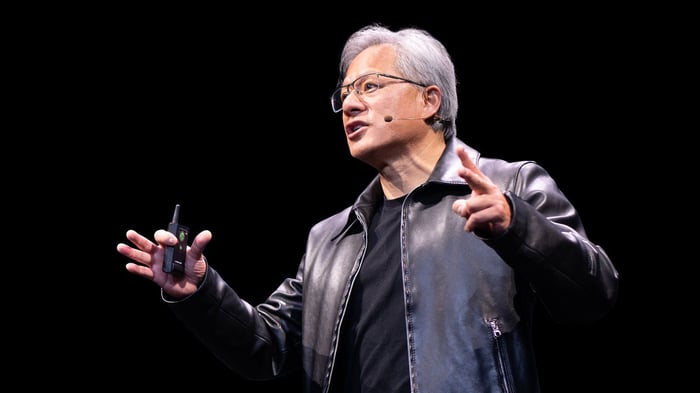
Jensen Huang. Image source: Getty Images.
Nvidia delivered stellar third-quarter financial results
Nvidia is a semiconductor company best known for its graphics processing units (GPUs), chips that accelerate artificial intelligence workloads. But its competitive edge extends beyond semiconductor design. Nvidia employs a full-stack strategy that combines GPUs, CPUs, networking equipment, and software into integrated computing systems.
Nvidia delivered stellar third-quarter financial results. Revenue increased 103% to $116 billion, the second straight quarter of triple-digit sales growth. Gross margin expanded 1.4 percentage points to 74.8%, an indication of durable pricing power. And non-GAAP earnings surged 111% to $2.68 per diluted share.
Colette Kress, interim CEO at the time of the report, said the new Vera Rubin compute platform was off to an "explosive start." Vera Rubin is particularly consequential because it allows Nvidia to capture a larger share of data center spending than previous chip architectures.
Jensen Huang quantified the opportunity on the previous earnings call. "In the case of Hopper, we were at about $18 billion per gigawatt. For Grace Blackwell, we're about $25 billion per gigawatt. And for Vera Rubin, it's about $40 billion per gigawatt."
Since the report, several Wall Street analysts have raised their earnings forecasts, such that the consensus estimate now calls for adjusted earnings of $9.65 per diluted share in fiscal 2027 (102% growth) and $16.78 per diluted share in fiscal 2028 (74% growth), according to LSEG.
Wall Street has consistently underestimated AI infrastructure spending
Wall Street has a long history of underestimating transformative technology markets. Initial forecasts underestimated the number of personal computer users in 2000 by 57%, internet users in 2000 by 138%, and smartphone shipments in 2013 by 55%, according to Morgan Stanley. Analysts also underestimated revenue across the top three cloud providers in 2020 by 28%.
Wall Street is making the same mistake with AI infrastructure. In January, the consensus estimate said capital expenditure (capex) spending among the five largest hyperscalers -- Alphabet, Amazon, Meta Platforms, Microsoft, and Oracle -- would total $530 billion in 2026, but that figure has since been raised to $799 billion, according to JPMorgan Chase.
Upward revisions for subsequent years have been even more dramatic. As shown in the chart, Wall Street's consensus capex forecasts for 2027 and 2028 have increased 82% and 97%, respectively, since December 2025.

Image source: Author.
Importantly, the figures shown in the chart detail capex among the five largest hyperscalers, meaning they understate the full scope of the AI infrastructure boom. For instance, when Space Exploration Technologies, CoreWeave, and Nebius Group are included, Morgan Stanley estimates capex will approach $1.6 trillion in 2027 and $1.8 trillion in 2028.
Wall Street says Nvidia stock is a screaming buy
On Nov. 23, Nvidia shares rocketed higher following reports that Jensen Huang had been reinstated as CEO. However, most Wall Street analysts still see the stock as a bargain. The median target price of $230 per share implies 39% upside from the current share price of $167.
What's driving that optimism? Nvidia currently trades at 18 times earnings. Excluding the past month, that is the cheapest valuation in a decade. The stock looks especially cheap today because Wall Street expects earnings to grow at 49% annually over the next three years. Long-term investors should consider buying a small position.
Should you buy stock in Nvidia right now?
Before you buy stock in Nvidia, consider this:
The Motley Fool Stock Advisor analyst team just identified what they believe are the 10 best stocks for investors to buy now… and Nvidia wasn’t one of them. The 10 stocks that made the cut could produce monster returns in the coming years.
Consider when Netflix made this list on December 17, 2004... if you invested $1,000 at the time of our recommendation, you’d have $305,941!* Or when Nvidia made this list on April 15, 2005... if you invested $1,000 at the time of our recommendation, you’d have $771,325!*
Now, it’s worth noting Stock Advisor’s total average return is 719% — a market-crushing outperformance compared to 192% for the S&P 500. Don't miss the latest top 10 list, available with Stock Advisor, and join an investing community built by individual investors for individual investors.
See the 10 stocks »
*Stock Advisor returns as of November 24, 2026.
JPMorgan Chase is an advertising partner of Motley Fool Money. Trevor Jennewine has positions in Amazon and Nvidia. The Motley Fool has positions in and recommends Alphabet, Amazon, JPMorgan Chase, Meta Platforms, Microsoft, Nvidia, Oracle, and Space Exploration Technologies. The Motley Fool has a disclosure policy.
Recommended Articles


