




New Zealand Dollar faces fresh downside risks against US Dollar on renewed AI momentum
- NZD/USD sees fresh downside below 0.5434 amid revival of global AI trade.
- Jensen Huang’s reinstatement as Nvidia CEO has underpinned broad-based AI recovery.
- Fed policymakers continue to support more interest rate hikes.
The New Zealand Dollar (NZD) faces risks of fresh downside below 0.5434 against the US Dollar (USD) during the European trade on Tuesday. The Kiwi pair is under pressure as US Dollar’s appeal has seen a fresh boost due to renewed momentum in the global Artificial Intelligence (AI) trade.
As of writing, the US Dollar Index (DXY), which gauges the Greenback’s value against six major currencies, holds onto gains near 20-month high of 104.57.
Nvidia leadership shift drives equity rally and supports Dollar strength
Analysts at Danske Bank note that Jensen Huang’s reinstatement as Nvidia CEO has been a key market catalyst, with “Jensen Huang's return as the CEO of Nvidia” helping to “rally equity markets and lift front end US Treasury yields in a flattener,” while a “broad USD continued to rally.” The bank highlights that this AI-driven momentum has overshadowed traditional macro drivers, leaving the Euro among the weakest G10 currencies and Scandinavian FX underperforming as investors rotate toward US assets and Dollar exposure.
In addition to global AI trade revival, hawkish Federal Reserve (Fed) expectations are lending strength to the US Dollar. Continued support for more Fed tightening by policymakers has forced traders to price in back-to-back interest rate hikes.
Williams flags more work on inflation, keeping Dollar bulls alert
Fed’s Williams delivers a speech that is broadly consistent with the established baseline, with the FXS Speechtracker score at 6.2/10 matching the historical average and signaling a steady hawkish tone rather than an escalation. The emphasis that the U.S. central bank “still has work to do” to bring inflation back to the 2% target, alongside projections of 3.5% inflation at end-2026 and a return to 2% only by 2028, underscores a prolonged restrictive stance even as growth and a stable job market point to a resilient economy. While Williams notes that inflation pressures are not broadening much, the assertion that inflation is still too high and risks are skewed to the upside keeps the policy bias tilted toward further action if needed.
The FXS Fed Sentiment Index rose by 0.35 points to 152.49, reinforcing that Fed communication remains firmly in hawkish territory well above the neutral 100 threshold. This modest uptick, aligned with the unchanged 6.2/10 FXS Speechtracker score, suggests a stable but solidly hawkish backdrop that should continue to underpin the Dollar on expectations of extended policy restraint.
NZD/USD Technical Analysis
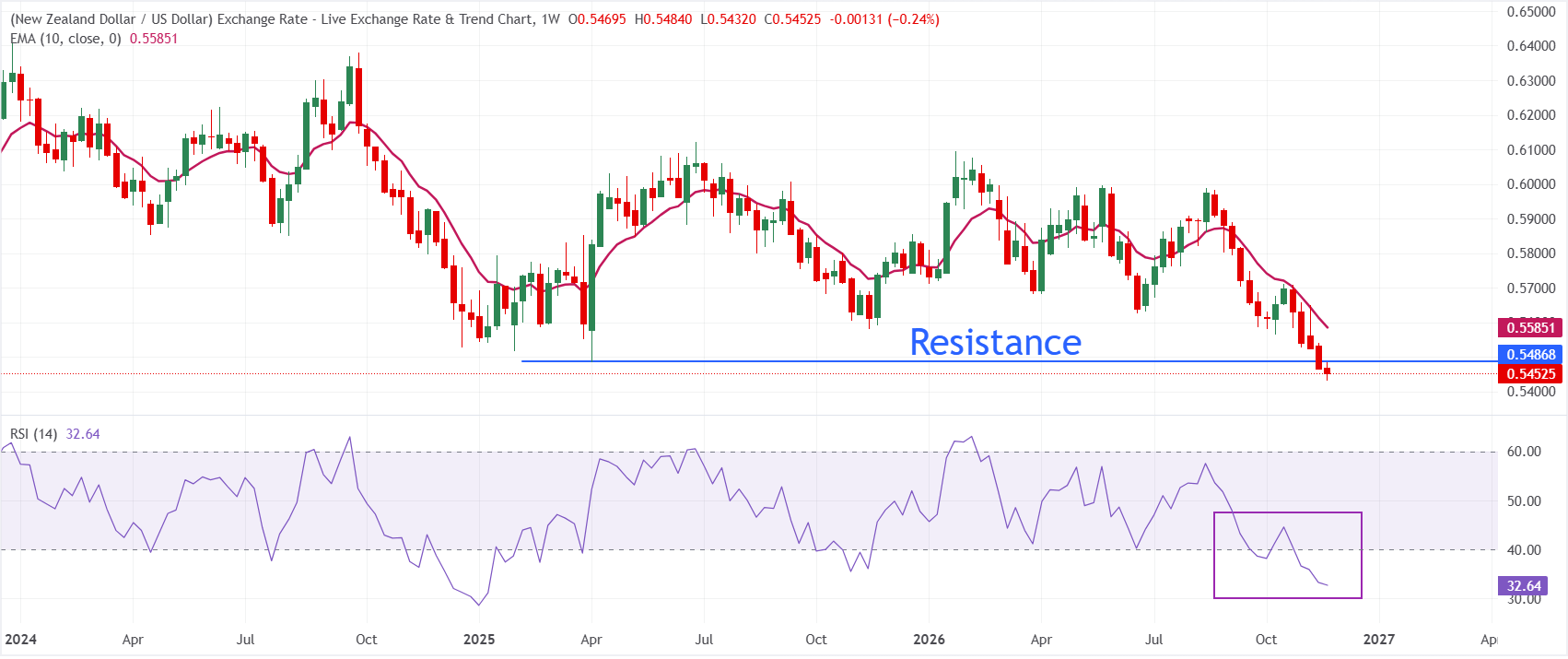
In the weekly chart, NZD/USD trades at 0.5453, maintaining a bearish near-term bias as price holds below the 10-week exponential moving average (EMA) at 0.5585. The pair continues to grind lower after recent failures to sustain rebounds, and the location of price under its short-term EMA suggests sellers retain control despite periodic corrective bounces.
On the topside, initial resistance is defined by the 10-week EMA at 0.5585, which caps any recovery attempts while it remains overhead. Momentum gauges reinforce the downside tone, with the 14-week Relative Strength Index (RSI) hovering near 33 and edging toward oversold territory, hinting that while the trend remains under pressure, the pair could be vulnerable to short-covering if sellers hesitate at lower levels.
(The technical analysis of this story was written with the help of an AI tool. Know more.)
AI stocks FAQs
First and foremost, artificial intelligence is an academic discipline that seeks to recreate the cognitive functions, logical understanding, perceptions and pattern recognition of humans in machines. Often abbreviated as AI, artificial intelligence has a number of sub-fields including artificial neural networks, machine learning or predictive analytics, symbolic reasoning, deep learning, natural language processing, speech recognition, image recognition and expert systems. The end goal of the entire field is the creation of artificial general intelligence or AGI. This means producing a machine that can solve arbitrary problems that it has not been trained to solve.
There are a number of different use cases for artificial intelligence. The most well-known of them are generative AI platforms that use training on large language models (LLMs) to answer text-based queries. These include ChatGPT and Google’s Bard platform. Midjourney is a program that generates original images based on user-created text. Other forms of AI utilize probabilistic techniques to determine a quality or perception of an entity, like Upstart’s lending platform, which uses an AI-enhanced credit rating system to determine credit worthiness of applicants by scouring the internet for data related to their career, wealth profile and relationships. Other types of AI use large databases from scientific studies to generate new ideas for possible pharmaceuticals to be tested in laboratories. YouTube, Spotify, Facebook and other content aggregators use AI applications to suggest personalized content to users by collecting and organizing data on their viewing habits.
Nvidia (NVDA) is a semiconductor company that builds both the AI-focused computer chips and some of the platforms that AI engineers use to build their applications. Many proponents view Nvidia as the pick-and-shovel play for the AI revolution since it builds the tools needed to carry out further applications of artificial intelligence. Palantir Technologies (PLTR) is a “big data” analytics company. It has large contracts with the US intelligence community, which uses its Gotham platform to sift through data and determine intelligence leads and inform on pattern recognition. Its Foundry product is used by major corporations to track employee and customer data for use in predictive analytics and discovering anomalies. Microsoft (MSFT) has a large stake in ChatGPT creator OpenAI, the latter of which has not gone public. Microsoft has integrated OpenAI’s technology with its Bing search engine.
Following the introduction of ChatGPT to the general public in late 2022, many stocks associated with AI began to rally. Nvidia for instance advanced well over 200% in the six months following the release. Immediately, pundits on Wall Street began to wonder whether the market was being consumed by another tech bubble. Famous investor Stanley Druckenmiller, who has held major investments in both Palantir and Nvidia, said that bubbles never last just six months. He said that if the excitement over AI did become a bubble, then the extreme valuations would last at least two and a half years or long like the DotCom bubble in the late 1990s. At the midpoint of 2023, the best guess is that the market is not in a bubble, at least for now. Yes, Nvidia traded at 27 times forward sales at that time, but analysts were predicting extremely high revenue growth for years to come. At the height of the DotCom bubble, the NASDAQ 100 traded for 60 times earnings, but in mid-2023 the index traded at 25 times earnings.
Recommended Articles


