




Semiconductor Sell-Off: These Artificial Intelligence (AI) Chip Stocks Are Screaming Buys Before They Go Parabolic
Key Points
TSMC's status as the world's largest semiconductor foundry explains why the company has been growing at a nice clip and can outperform Wall Street's expectations.
The improving demand for Applied Materials' semiconductor manufacturing equipment has supercharged its growth, a trend that's sustainable.
The earnings growth potential and the valuation of both companies make them worth buying right away.
- 10 stocks we like better than Taiwan Semiconductor Manufacturing ›
The semiconductor sector has been under significant pressure lately, as evidenced by the 25% slide in the PHLX Semiconductor Sector index since the beginning of October.
Investors have been booking profits in semiconductor stocks for various reasons. For instance, recent developments at Nvidia have dented confidence in the semiconductor sector, adding to already fragile investor sentiment driven by high inflation and a hawkish Federal Reserve. However, the semiconductor sell-off presents an opportunity for investors to buy top stocks at attractive valuations, especially given that the industry continues to grow at an incredible pace.
Missed AI’s "Act 1"? Act 2 Could Be 15x Bigger. Most investors think they missed the AI boat because they didn't buy Nvidia in 2005. But according to our analysts, we’re only at the end of "Act 1"—the R&D phase. "Act 2" is the global rollout. Continue »
The Semiconductor Industry Association (SIA) noted last month that global semiconductor revenue increased by 144% year over year in August 2026 to $159.7 billion. What's more, the industry's worldwide revenue has crossed $1 trillion in the first eight months of the year, and SIA expects the figure to exceed $1.6 trillion by year-end.
McKinsey sees more upside for the semiconductor market, expecting revenue to cross $2.3 trillion in 2030. That's why we will take a look at some obvious names that will benefit from the industry's secular growth -- Taiwan Semiconductor Manufacturing (NYSE:TSM) and Applied Materials (NASDAQ:AMAT) -- and deliver phenomenal gains to investors.

Image source: Getty Images.
TSMC: The kingpin of the AI chip revolution
Shares of Taiwan Semiconductor Manufacturing, popularly known as TSMC, have dropped 22% since October's beginning. As a result, TSMC stock can now be bought at an attractive 25 times earnings, a discount to the tech-laden Nasdaq-100 index's earnings multiple of 30.
TSMC is one of the most important semiconductor companies, manufacturing chips for leading AI chip designers, including Nvidia, Advanced Micro Devices, and Broadcom. TSMC controls an impressive 73% of the global pure-play foundry market, according to Counterpoint Research, which explains why it is one of the best ways to play the AI chip boom.
The company's dominant position has translated into healthy revenue and earnings growth. Its revenue has increased by 43% year over year in the first 10 months of 2026, while its dominant position in the foundry market has boosted margins due to strong pricing power. This is evident from the following chart.
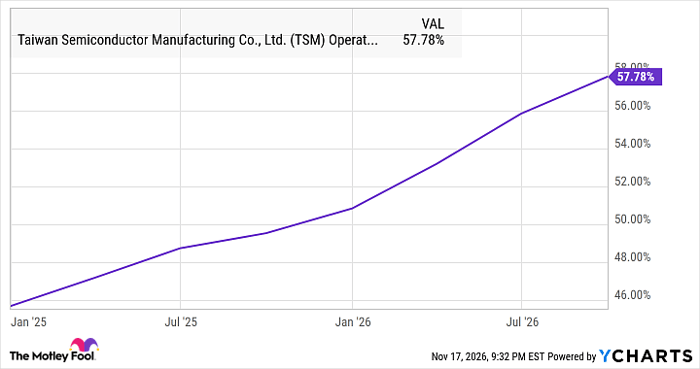
TSM Operating Margin (TTM) data by YCharts
The company's margin profile will continue to improve in 2027. That's because TSMC is reportedly planning to increase chip manufacturing prices by 10% next year. As a result, I won't be surprised to see TSMC's earnings per share (EPS) outpacing analysts' expectations in 2027 and in the long run. The company's EPS is expected to increase by 64% in 2026 to $17.50, followed by a 34% increase in 2027.
Given that TSMC predicts AI accelerator revenue will grow at a mid- to high-50% compound annual growth rate (CAGR) through 2029, it could outperform Wall Street's expectations. However, the stock could deliver impressive gains even if it grows in line with consensus estimates, as seen below.
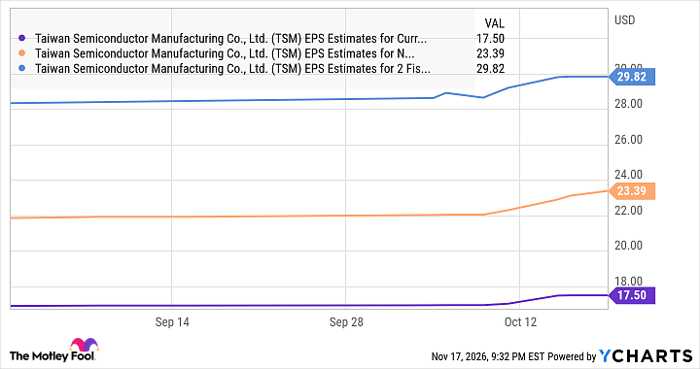
TSM EPS Estimates for Current Fiscal Year data by YCharts
Assuming TSMC's bottom line reaches $29.82 per share in 2028, and it continues to trade at 25 times earnings, its stock price could reach $746. That's double the current stock price, which is why buying TSMC following its recent dip seems like a prudent move.
Applied Materials: Accelerating growth should supercharge the stock
The chips manufactured by TSMC are made possible by Applied Materials' semiconductor manufacturing equipment. Specifically, Applied Materials sells wafer and fab equipment (WFE), a market experiencing strong growth driven by booming AI chip demand.
Morgan Stanley expects the WFE market's revenue to increase by 27% in 2026 to $149 billion. It expects a stronger jump of 28% next year to $191 billion, followed by another double-digit jump in 2028 to $215 billion. The good news for investors is that Applied Materials is growing faster than the WFE market. Its revenue increased by 53% year over year in the fourth quarter of fiscal 2026 (which ended on Oct. 25, 2026) to a record $10.41 billion.
Its non-GAAP EPS increased by 92% year over year to $4.16, driven by a 2.5 percentage-point growth in gross margin to 50.6%. Analysts expect Applied Materials to sustain its healthy growth in the current fiscal year, with EPS projected to increase by 50% to $19.29. Importantly, the company's EPS is poised to increase at solid rates in fiscal years 2028 and 2029.
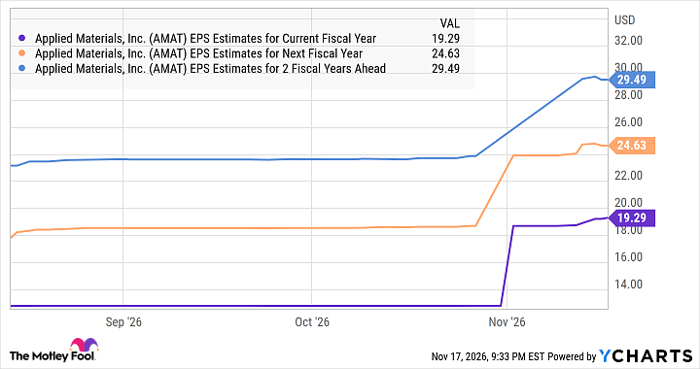
AMAT EPS Estimates for Current Fiscal Year data by YCharts
With Applied Materials trading at an attractive 20 times forward earnings, buying the stock is a no-brainer following a 34% drop in its share price since the beginning of October. Analysts are bullish on the stock's prospects over the coming year, with a 12-month median price target of $580 implying 66% upside.
As such, buying this AI stock seems like a no-brainer given its important role in the semiconductor ecosystem, accelerating growth, and attractive valuation, all of which could eventually trigger a bull run in 2027 and beyond.
Should you buy stock in Taiwan Semiconductor Manufacturing right now?
Before you buy stock in Taiwan Semiconductor Manufacturing, consider this:
The Motley Fool Stock Advisor analyst team just identified what they believe are the 10 best stocks for investors to buy now… and Taiwan Semiconductor Manufacturing wasn’t one of them. The 10 stocks that made the cut could produce monster returns in the coming years.
Consider when Netflix made this list on December 17, 2004... if you invested $1,000 at the time of our recommendation, you’d have $321,850!* Or when Nvidia made this list on April 15, 2005... if you invested $1,000 at the time of our recommendation, you’d have $955,232!*
Now, it’s worth noting Stock Advisor’s total average return is 793% — a market-crushing outperformance compared to 203% for the S&P 500. Don't miss the latest top 10 list, available with Stock Advisor, and join an investing community built by individual investors for individual investors.
See the 10 stocks »
*Stock Advisor returns as of November 19, 2026.
Harsh Chauhan has no position in any of the stocks mentioned. The Motley Fool has positions in and recommends Advanced Micro Devices, Applied Materials, Broadcom, Nvidia, and Taiwan Semiconductor Manufacturing. The Motley Fool has a disclosure policy.
Recommended Articles


