




4 Financial Stocks to Buy That Gained in 2022's Bear Market While the S&P 500 Lost 19%
Key Points
Chubb, Travelers, Progressive, and Allstate gained between 14.1% and 26.4% in 2022, while the S&P 500 fell 19%.
Q3 results remain profitable, but premium growth has slowed as commercial pricing gets more competitive.
The stocks have diverged in 2026, with Travelers up about 39% and Progressive up only about 2%.
- 10 stocks we like better than Chubb ›
The S&P 500 has been on quite a run. The index gained 24.2% in 2023, 23.3% in 2024, and another 16.4% last year.
But stock market runs don't last forever. The index is up less than 10% so far this year, with just a few weeks to go before the calendar flips. And to be honest, we're due for a downturn, particularly as the economy wrestles with high interest rates and oil prices, as well as increasing fears about spending by big tech companies on artificial intelligence (AI).
Missed Nvidia in 2009? This Rare Signal Is Flashing Again. In 2009, a "Double Down" signal flashed for a little-known chipmaker called Nvidia. For the first time in years, that same "Total Conviction" signal is flashing for a company 1/100th the size of Nvidia. Continue »
In 2022, the S&P 500 lost 19%, and investors who had loaded up on growth stocks took some painful losses. Four financial stocks, however, had a very different year. Progressive (NYSE:PGR) gained 26.4%, Travelers (NYSE:TRV) rose 19.9%, Allstate (NYSE:ALL) climbed 15.3%, and Chubb (NYSE:CB) advanced 14.1%.
Could those same stocks help investors survive another market decline?

Image source: Getty Images.
Financial stocks that held up in 2022
Insurance isn't a particularly exciting business. People who follow Warren Buffett's investing principles probably aren't surprised that some of Berkshire Hathaway's best companies are insurers, and insurance profits make up a huge part of Berkshire's quarterly earnings statement.
Insurance customers buy policies, pay their premiums, and hope they never need to file a claim. But that predictability can be valuable when the rest of the market is struggling.
Insurers also have some advantages that were important in 2022. Inflation pushed up the cost of car repairs and home rebuilding, so insurance companies raised their rates. Because insurers invest the premiums they collect while waiting to pay claims -- often into bonds -- higher interest rates mean more investment income.
That combination worked beautifully in 2022. But four years later, the insurance business looks a little different.
1. Chubb
Chubb, which is based in Switzerland, is the biggest publicly traded property and casualty insurer in the world. Its third-quarter results show why investors have continued to favor the company. Its core operating income was $2.98 billion, and its operating earnings were $7.66 per share -- a quarterly record for the company. Adjusted investment income reached a record $1.89 billion.
The company also reported a combined ratio of 84.1%. The combined ratio measures how much an insurer spends on claims and operating expenses for every dollar of premiums it earns. Anything below 100% means the company is making money on its insurance policies before counting investment income. So at 84.1%, Chubb has plenty of room to make a profit.
But there's something else in its results worth watching. Net premiums written increased just 1.9%, and CEO Evan Greenberg acknowledged that commercial insurance is becoming more competitive. That's a change from the environment that helped insurers outperform in 2022. Chubb is still generating outstanding profits, but it may have less freedom to raise prices.
2. Travelers
Travelers has been the biggest winner of this group in 2026, and its Q3 earnings help explain why. Revenue in the quarter was $12.41 billion, nearly unchanged from a year ago, but core earnings were $9.18 per share, up from $8.14 a year earlier. Its combined ratio improved to 86.8%, indicating that Travelers kept more of its premium revenue after paying claims and expenses.
Premium growth, however, has slowed considerably. Net premiums written were essentially flat, although they increased 2% when excluding a Canadian business the company sold.
Travelers trades at approximately 11 times forward earnings. That's not unreasonable, but after its 39% rally, investors are paying more for those profits than they were at the beginning of the year.
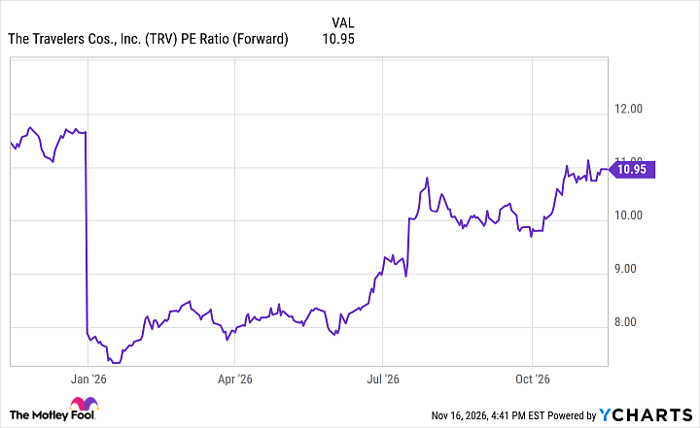
TRV PE Ratio (Forward) data by YCharts
3. Progressive
Although Progressive was the best-performing stock of this group back in 2022, this year it's bringing up the rear. Shares are up only about 4% in 2026 even though the underlying insurance business continues to perform well.
Net premiums written in the second quarter were $22.3 billion, up 4% from a year ago. Its combined ratio improved from 89.5% to 88.7%.
Progressive's business is heavily concentrated in auto insurance where pricing and competition can change quickly. The company benefited enormously when insurers raised rates to keep pace with inflation, but that pricing advantage isn't as strong today.
4. Allstate
Allstate provides a reminder that insurance companies face risks unrelated to the stock market. Its Q3 adjusted earnings declined to $9.76 per share from $11.17 a year earlier. The biggest problem was the company's payments for catastrophic losses, which increased from $558 million to $1.65 billion.
Allstate has substantial exposure to homeowners insurance, which means hurricanes, wildfires, and other severe weather events can have an outsize impact on its results.
Still, its policies in force increased 3.3%, suggesting that customers aren't abandoning the company despite higher insurance costs.
Can insurance stocks repeat their 2022 performance?
It's no accident that Chubb, Travelers, Progressive, and Allstate did well in the 2022 bear market. People still needed insurance, and rising premiums helped insurers protect their profits.
But the pricing environment that made 2022 so profitable has changed, so investors can't assume the next market downturn will produce identical results as the last one.
Should you buy stock in Chubb right now?
Before you buy stock in Chubb, consider this:
The Motley Fool Stock Advisor analyst team just identified what they believe are the 10 best stocks for investors to buy now… and Chubb wasn’t one of them. The 10 stocks that made the cut could produce monster returns in the coming years.
Consider when Netflix made this list on December 17, 2004... if you invested $1,000 at the time of our recommendation, you’d have $321,850!* Or when Nvidia made this list on April 15, 2005... if you invested $1,000 at the time of our recommendation, you’d have $955,232!*
Now, it’s worth noting Stock Advisor’s total average return is 793% — a market-crushing outperformance compared to 203% for the S&P 500. Don't miss the latest top 10 list, available with Stock Advisor, and join an investing community built by individual investors for individual investors.
See the 10 stocks »
*Stock Advisor returns as of November 18, 2026.
Patrick Sanders has no position in any of the stocks mentioned. The Motley Fool has positions in and recommends Berkshire Hathaway. The Motley Fool recommends Progressive. The Motley Fool has a disclosure policy.
Recommended Articles


