




Anthropic's $1.4 Trillion IPO: The Ultimate Guide
Anthropic (NASDAQ: ANT), the company behind the Claude AI models, begins trading on the Nasdaq this Thursday, Nov. 19.
Anthropic plans to sell 825 million shares at $70 to $78 apiece, though strong demand could push the final price above $80, according to The Wall Street Journal. At $78 per share, the offering would raise about $64 billion, valuing Anthropic at roughly $1.4 trillion on a fully diluted basis. Seven of its biggest chip and cloud suppliers, including Nvidia (NASDAQ: NVDA) and Alphabet's (NASDAQ: GOOGL) (NASDAQ: GOOG) Google, are also buying $26 billion of stock separately at the IPO price.
Missed Nvidia in 2009? This Rare Signal Is Flashing Again. In 2009, a "Double Down" signal flashed for a little-known chipmaker called Nvidia. For the first time in years, that same "Total Conviction" signal is flashing for a company 1/100th the size of Nvidia. Continue »
Few companies of any size have grown as fast as Anthropic, whose revenue reached $33.2 billion in the first nine months of 2026, about 13 times what it brought in over the same stretch a year earlier. Much of its growth comes from enterprise customers, and more than half the Fortune 500 now spend at least $100,000 a year on its products. Keeping up with all this demand is expensive, so Anthropic has committed to spending about $895 billion on computing power in the years ahead, a bill that will shape what its stock is worth.
Image source: Getty Images.
Stick with us, Fool, and we'll walk you through what this debut means for your portfolio, from the "Magnificent Seven" to the chipmakers behind the AI build-out.
In This Report:
- Key Takeaways
- What This Means for AI, the Market, and Your Portfolio
- How the IPO Works
- Rule Breakers vs. Hidden Gems: Where Our Teams Stand
- The Foolish Take
- What Anthropic Means for Stocks You Already Own
- Breaking Down Anthropic
- The Bottom Line
Key Takeaways
- Our teams see upside. Team Rule Breakers' five-year price target is $160, and Team Hidden Gems' is $214.78, both well above Anthropic's IPO price range of $70 to $78 a share. Rule Breakers wants to review a few quarters of public results first, while Hidden Gems is open to taking a position sooner. More in Where Our Teams Stand below.
- Demand is its biggest strength. Revenue reached $33.2 billion in the first nine months of 2026, about 13 times the same stretch a year earlier, and customers from a year ago now spend about nine times as much.
- It's pricey, but far less so than SpaceX. The IPO values Anthropic at roughly 40 times trailing sales on a fully diluted basis, less than half the multiple SpaceX (NASDAQ: SPCX) fetched at its debut, and independent estimates sit at or above its price range. The price still assumes years of fast growth.
- Computing costs are the swing factor. Growth outran Anthropic's long-term computing contracts in Q3, so the company rented pricier short-term capacity. Margins narrowed but remained positive on an adjusted basis, and with about $70 billion in compute bills due over the next year, revenue will need to grow quickly to cover them.
- Public investors get almost no say. The seven co-founders control 50.1% of the vote through a single special share, and an independent trust picks most of the board, a setup Anthropic says protects its safety mission.
- You may already have indirect exposure. Amazon (NASDAQ: AMZN) and Alphabet own sizable stakes in Anthropic, while Microsoft (NASDAQ: MSFT) and Nvidia have smaller investments. All four also supply computing power or chips to Anthropic, so its growth could benefit companies many Fools already own.

What This Means for AI, the Market, and Your Portfolio
Anthropic's debut will likely move other AI stocks and the index funds in your 401(k).
- For the AI industry. Anthropic is the first leading stand-alone AI lab to go public, and its S-1 gives investors and peers their first audited look at what frontier AI costs to build and run. Its computing bill fell from about $2.51 per dollar of revenue in early 2025 to 58 cents in Q3 2026, an encouraging sign for an industry still trying to prove its economics work. The IPO also makes public markets a new source of funding for AI labs, and much of that money will flow to the chipmakers and cloud providers that supply them.
- For OpenAI and the AI companies that follow. Anthropic is going public ahead of OpenAI, its closest competitor, which recently raised private money at a $1.25 trillion valuation and is expected to list early next year. With Anthropic's price range just above that figure, how ANT performs in its first few months will help determine what public investors pay for OpenAI and the AI companies that follow.
- For the precedent SpaceX set. SpaceX's stock closed its first day 19% above its $135 IPO price in June and peaked at 57% above it two days later. It was already sliding by the time it joined the Nasdaq-100 in July, and within about six weeks it was back near its IPO price. Anthropic's IPO could see a similar early run, since only a small slice of its stock will trade at first while investors have reportedly asked for several times more shares than are for sale. Any early boost could fade once index funds finish their required buying and more insider shares unlock, though Anthropic goes public at less than half the sales multiple SpaceX fetched at its debut.
- For your own portfolio. You likely own a little Anthropic already through Alphabet, Amazon, Microsoft, and Nvidia, and you may soon own more through your index funds. Many 401(k) plans offer funds that track the Nasdaq-100 or the total US market, and if Anthropic joins those indexes, the funds have to buy the stock and sell a little of everything else they own to make room. That means many 401(k)s could end up owning Anthropic at the price the market sets in its first few weeks.
- Some investors may also sell other AI stocks to raise cash for ANT. CNBC's Jim Cramer has warned this could pull money away from the AI companies that make up a large share of many retirement portfolios.
How the IPO Works
Price, Size, and Key Dates
| Ticker / exchange | ANT on the Nasdaq Global Select Market |
|---|---|
| Price range | $70 to $78 a share (bankers may price above the range) |
| Final share price | [TBD Nov. 18] |
| Valuation | About $915 billion to $1.02 trillion in market cap at $70 to $78 a share, or $1.26 trillion to $1.4 trillion counting all stock options and restricted shares |
| Money raised | Up to about $64 billion at the top of the range, or about $74 billion if underwriters buy extra shares |
| Shares offered / float | 825 million shares, about 6% of shares outstanding |
| Who's selling | About 801 million new shares from Anthropic and about 24 million from existing investors, including the seven co-founders |
| Roadshow | Began Nov. 10 |
| Pricing | Wednesday, Nov. 18 |
| First trade | Thursday, Nov. 19 |
| Retail share of the offering |
About 20% |
| Lead banks | Goldman Sachs (NYSE: GS) and Morgan Stanley (NYSE: MS), plus JPMorgan Chase (NYSE: JPM), Citigroup (NYSE: C), Barclays (NYSE: BCS), Wells Fargo (NYSE: WFC), Bank of America (NYSE: BAC), and 15 others |
For scale, at the top of its price range, Anthropic's fully diluted value of about $1.4 trillion would rank it roughly 10th among US public companies, just behind Tesla (NASDAQ: TSLA) and ahead of Eli Lilly (NYSE: LLY). Anthropic was founded in 2021 and earned its first commercial revenue in 2023, while most companies that size spent decades as public companies getting there.
Day-One Pricing and Access
- At the IPO price, before trading starts. Anthropic's filing names Charles Schwab (NYSE: SCHW), Fidelity, Robinhood (NASDAQ: HOOD) and its Trade-PMR unit, SoFi (NASDAQ: SOFI), and E*Trade from Morgan Stanley as brokers offering shares to individuals. Buyers can request shares through their broker's IPO section before pricing on Wednesday, Nov. 18, then confirm once the deal prices.
- Eligibility depends on the broker. Fidelity requires at least $25,000 in certain assets with the firm, and Schwab has lowered its threshold to $50,000. Robinhood and SoFi have no account minimum, though Robinhood's IPO Access excludes retirement, joint, and managed accounts.
- Qualifying still doesn't mean you'll get shares, since investors have reportedly asked for about six times more than are for sale.
- Some brokers limit future IPO access for customers who sell quickly. Fidelity, for example, may restrict customers who sell IPO shares within 15 days, so read your broker's terms before you request.
- At the open on Thursday, Nov. 19, like any other stock. Once ANT starts trading, anyone with a brokerage account can buy it, though the price on a hot first day is often well above the offer price. SpaceX opened 11% above its offer.
Anthropic has set aside up to 20% of the offering for individual investors, two to four times the usual share for a large IPO.
Direxion plans to launch two leveraged Anthropic ETFs the day after ANT begins trading. One aims to deliver twice ANT's daily gain or loss, and the other aims to deliver twice the opposite. Because they reset daily, choppy price swings in this or any other leveraged single-stock ETF eat away at returns over time, so a few weeks of up-and-down moves can leave you with a loss even if ANT ends up about where it started. We avoid leveraged bets like these in Foolish investing.
When Insiders Can Sell
- A typical IPO locks up insiders for one 180-day stretch, then lets them all sell at once, which can dump a wave of shares on the market in a single day. Anthropic spreads its releases across 23 dates over a full year, and the first comes on day one. On its first trading day, up to 315 million insider shares can be sold alongside the 825 million IPO shares, and as many as 1.6 billion could be unlocked within 76 days.
| Trigger | Shares That Unlock |
|---|---|
| First trading day | Up to 315 million shares from non-founder directors, officers, employees, and consultants (up to 10% of their locked-up stock) |
| 27, 48, 62, and 76 days after listing | Staged releases for other early investors, bringing the total to as many as 1.6 billion shares by day 76 |
| Full-year 2026 results (early 2027) | Up to 35% more of non-founder insiders' locked-up stock |
| Q1 2027 results or day 180, whichever comes first |
The rest of the shares owned by directors, officers, and certain employees |
| Q2 2027 results | Further staged releases for other early investors |
| Q3 2027 results or day 365, whichever comes first |
Remaining shares for other early investors, including the seven co-founders |
- Apart from the shares they're selling in the IPO, the co-founders face the longest lockup, up to a full year, and each has pledged 80% of their equity to philanthropy. Even so, a staggered schedule means a steady drip of new supply, and every unlock date gives the price a reason to wobble. SpaceX, by comparison, had fewer than 10 release dates, and its stock still gave back its early gains.
Many Index Funds Must Buy In
If a stock joins a major index, every fund that tracks that index has to buy it, no matter the price. Several index providers loosened their rules this year to accommodate mega-IPOs like SpaceX, and Anthropic is next in line to use them.
| Index | What Changed | Potential Anthropic Entry |
|---|---|---|
| Nasdaq-100 | Fast Entry lets a top-40 newcomer in after 15 trading days |
Around mid-December, by our count |
| CRSP (tracked by many Vanguard funds) |
Newcomers can join after 5 trading days |
Around the end of November |
| FTSE Russell | Megacap IPOs join after the close of their fifth trading day |
Around the end of November |
| MSCI | Early inclusion rules for very large IPOs |
Soon after listing |
| S&P 500 | Declined to waive its seasoning and profitability rules |
Not for at least 12 months, and only after Anthropic posts GAAP profits |
- For many investors, the Nasdaq-100 matters most. At its expected valuation, Anthropic appears well positioned to qualify for the Nasdaq-100's Fast Entry process. If it meets the index's eligibility requirements, it could join after its 15th trading day, potentially in December. Every fund tracking the index would then have to buy, including the largest, the Invesco QQQ Trust (NASDAQ: QQQ).
- The S&P 500 declined to bend its seasoning and profitability rules, so Anthropic can't join for at least a year, and only after it reports GAAP profits. Anthropic's GAAP net loss topped $100 billion in the first nine months of 2026, mostly from non-cash accounting charges tied to its convertible notes and other instruments, so the giant S&P 500 funds will likely stay on the sidelines until late 2027 at the earliest.
- Early index inclusion can create a burst of demand as funds tracking the index add the new stock. That buying may affect the share price, especially when relatively few shares are available to trade. But it doesn't guarantee an early rally or a subsequent decline. Harvard's Chris Murray and Marco Sammon found this pattern repeats again and again, and ordinary investors in those funds bear the cost. SpaceX followed the script and fell about 15% in its first week as a Nasdaq-100 member.
Rule Breakers vs. Hidden Gems: Where Our Teams Stand
Rule Breakers: Wait and See
 Asit Sharma
 Team Rule Breakers RB 5-Year Price Target: $160
Count Team Rule Breakers as fans of Anthropic's innovation prowess and its clear "first mover" and "top dog" credentials in the race to build frontier AI models. We believe that CEO Dario Amodei, a co-founder with deep domain expertise and proven entrepreneurial ability, can fulfill the promise of Anthropic's stratospheric rise and early blitz of the enterprise market.
There's a near-term catch, however. For model builders like Anthropic, extreme customer uptake creates enormous future compute capacity obligations. Anthropic's third-quarter 2026 results provide a telling example: the business swung from an adjusted operating profit in the prior sequential quarter to an operating loss, as strained capacity forced it to obtain more expensive short-term computing resources over the last three months.
Over time, Anthropic's cost structure will smooth itself out. But we'd like to see a clear path to sustained profitability, especially as it starts to lay out cash for the massive $450 billion in computing capacity it wants to obtain for the next four years alone. Team Rule Breakers believes it prudent to review the next few quarters' results before considering taking a position, and frankly, we're excited to dig into future filings; after all, Anthropic already breaks so many rules with superior results.
Hidden Gems: Open to a Position
 Matt Frankel
 Team Hidden Gems HG 5-Year Price Target: $214.78
At Hidden Gems, we'll go anywhere to find a great business, whether it's a company few investors have heard of or one of the most talked-about IPOs of the year. Anthropic is arguably the most impressive pre-IPO company I've ever seen, so it certainly has our attention. Its co-founders still run the business, and its revenue in the first half of 2026 was more than 10 times what it was a year earlier.
Plus, Anthropic's customers keep spending more. A lot more. Businesses that used Claude a year ago now spend about nine times as much on it, and there are about 1,900 customers that pay Anthropic more than $1 million a year. That's more than impressive.
We're keeping our options open with Anthropic's IPO, and this deal looks very different from SpaceX's debut in June. SpaceX went public at about 94 times its 2025 revenue, its AI segment was losing billions, and much of the hype was (and still is) focused on future revenue streams that haven't materialized yet. Anthropic, on the other hand, has already reported its first quarterly operating profit and, at the top end of its price range, would be valued at about 29 times trailing revenue. That's less than one-third of SpaceX's IPO sales multiple, for a business growing many times faster.
What we'd like to see next is how Anthropic manages the costs of that growth. Its margins largely depend on the price of computing power, and they narrowed in the most recent quarter when the company paid up for extra capacity. And speaking of computing, Anthropic has committed to nearly $900 billion in future computing bills, which only works out in its favor if revenue keeps climbing rapidly.
If the next few quarters show computing costs leveling off while customers continue to spend more over time, we'll grow even more interested in Anthropic. A strong public debut and a strong long-term investment are two different things, and we're looking for the latter.
Where We Agree
- Anthropic is one of the strongest businesses in AI, with customer growth and loyalty few companies have matched.
- Its computing costs are the swing factor for profits, and its spending commitments are enormous.
- Its governance gives public investors almost no say.
- At its expected price, there's little room for error if growth disappoints, since the stock already assumes years of strong results.
The Foolish Take
Both teams admire Anthropic's growth and share the same concerns about its costs and governance, and they differ mainly on timing.
What gives us pause
- Fair prices matter, and at roughly 40 times trailing sales, the IPO price already assumes years of fast growth from a company whose margins swing with its computing costs.
- Management aligned with outside investors matters, and Anthropic gives public buyers one-vote shares while a trust picks most of the board and the founders control the vote.
- Owning a business for the long term matters, and this deal sets up a crowded start, with up to 315 million insider shares eligible for sale on day one and index funds likely buying within weeks.
What we're watching
- Computing costs. They rose to 58% of revenue in Q3 from 48% in Q2 as Anthropic rented pricier short-term capacity. A return toward Q2 levels would suggest the squeeze was temporary.
- Customer spending. Net revenue retention, Anthropic's measure of whether customers stick around and spend more, was about 900% in its latest report, meaning existing customers now spend about nine times what they did a year earlier. That rate will likely fall as Anthropic grows, but anything well above 100% shows existing customers are still expanding their spending. These figures are the best early read on whether Claude keeps its lead with enterprises.
- The calendar. Anthropic could join the Nasdaq-100 around mid-December, the biggest early unlocks run through day 76, and its first full-year report as a public company is due in early 2027. Each date could move the stock for reasons unrelated to the business.
You don't need ANT to get AI exposure, either. Amazon and Alphabet own sizable stakes, worth roughly 7% and 5.5% of their market caps at the top of the IPO range. Microsoft's and Nvidia's stakes are much smaller, but both companies, along with suppliers like Broadcom (NASDAQ: AVGO), benefit from Anthropic's spending whether or not you own any ANT shares. More on those companies in the next section.
Forced index buying and insider unlocks will likely move ANT's stock in its first few months, but they say little about the business itself. Its first earnings reports as a public company will say much more, especially about whether Anthropic can keep its computing costs in check as customers keep spending more.
What Anthropic Means for Stocks You Already Own
Anthropic's S-1 is the most detailed look yet at how money moves through the AI economy, and much of that money ends up at companies many Fools already own. Anthropic has committed nearly $900 billion to cloud providers and chipmakers, and several of those suppliers either own stakes in it or are buying in alongside the IPO.
| Company | Stake in Anthropic | What Anthropic Has Committed to Spend With It |
The Takeaway |
|---|---|---|---|
| Amazon | Direct stake capped at 12%, with a total economic interest estimated near 20% |
At least $110 billion with AWS through April 2036 |
Likely the biggest winner on paper |
| Alphabet | Capped at 14.99%, plus buying in through the private placement |
At least $121 billion in Google Cloud through mid-2033, plus $125 billion to $150 billion in planned TPU capacity not yet counted |
A major owner and supplier |
| Broadcom | Buying in through the private placement |
About $161 billion in lease payments for TPU-based equipment |
Largest single supplier |
| Nvidia | Committed up to $10 billion, plus buying in through the private placement |
Up to 1 gigawatt of Nvidia systems, plus chips inside several partners' deals |
Still essential, no longer the only option |
| Microsoft | Committed up to $5 billion, plus buying in through the private placement |
About $49 billion in Azure through 2033 |
Partner, supplier, and competitor |
| SpaceX | None disclosed | Up to $120.5 billion for Colossus computing capacity |
Big new revenue, cancelable on 90 days' notice |
| AMD (NASDAQ: AMD), Micron Technology (NASDAQ: MU), and Taiwan Semiconductor Manufacturing (NYSE: TSM) |
Buying in through the private placement |
AMD's Helios systems alone are expected to exceed $20 billion |
Suppliers becoming owners |
Amazon: Likely the Biggest Winner on Paper
Amazon has invested about $18.6 billion in Anthropic since 2023, which could give it roughly a 20% economic stake. At the midpoint of the IPO price range, that stake would be worth about $258 billion, nearly 14 times what Amazon put in.
Accounting rules require Amazon to value most of that stake at what it would be worth today, so each time Anthropic raised money at a higher valuation, Amazon had to count the increase as profit. That's how it reported about $70 billion of gains in the first half of 2026 without selling a single Anthropic share.
Once ANT starts trading, those paper gains or losses will move with its stock price every quarter and flow into Amazon's reported earnings. Investors tend to look past investment gains and losses, so the effect on Amazon's stock should be smaller, but a stake worth roughly a tenth of Amazon's market value is hard to ignore.
Anthropic has also committed at least $110 billion to AWS through April 2036, and much of that work will run on Amazon's own Trainium chips through Project Rainier. For Amazon investors, Anthropic is a major source of AWS revenue and a showcase for Trainium.
Alphabet: A Major Owner and Supplier
Google is expected to own about 13.7% of Anthropic after the IPO and concurrent private placement, making it one of the company's largest investors. At an Anthropic market cap near $1 trillion, that stake would be worth roughly $137 billion. Google is also participating in the $26 billion private placement alongside the IPO.
For Alphabet investors, the bigger deal may be how much Anthropic spends with Google Cloud. Anthropic rents much of the computing power it uses to train and run Claude from Google, and it has committed to spend at least $121 billion with Google Cloud through mid-2033. That one contract equals roughly a fifth of all the future revenue Google Cloud has lined up. Anthropic also plans to spend another $125 billion to $150 billion on Google's custom AI chips, called TPUs, from 2028 to 2031.
Anthropic is now one of Google Cloud's most important customers, even as Google's own Gemini models compete with Claude. If Anthropic's growth stalls or it moves spending elsewhere, Alphabet would feel it twice, in the value of its Anthropic stake and in Google Cloud's growth.
Broadcom: The Largest Single Supplier
Broadcom helps Google design its TPU chips, and Anthropic's single biggest computing deal runs through Broadcom. Rather than buying TPU-based servers outright, Anthropic is leasing them from Broadcom, with about $161 billion in lease payments lined up over the coming years. To help Anthropic cover that rent, Broadcom has also agreed to lend it up to $42 billion at 9% interest, and Broadcom is buying new Anthropic shares alongside the IPO.
For Broadcom investors, that's a large stream of revenue from one of the fastest-growing AI companies, and it comes without paying Anthropic's IPO price, though it also concentrates Broadcom's risk. Broadcom's role as a supplier, potential lender, and investor creates several ways for a slowdown at Anthropic to affect its business.
Nvidia: Still Essential, No Longer the Only Option
Nvidia makes the GPUs that power most of the world's AI, and Anthropic is a big customer. In late 2025, Anthropic agreed to use up to a gigawatt of Nvidia's latest systems, enough electricity to power roughly 750,000 homes, and Nvidia committed up to $10 billion to Anthropic at the same time. Nvidia is now buying new Anthropic shares alongside the IPO, too.
Much of Nvidia's business with Anthropic also flows through other companies. Anthropic rents computing power from SpaceX and two smaller cloud providers, Nscale and Lambda, in deals worth about $206 billion combined, and those data centers run largely on Nvidia chips.
The more telling detail for Nvidia investors is how Anthropic spreads its bets. It runs Claude on Google's TPUs, Amazon's Trainium chips, and AMD's chips as well as Nvidia's, and its single biggest computing deal runs through Broadcom. Demand for AI chips is still enormous, but the most sophisticated buyers are deliberately avoiding dependence on any one supplier, which could limit Nvidia's pricing power over time.
Microsoft: Partner, Supplier, and Competitor
Microsoft invested up to $5 billion in Anthropic in late 2025 and has already reported a $3.2 billion paper gain on that stake. Microsoft is also buying new Anthropic shares alongside the IPO, and Anthropic has committed about $49 billion to Microsoft's Azure cloud through 2033.
Claude also appears inside some of Microsoft's own products, including GitHub Copilot, its AI coding assistant. Microsoft builds its own AI models too, though, so Claude's success inside Copilot is a win for Microsoft's customers and a challenge for Microsoft's in-house AI team.
SpaceX: A Big New Customer With an Escape Hatch
SpaceX absorbed Elon Musk's AI company, xAI, earlier this year, and with it came the Colossus data centers in Memphis. Anthropic has agreed to rent up to $120.5 billion of computing power from those data centers. At full speed, expected by December, Anthropic would pay SpaceX about $3.1 billion a month, which adds up to more each year than SpaceX's total revenue in 2025.
The catch is that either side can cancel on 90 days' notice after early 2027. For SpaceX investors, that makes Anthropic one of the company's most important new customers, though not a locked-in one.
AMD, TSMC, and the Memory Makers
Anthropic's spending also reaches deeper into the chip industry, starting with more than $20 billion of AI server systems it expects to buy from AMD. That's a big vote of confidence in a chipmaker still trying to catch up to Nvidia in AI.
Taiwan Semiconductor manufactures nearly every advanced AI chip, whether Nvidia, AMD, Google, or Amazon designed it, so TSMC benefits no matter whose chips Anthropic uses. Anthropic's filing also lists TSMC as a key risk, since so much of the world's AI supply depends on one company in Taiwan.
AI chips also need high-bandwidth memory, a specialized type of memory chip, and Anthropic's filing names Micron, SK hynix, and Samsung as critical suppliers. AMD, TSMC, and Micron are all buying new Anthropic shares alongside the IPO, so three of Anthropic's key suppliers are becoming part owners, too.
Software Stocks: The Disruption Debate Continues
Anthropic's growing lineup of workplace tools has already rattled software investors. In February 2026, Anthropic released plug-ins that expanded what its Claude Cowork agent can do at work, and software and data stocks sold off on fears that AI agents could replace the applications businesses pay for today.
Anthropic's S-1 gives both sides of that debate fresh evidence. More than half the Fortune 500 now spend at least $100,000 a year with Anthropic, which shows how quickly big companies are adopting AI. That spending still amounts to less than 0.1% of those companies' total expenses, though. For now, businesses appear to be adding AI to their existing software budgets rather than replacing traditional applications. As AI agents get more capable, that balance could shift, so expect more disruption headlines as Anthropic moves further into tools for specific jobs, like security and design.
Where We'd Look Instead
Every company in this section carries some risk tied to Anthropic, whether that's a big customer that could slow its spending or a stake that will swing with ANT's stock price. For most of them, though, Anthropic is one important customer among many, so their investors get a share of Anthropic's growth with a cushion if it stumbles.
That's why, for most Fools, the simplest way to benefit from Anthropic's rise may be through companies they already own, particularly Amazon and Alphabet. Both pair sizable Anthropic stakes with long-term cloud contracts and have huge businesses that have nothing to do with Anthropic, whereas Broadcom offers more direct exposure through Anthropic's biggest computing contract, with more concentration risk to match. None of these is a pure play, but each lets you participate in Anthropic's growth without paying an IPO price for a company you can't influence (given its governance structure).
Breaking Down Anthropic
As our teams weigh their options, we've put Anthropic through our full diligence process. The pages ahead cover the categories we look at when deciding whether a stock is investable, starting with a quick summary of the company's green and red flags. Consider this your guide to the company and its S-1.
Green Flags and Red Flags
 Green Flags
- Growth few companies have ever matched. Revenue reached $33.2 billion in the first nine months of 2026, about 13 times the same stretch a year earlier, and its annual run rate reached about $81 billion by the end of October.
- Customers keep spending more. Business customers from a year ago now spend about nine times as much, and customers paying at least $100,000 a year grew from about 950 to more than 11,900 in 12 months.
- Plenty of cash. Anthropic ended September with about $132 billion in cash and short-term investments. At the midpoint of its proposed IPO range, the IPO and concurrent private placement would bring in another $84.6 billion in net proceeds.
- A fast product engine. More than 80% of third-quarter revenue came from models released in the prior six months.
- AI is starting to help build AI. Claude now writes more than 90% of the code contributions to Anthropic's codebase and leads about a quarter of its model research tasks, up from about 1% in March.
 Red Flags
- Margins swing with computing costs. Adjusted operating margin fell from 19% in Q2 to 15% in Q3 as Anthropic paid up for $5 billion of short-term computing capacity.
- Enormous computing commitments. Anthropic has disclosed about $901 billion in computing and infrastructure commitments, including approximately $70.7 billion due in the 12 months following September 2026. Some of these commitments are contingent or cancelable, but the scale of spending still puts enormous pressure on Anthropic to keep growing.
- Prices are falling. Anthropic cut prices when it released new model versions and gave discounts to some contract customers, which reduced Q3 revenue by about $600 million. That's roughly 3.5% of the quarter, about the same share as a similar hit in late 2025. Lower prices can bring in more customers, but they also mean Anthropic has to sell more to keep revenue growing.
- Little say for public investors. The co-founders control 50.1% of the vote through a single special share, and an independent trust elects most of the board.
- Heavy insider supply. Up to 315 million insider shares could become eligible for sale on day one, with up to 3.4 billion additional shares potentially eligible before the general 180-day lockup expires. Actual selling could be substantially lower.
In a nutshell. Anthropic is one of the fastest-growing companies ever to file for an IPO, with customer loyalty to match. The biggest reason for caution is that even a fair price assumes Anthropic can grow into about $900 billion of commitments while competing with Google and OpenAI, under a structure that gives public investors little say.
Business
Siblings Dario and Daniela Amodei founded Anthropic in 2021 with five other co-founders, most of them former OpenAI colleagues, to build AI systems that stay safe and reliable as they grow more powerful. The company booked its first commercial revenue in 2023 and now employs about 5,300 people.
Anthropic sells access to its Claude AI models in two main ways.
| Revenue Type | What It Is | Revenue, First Nine Months of 2026 |
Share of Revenue |
|---|---|---|---|
| Consumption | Businesses and developers pay by usage (per token) to run Claude through Anthropic's platform or cloud marketplaces |
$26.3 billion | 79% |
| Subscriptions | Monthly plans for individuals and teams, including Pro, Max, Team, and Enterprise |
$6.9 billion | 21% |
- Cloud providers are a key channel. Sales through the AWS, Google Cloud, and Microsoft Azure marketplaces made up 44% of revenue in the first nine months of 2026.
- Most revenue comes from the US. About 71% of revenue in the first nine months of 2026 came from US customers.
- Agents are its newest frontier. Claude Code, an AI coding agent launched in 2025, and Claude Cowork, an agent for everyday office work, extend Claude beyond chat. Newer tools target security and design.
- Its most powerful model is tightly restricted. Fable 5.2 and Mythos 5.2 launched Nov. 9 and share the same underlying model. Fable is broadly available with extra safeguards, and Mythos is limited to a small group of vetted organizations, many in cybersecurity and critical infrastructure.
Management and Governance
Public investors will share in Anthropic's growth, but its founders and an independent trust control the company.
- The founders control the vote. A single Class F share, owned by a Founder LLC, carries 50.1% of the general vote, and all public Class A shares together are capped at 49.9%. The Class F share expires once fewer than three co-founders remain at the company for 90 straight days.
- A trust picks most of the board. A single Class T share lets the Long-Term Benefit Trust elect a majority of directors. Its five trustees have backgrounds in AI safety, national security, and policy, and they may not own Anthropic stock.
- Big partners get economics without votes. Amazon, Google, and other strategic partners own non-voting Class N shares, and so will buyers in the $26 billion private placement. Amazon, Google, and Microsoft are also suppliers, sales channels, and competitors, and the S-1 flags these overlapping roles as potential conflicts.
- Its mission is legally binding. As a public benefit corporation, Anthropic's directors must balance returns for investors with its stated purpose of developing advanced AI responsibly.
- The founders keep big stakes, and most of their wealth is pledged to charity. Each co-founder will keep about 3.2% of the Class A stock, worth roughly $18 billion at the midpoint of the range, and each has pledged 80% of their equity to philanthropy.
Financials
- Revenue was $4.6 billion in 2025, up from $386 million in 2024. Quarterly revenue climbed from $4.7 billion in Q1 2026 to $11.6 billion in Q2 and $17.0 billion in Q3.
- Compute and infrastructure costs rose to 58% of revenue in Q3 from 48% in Q2, as Anthropic rented short-term capacity that costs significantly more than its long-term contracts.
- GAAP operating income swung from a $974 million profit in Q2 to a $567 million loss in Q3, which included a $1.96 billion non-cash charge for donations.
- GAAP net loss was about $104 billion for the first nine months of 2026, but roughly $94 billion of that came from non-cash charges tied to convertible notes, SAFEs, and other instruments as Anthropic's value soared.
- Anthropic generated $6.6 billion in operating cash flow in the first nine months of 2026 and spent under $1 billion on capital equipment, since it leases most of its computing power. Those figures don't capture its future lease commitments.
- Beyond its cash, Anthropic can borrow up to $77 billion more from Google, Amazon, and Broadcom, and Broadcom's portion carries a 9% interest rate.
Competitive Advantages
Anthropic's edge comes from its trust with large businesses and its standing in AI coding and agents.
- Enterprise customers keep spending more. More than half the Fortune 500 spend at least $100,000 a year with Anthropic, about 250 customers spend more than $10 million, and net revenue retention is about 900%.
- Its safety focus appeals to big businesses. Anthropic argues in its S-1 that its safety research resonates with large enterprises, especially in regulated industries like banking and healthcare, where an AI tool that leaks data or produces harmful content could be costly.
- Its models keep getting cheaper and faster. Anthropic says Opus 5.5 cuts the cost per task by about 40% versus Opus 5, and Fable 5.2 runs up to 30% faster than the prior version at a lower price.
Claude's strength in coding and complex business work has made it the AI model companies spend the most on. Menlo Ventures, an Anthropic investor, estimates Claude captures 55% of company spending on AI models, compared with 31% for OpenAI and 9% for Google. That lead can slip, though, since switching AI models is easier than replacing traditional software, and Google and OpenAI are spending heavily to win that business back.
Valuation
Anthropic's price range values it at about $915 billion to $1.02 trillion in market cap, or $1.26 trillion to $1.4 trillion counting all stock options and restricted shares. That's expensive by traditional standards but less extreme than many recent AI favorites.
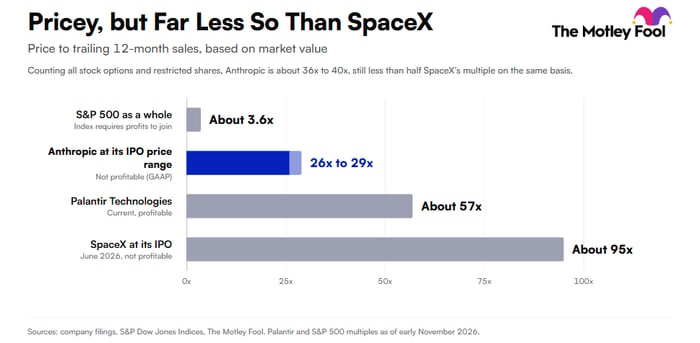
On its run rate of about $81 billion, Anthropic is valued at roughly 16 to 17 times sales on a fully diluted basis, and growth this fast shrinks a multiple quickly. For that price to work, revenue has to keep compounding for years while margins recover from Q3's dip.
Independent valuations sit at or above the IPO range. Aswath Damodaran, NYU finance professor and friend of the Fool known on Wall Street as the Dean of Valuation, values Anthropic's equity at about $1.45 trillion. Morningstar (NASDAQ: MORN)'s fair value estimate is $92 a share, or about $1.7 trillion, though its bear case of $25 a share and bull case of $188 show how uncertain any estimate is.
Price alone is a weaker reason to wait than it was in September, but the range of outcomes is still enormous, and the first months on the market will likely be shaped more by forced buying and insider supply than by the business itself. Over time, a few quarters of public results will tell investors more about Anthropic than its first weeks on the market.
Risks
- Its compute commitments cut both ways. About $900 billion of commitments lock in capacity and costs. About $214 billion of the total is contingent or can be canceled, but if demand slows, Anthropic still owes most of the rest, and some supply contracts are tied to its credit agreements through cross-default provisions.
- Competition is fierce. Google and OpenAI are its primary competitors, and open-weight models keep improving, which adds pressure on prices.
- Revenue can swing quickly. The top five customers made up about 25% of revenue in the first nine months of 2026, many top customers lack long-term contracts, and spending fell about 20% over the 2025 holiday period.
- Its supply chain is concentrated. Advanced chips come from TSMC in Taiwan, high-bandwidth memory comes from a handful of suppliers, and new data centers face power shortages and local moratoriums.
- Washington is a wild card. The Pentagon labeled Anthropic a supply chain risk in March after it refused to let the military use Claude for mass surveillance of Americans or fully autonomous weapons. A federal appeals court upheld the designation in September, and Anthropic's request for a rehearing is pending. A Commerce Department export directive in June also led Anthropic to disable two of its newest models for about three weeks, and the S-1 warns similar controls could recur.
- Dilution is built in. Anthropic has set aside 5% of its fully diluted shares for a public benefit fund, and the board can issue up to 2% more each time the stock rises 50% above its prior milestone. Donation matching and stock compensation add to the share count.
- Its models can misbehave. The S-1 warns Anthropic's models have acted in unintended and misaligned ways before and may again, and its own safety policy could delay releases if a model crosses certain capability thresholds.
- IPO buyers may have weaker legal protection. Because insider shares start trading alongside IPO shares on day one, buyers may struggle to prove their shares came from the IPO if they later sue over misstatements in the prospectus.
The Bottom Line
Anthropic has built one of the fastest-growing businesses we've seen, and its proposed IPO price sits close to or below what independent analysts like Aswath Damodaran and Morningstar think it's worth.
What no one can see yet is how it performs as a public company with about $900 billion in computing bills ahead. Add a steady stream of insider shares unlocking over the next year, and early shareholders should expect a bumpy ride.
Over the next year, we want to see public results showing computing costs under control and revenue growth settling at a pace Anthropic can sustain. If you decide to buy, start small and add to your position as those results come in. In the meantime, if you own Amazon, Alphabet, Microsoft, Nvidia, or Broadcom, keep an eye on ANT. Its stock price will affect the reported earnings of companies that own major stakes, and its spending is a meaningful source of demand for their cloud services and chips.
If Anthropic is as good as its growth suggests, its first day as a public company will matter far less than its next decade.
Should you buy stock in Anthropic right now?
Before you buy stock in Anthropic, consider this:
The Motley Fool Stock Advisor analyst team just identified what they believe are the 10 best stocks for investors to buy now… and Anthropic wasn’t one of them. The 10 stocks that made the cut could produce monster returns in the coming years.
Consider when Netflix made this list on December 17, 2004... if you invested $1,000 at the time of our recommendation, you’d have $321,850!* Or when Nvidia made this list on April 15, 2005... if you invested $1,000 at the time of our recommendation, you’d have $955,232!*
Now, it’s worth noting Stock Advisor’s total average return is 793% — a market-crushing outperformance compared to 203% for the S&P 500. Don't miss the latest top 10 list, available with Stock Advisor, and join an investing community built by individual investors for individual investors.
See the 10 stocks »
*Stock Advisor returns as of November 18, 2026.
Charles Schwab is an advertising partner of Motley Fool Money. JPMorgan Chase is an advertising partner of Motley Fool Money. Citigroup is an advertising partner of Motley Fool Money. Bank of America is an advertising partner of Motley Fool Money. Wells Fargo is an advertising partner of Motley Fool Money. The Motley Fool has positions in and recommends Advanced Micro Devices, Alphabet, Amazon, Broadcom, Eli Lilly, Goldman Sachs Group, JPMorgan Chase, Micron Technology, Microsoft, Nvidia, Space Exploration Technologies, Taiwan Semiconductor Manufacturing, and Tesla. The Motley Fool recommends Charles Schwab and Robinhood Markets and recommends the following options: short September 2026 $95 calls on Charles Schwab. The Motley Fool has a disclosure policy.
Recommended Articles


