




Intel vs. Taiwan Semiconductor Manufacturing: Which Tech Stock Is a Better Buy for 2027?
Key Points
Intel is aggressively pivoting to a foundry model to manufacture chips for outside customers while maintaining its core design business.
Taiwan Semiconductor Manufacturing remains the dominant leader in the pure-play foundry market.
Which semiconductor stock is the better choice for your portfolio through 2027?
- Motley Fool Issues Rare "Total Conviction" Buy Alert ›
The chip industry is undergoing a massive shift as artificial intelligence and local manufacturing take center stage. Choosing between Intel (NASDAQ:INTC) and Taiwan Semiconductor Manufacturing (NYSE:TSM) requires weighing a turnaround story against a market leader.
Intel focuses on designing its own processors while opening its factories to external customers. Taiwan Semiconductor Manufacturing serves as a pure-play foundry, producing high-end chips for nearly every major player among semiconductor stocks. Both companies are central to the global tech supply chain but offer very different risk and reward profiles.
The case for Intel
Intel designs and manufactures a wide range of processors, accelerators, and software solutions for the modern computing world. Under its latest strategy, the company is combining its internal chip design with a massive expansion of its foundry services to manufacture chips for other businesses. Its customer base is diverse, including distributors, original equipment manufacturers, and cloud service providers across sectors like healthcare, finance, and telecommunications.
In the 12 months ended Sept. 26, 2026, revenue reached approximately $59.9 billion, representing revenue growth of nearly 12.1% compared to the previous period. However, the company faced significant headwinds, reporting a net loss of roughly $12 billion during this time frame. This result highlights the high costs associated with its ongoing efforts to regain a leading position in the semiconductor market.
As of Intel's December 2025 balance sheet, the company carries a debt-to-equity ratio of nearly 0.4, which compares total debt to shareholder equity. The current ratio is approximately 2, indicating the ability to cover short-term financial obligations with assets that can be converted to cash within a year. In the fiscal year ended Dec. 27, 2025, free cash flow was approximately negative $4.9 billion. Note that stock-based compensation accounted for roughly 25.1% of operating cash flow, inflating reported cash generation, since SBC is a non-cash expense added back in the cash flow statement.
The case for Taiwan Semiconductor Manufacturing
Taiwan Semiconductor Manufacturing operates as a pure-play foundry, focusing exclusively on manufacturing semiconductors designed by its customers. It serves the most demanding segments of the market, including smartphones and high-performance artificial intelligence applications, from its base in Taiwan and facilities worldwide. By acting as a manufacturer for others, the company avoids competing directly with its clients while maintaining a critical role in the global tech supply chain.
In the 12 months ended Sept. 30, 2026, revenue reached nearly $150.2 billion, an increase of approximately 36.1%. This growth translated into net income of close to $76.8 billion, resulting in a robust net margin of roughly 51.1%. These figures demonstrate the strong demand for the advanced manufacturing nodes that the company provides to its diverse customer base.
As of TSM's December 2025 balance sheet, the current ratio was roughly 2.5, reflecting a healthy cushion for meeting short-term liabilities. The company maintains a conservative debt-to-equity ratio of nearly 0.2, showing that its total debt is low relative to its equity. In the fiscal year ended Dec. 31, 2025, free cash flow was approximately $30.1 billion, providing substantial capital to reinvest in the next generation of chip technology.
Risk profile comparison
Intel faces intense competition from companies like NVIDIA (NASDAQ:NVDA) and AMD (NASDAQ:AMD), as well as hyperscalers who are increasingly designing their own custom silicon. The company is also navigating legal challenges, including shareholder lawsuits filed in November 2026 alleging concealment of manufacturing and inventory issues. High capital intensity and the operational risks of its turnaround strategy remain significant hurdles as it builds out new leading-edge factories while relying on sole-source suppliers like ASML (NASDAQ:ASML) for critical tools.
Taiwan Semiconductor Manufacturing is exposed to risks associated with the high concentration of its manufacturing facilities in a single geographic region. This concentration creates sensitivity to geopolitical tensions and potential supply chain disruptions that could impact its global operations. Additionally, the company must continually invest billions in new technology nodes to stay ahead of rivals, which entails significant capital risk if demand for high-end chips from major customers like Apple (NASDAQ:AAPL) or NVIDIA fluctuates.
Valuation comparison
Taiwan Semiconductor Manufacturing looks cheaper on a forward P/E basis, while Intel has a lower P/S ratio based on sales over the past 12 months.
| Metric | Intel | Taiwan Semiconductor Manufacturing |
|---|---|---|
| Forward P/E | 37 | 22.6 |
| P/S ratio | 4.9 | 12.9 |
Valuation metrics include sourcing from Financial Modeling Prep (FMP) and may differ from other data providers.
Which stock would I buy for 2027?
A large part of the reason Intel reported that $12 billion loss is because it's in the midst of a turnaround. It's pivoting toward providing chip manufacturing services for third parties. In order to do so, the chipmaker is having to shell out a lot of money to build fabrication plants. Intel even suspended its dividend a few years ago in pursuit of this new strategy. That spending will likely continue, as turning around a ship of Intel's size is neither a fast nor an easy endeavor.
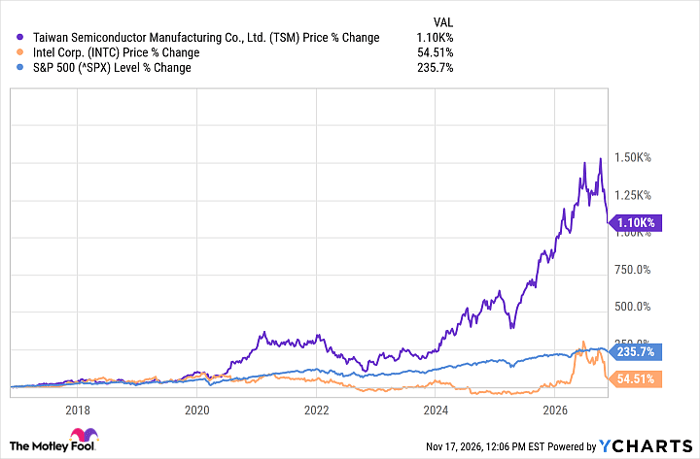
Now, let's see how each stock has performed over the past 10 years:
TSM data by YCharts
Intel's stock is miles behind Taiwan Semiconductor's, and worse yet, it hasn't even kept pace with the S&P 500 (SNPINDEX:^GSPC), trailing it by over 180 percentage points.
Taiwan Semiconductor dominates the foundry market and maintains a strong net margin despite operating in a capital-intensive business. It also pays a modest dividend.
I think there are too many unknowns tied to Intel's strategic transformation. Taiwan Semiconductor looks like a better buy for 2027 and beyond.
Should you buy stock in Intel right now?
Before you buy stock in Intel, consider this:
The Motley Fool Stock Advisor analyst team just identified what they believe are the 10 best stocks for investors to buy now… and Intel wasn’t one of them. The 10 stocks that made the cut could produce monster returns in the coming years.
Consider when Netflix made this list on December 17, 2004... if you invested $1,000 at the time of our recommendation, you’d have $327,620!* Or when Nvidia made this list on April 15, 2005... if you invested $1,000 at the time of our recommendation, you’d have $959,410!*
Now, it’s worth noting Stock Advisor’s total average return is 802% — a market-crushing outperformance compared to 205% for the S&P 500. Don't miss the latest top 10 list, available with Stock Advisor, and join an investing community built by individual investors for individual investors.
See the 10 stocks »
*Stock Advisor returns as of November 18, 2026.
Erin Kennedy has positions in Apple and Taiwan Semiconductor Manufacturing. The Motley Fool has positions in and recommends ASML, Advanced Micro Devices, Apple, Intel, Nvidia, and Taiwan Semiconductor Manufacturing. The Motley Fool has a disclosure policy.
Recommended Articles


