




Had You Parked $10,000 in This Vanguard ETF When Warren Buffett Recommended It in 2014, Here's How Much You'd Have Today
Key Points
Warren Buffett steered the Berkshire Hathaway investment company to market-beating returns for 60 years.
Buffett consistently recommends index funds for everyday investors who are looking for steady returns over the long term.
He recommended the Vanguard S&P 500 ETF in 2014 because of its ultra-low fees, and investors who bought it back then would have done very well.
- Motley Fool Issues Rare "Total Conviction" Buy Alert ›
Warren Buffett served as the CEO of the Berkshire Hathaway (NYSE:BRKA)(NYSE:BRKB) holding company from 1965 to 2025, during which time he cemented himself as one of history's best investors. He turned the company from a struggling textiles manufacturer into a $1 trillion conglomerate with numerous subsidiaries, a $350 billion stock portfolio, and over $300 billion in cash.
Berkshire stock delivered a compound annual return of 19.7% during Buffett's tenure, meaning an investment of $500 in 1965 would have grown into a whopping $24.2 million by the time he stepped down. But as a full-time professional, he always knew the average investor would struggle to replicate his performance.
Missed Nvidia in 2009? This Rare Signal Is Flashing Again. In 2009, a "Double Down" signal flashed for a little-known chipmaker called Nvidia. For the first time in years, that same "Total Conviction" signal is flashing for a company 1/100th the size of Nvidia. Continue »
As a result, Buffett has consistently said everyday investors should buy an exchange-traded fund (ETF) that tracks an index like the S&P 500 (SNPINDEX:^GSPC), instead of trying to pick individual stocks. In Berkshire's 2013 report (published in February 2014), he specifically highlighted the Vanguard S&P 500 ETF (NYSEMKT:VOO) because of its ultra-low fees.
Had an investor parked $10,000 in the ETF when Buffett recommended it, here's how much they would have today.
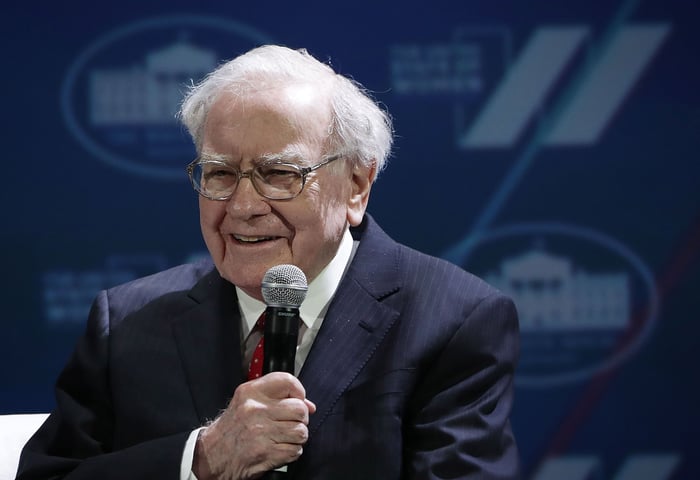
Image source: Getty Images.
An ideal index fund for investors of any experience level
The S&P 500 is made up of 500 American companies from 11 different sectors of the economy. Companies need to have a market capitalization of at least $22.7 billion to qualify for inclusion in the index, and they also must maintain profitability. But even after ticking those boxes, a special committee has the final say over which companies make the cut, in order to ensure a high-quality composition.
The S&P is weighted by market capitalization, so the largest companies in the index have a greater influence over its performance than the smallest. That's why the information technology sector has the highest weighting in the index by a country mile. It's home to giants like Apple, Nvidia, Microsoft, Broadcom, and Micron Technology, which alone have a combined market cap of $15.8 trillion.
The top three S&P sectors are listed below, along with their weightings in the Vanguard S&P 500 ETF, and their three largest members:
| Sector | Vanguard ETF Sector Weighting | Largest Companies |
|---|---|---|
| Information Technology | 39.7% | Apple, Nvidia, Microsoft |
| Financials | 11.4% | Berkshire Hathaway, JPMorgan Chase, Visa |
| Communication Services | 9.9% | Alphabet, Meta Platforms, Netflix |
Data source: Vanguard. Sector weightings are accurate as of Sept. 30, 2026, and are subject to change.
The other eight sectors are healthcare, consumer discretionary, industrials, consumer staples, energy, utilities, materials, and real estate, which together represent the remaining 39% of the S&P 500 by market cap.
Following Warren Buffett's advice would have paid off
The S&P 500 has delivered a compound annual return of 10.7% since it was established in 1957, assuming all dividends were reinvested. However, it has produced an even higher annual return of 13.8% since Buffett recommended the Vanguard S&P 500 ETF in 2014.
That means an investment of $10,000 in the ETF in February 2014 would be worth $51,977 today, excluding fees. On that note, the ETF has an expense ratio of just 0.03%, so every $10,000 invested in the fund would incur an annual fee of just $3. In essence, holding costs would have been negligible over the last 12 years.
It's possible the ETF continues to deliver similar returns going forward, especially given the strength of the technology sector which is being supercharged by the artificial intelligence revolution. But a number of other potentially valuable technologies are in the pipeline including robotics, self-driving vehicles, and quantum computing, which could contribute significantly to long-term upside in the S&P 500.
An index fund like the Vanguard S&P 500 ETF gives investors ample exposure to those high-growth areas of the market, with plenty of diversification through holdings in defensive sectors like financials and consumer staples.
Therefore, I think Buffett's advice will stand the test of time, so it's not too late to follow it.
Should you buy stock in Vanguard S&P 500 ETF right now?
Before you buy stock in Vanguard S&P 500 ETF, consider this:
The Motley Fool Stock Advisor analyst team just identified what they believe are the 10 best stocks for investors to buy now… and Vanguard S&P 500 ETF wasn’t one of them. The 10 stocks that made the cut could produce monster returns in the coming years.
Consider when Netflix made this list on December 17, 2004... if you invested $1,000 at the time of our recommendation, you’d have $335,171!* Or when Nvidia made this list on April 15, 2005... if you invested $1,000 at the time of our recommendation, you’d have $1,000,640!*
Now, it’s worth noting Stock Advisor’s total average return is 823% — a market-crushing outperformance compared to 208% for the S&P 500. Don't miss the latest top 10 list, available with Stock Advisor, and join an investing community built by individual investors for individual investors.
See the 10 stocks »
*Stock Advisor returns as of November 16, 2026.
JPMorgan Chase is an advertising partner of Motley Fool Money. Anthony Di Pizio has no position in any of the stocks mentioned. The Motley Fool has positions in and recommends Alphabet, Apple, Berkshire Hathaway, Broadcom, JPMorgan Chase, Meta Platforms, Micron Technology, Microsoft, Netflix, Nvidia, Vanguard S&P 500 ETF, and Visa. The Motley Fool has a disclosure policy.
Recommended Articles


