




The Stock Market Is Sending a Rare Warning. Here's Warren Buffett's Best Bear Market Advice.
Key Points
The Shiller CAPE Ratio is above its level before the Great Depression and near the peak it reached during the dot-com bust.
Warren Buffett often used bear markets as an opportunity to buy new stocks.
The Oracle of Omaha didn't often sell stocks during bear markets.
- 10 stocks we like better than S&P 500 Index ›
Warren Buffett, the former CEO of Berkshire Hathaway (NYSE: BRKA)(NYSE: BRKB), was best known for his stock-picking acumen. He was such a successful investor that he earned the nickname The Oracle of Omaha. While investors paid close attention to the stocks Buffett bought, they probably didn't focus enough on what he did after buying them. And he followed the same approach through both bull and bear markets.
As the market flashes a valuation warning sign, with the Shiller CAPE Ratio at levels last seen before major market downturns, now is the time to revisit Buffett's not-so-hidden long-term secret. After buying a stock, he would hold it for the long term to benefit from the company's long-term growth. Here's why that's so important to remember today.
Missed Nvidia in 2009? This Rare Signal Is Flashing Again. In 2009, a "Double Down" signal flashed for a little-known chipmaker called Nvidia. For the first time in years, that same "Total Conviction" signal is flashing for a company 1/100th the size of Nvidia. Continue »
Image source: Getty Images.
Buffett's three investment steps
You can simplify Warren Buffett's investment approach into three specific steps. First, find well-run businesses. Second, only buy those businesses when they are reasonably priced. Third, hold for the long term to benefit from the company's growth. The first two steps are far more exciting than the third, which can be as boring as watching paint dry or grass grow.
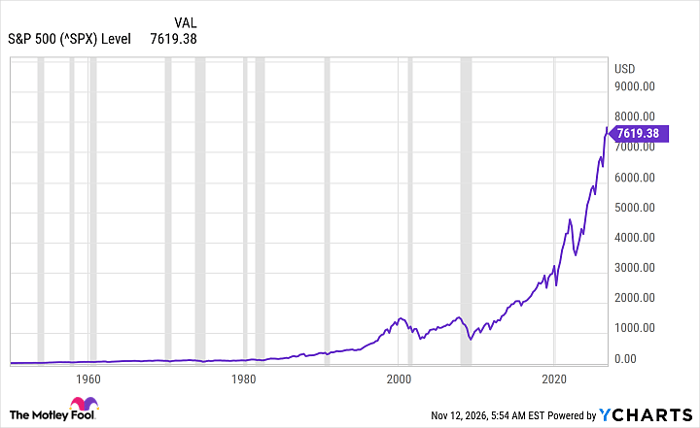
However, it is the most boring step that is likely to have the biggest impact on your long-term returns. And you don't have to look any further than the S&P 500 index (SNPINDEX: ^GSPC) to prove it. As the chart below highlights, even if you bought the S&P 500 just before a bear market started, you'd still end up growing your wealth over the long term if you just continued to hold it.
^SPX data by YCharts
Some of the biggest bear markets and worst recessions in history look like nothing more than blips today. Even if you had terrible timing, history suggests that the steady growth of the index would make up for that mistake if you just avoided selling out of fear.
Having the fortitude to hold for the long term is important today
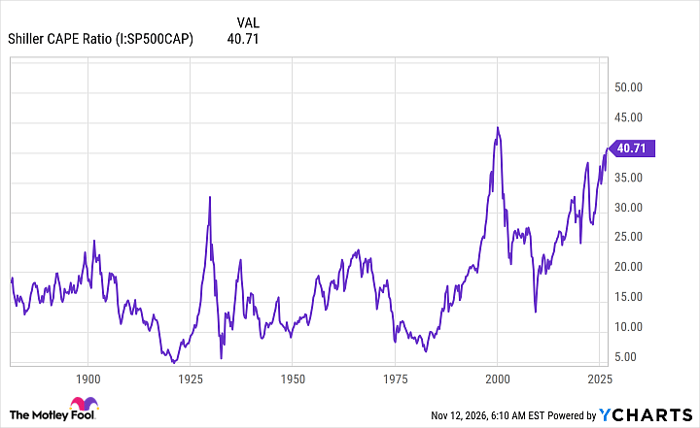
Holding for the long term could be the most important Buffett advice today because the market looks expensive. The Shiller CAPE Ratio, which is the S&P 500's price divided by the 10-year moving average of inflation-adjusted earnings of its constituent stocks, is near the elevated levels prior to the dot-com crash. And today's Shiller CAPE Ratio is above the levels reached before the Great Depression. A bear market wouldn't be all that shocking at this point.
Shiller CAPE Ratio data by YCharts
To be fair, Buffett often used bear markets to buy attractively priced stocks. So, if there is a bear market, you shouldn't stick your head in the sand and do nothing. But selling out of fear isn't what Buffett would recommend, particularly if you have taken the time to build a portfolio filled with well-run companies. If anything, a market downturn could be a good time to add to your positions.
Emotions are hard to control
The problem is that emotions are powerful, and fear is one of the strongest. It is hard to explain how difficult it is to watch your wealth slip away day after day to someone who has never experienced a deep, prolonged bear market. The emotional duress can cause actual physical pain, from sleepless nights to gut-churning agitation. It is why now, before the bear arrives, is the time to steel your resolve. To prepare to hold your ground. To prepare to buy when others are selling.
The elevated Shiller CAPE Ratio is the warning sign. Buffett's investment advice to buy good companies while they are attractively priced and then, most importantly, hold for the long term is the foundation that can help you survive if that warning sign proves prescient again.
Should you buy stock in S&P 500 Index right now?
Before you buy stock in S&P 500 Index, consider this:
The Motley Fool Stock Advisor analyst team just identified what they believe are the 10 best stocks for investors to buy now… and S&P 500 Index wasn’t one of them. The 10 stocks that made the cut could produce monster returns in the coming years.
Consider when Netflix made this list on December 17, 2004... if you invested $1,000 at the time of our recommendation, you’d have $335,171!* Or when Nvidia made this list on April 15, 2005... if you invested $1,000 at the time of our recommendation, you’d have $1,000,640!*
Now, it’s worth noting Stock Advisor’s total average return is 823% — a market-crushing outperformance compared to 208% for the S&P 500. Don't miss the latest top 10 list, available with Stock Advisor, and join an investing community built by individual investors for individual investors.
See the 10 stocks »
*Stock Advisor returns as of November 15, 2026.
Reuben Gregg Brewer has no position in any of the stocks mentioned. The Motley Fool has positions in and recommends Berkshire Hathaway. The Motley Fool has a disclosure policy.
Recommended Articles


