




Interactive Brokers Group vs. Mastercard: Which Financial Stock Is a Better Buy for 2027?
Key Points
Interactive Brokers Group provides direct-access trade execution for sophisticated investors across more than 170 global markets.
Mastercard maintains a massive electronic payments network with high net margins and global reach.
Which financial powerhouse belongs in your long-term portfolio for 2027?
- Motley Fool Issues Rare "Total Conviction" Buy Alert ›
Investors often weigh high-growth companies against established giants. Comparing Interactive Brokers Group (NASDAQ:IBKR) and Mastercard (NYSE:MA) reveals two different ways to potentially build wealth in the global financial markets.
Interactive Brokers Group focuses on low-cost execution for sophisticated, active traders and institutions around the world. Mastercard operates one of the largest payment networks, facilitating trillions of dollars in annual transaction volume. Both companies are central to modern finance, but they serve different roles for retail and institutional clients.
The case for Interactive Brokers Group
This company provides direct-access trade execution and clearing services for a diverse group of clients. It serves approximately 4.4 million cleared customer accounts, including hedge funds, mutual funds, and individual investors. Interactive Brokers focuses on automation and low costs to attract active participants as one of the leading financial stocks in the global market.
In fiscal 2025, revenue reached nearly $6.2 billion, representing growth of approximately 19.7% compared to the previous year. This performance helped the company generate net income of roughly $984 million. Interactive Brokers achieved a net margin of close to 15.9%, up from about 14.6% in the prior fiscal period, reflecting its ability to scale its low-cost model effectively.
According to its December 2025 balance sheet, the debt-to-equity ratio is 0, indicating the company has no debt relative to its shareholders' equity. The current ratio, which measures the ability to pay short-term obligations with short-term assets, sits at approximately 1.1. Free cash flow for fiscal 2025 was nearly $15.7 billion, representing cash from operations minus capital expenditures.
The case for Mastercard
This payments leader operates a technology-driven network that connects consumers, merchants, and financial institutions in more than 220 countries and territories. It earns fees by processing transactions and providing value-added services like data analytics and security. Mastercard relies on deep partnerships with banks and digital companies to facilitate its global reach.
In fiscal 2025, revenue reached nearly $32.8 billion, a 16.4% increase over the previous year. This robust top-line performance translated into net income of about $15 billion. The company maintained a high net margin of approximately 45.6%, which highlights its ability to convert a significant portion of every dollar earned into profit.
As of Mastercard's December 2025 balance sheet, the debt-to-equity ratio is roughly 2.5. The current ratio is approximately 1, indicating its short-term assets are roughly equal to its short-term liabilities. Free cash flow for the fiscal year ended in 2025 reached nearly $16.4 billion.
Risk profile comparison
Interactive Brokers Group faces risks from its concentrated ownership structure, as Chairman Thomas Peterffy holds voting control. The business is heavily dependent on its proprietary technology and automation, making it vulnerable to technical failures or systemic market events. It also faces global regulatory scrutiny and competition from other digital brokerage platforms.
Mastercard faces intense competition from rival payment networks like Visa (NYSE:V) and American Express (NYSE:AXP). Legal and regulatory risks are significant, particularly regarding interchange rates and antitrust concerns that could impact fee structures. The company must also manage risks related to data privacy, cybersecurity, and shifts in global economic conditions.
Valuation comparison
Interactive Brokers Group appears more attractively priced based on its forward P/E, which compares stock price to future earnings estimates.
| Metric | Interactive Brokers Group | Mastercard |
|---|---|---|
| Forward P/E | 28.8 | 33.5 |
Valuation metrics include sourcing from Financial Modeling Prep (FMP) and may differ from other data providers.
Which stock would I buy for 2027?
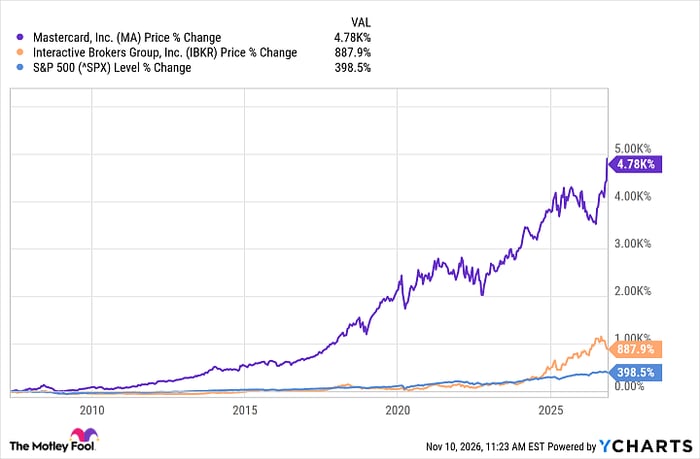
How a stock has performed in the past does not necessarily predict how it will perform in the future. Still, I do think it's worth reviewing. Interactive Brokers and Mastercard went public almost exactly a year apart, in 2007 and 2006, respectively.
MA data by YCharts
Mastercard shares have left both Interactive Brokers and the S&P 500 in the dust. The credit card giant also pays a modest dividend, which may appeal to some investors.
What I find most attractive about Mastercard is its high net margin. The ability to convert more than 45% of revenue into profits is impressive and would be the envy of most companies.
To be clear, I don't think Interactive Brokers is a bad stock. I just think the secular trend toward increasing use of digital payments is something Mastercard (and other payment specialists) will continue to benefit from. Because of these tailwinds, Mastercard gets my vote here.
Should you buy stock in Interactive Brokers Group right now?
Before you buy stock in Interactive Brokers Group, consider this:
The Motley Fool Stock Advisor analyst team just identified what they believe are the 10 best stocks for investors to buy now… and Interactive Brokers Group wasn’t one of them. The 10 stocks that made the cut could produce monster returns in the coming years.
Consider when Netflix made this list on December 17, 2004... if you invested $1,000 at the time of our recommendation, you’d have $344,878!* Or when Nvidia made this list on April 15, 2005... if you invested $1,000 at the time of our recommendation, you’d have $1,097,846!*
Now, it’s worth noting Stock Advisor’s total average return is 852% — a market-crushing outperformance compared to 208% for the S&P 500. Don't miss the latest top 10 list, available with Stock Advisor, and join an investing community built by individual investors for individual investors.
See the 10 stocks »
*Stock Advisor returns as of November 11, 2026.
American Express is an advertising partner of Motley Fool Money. Erin Kennedy has positions in Mastercard and Visa. The Motley Fool has positions in and recommends American Express, Interactive Brokers Group, Mastercard, and Visa. The Motley Fool recommends the following options: long January 2027 $43.75 calls on Interactive Brokers Group and short January 2027 $46.25 calls on Interactive Brokers Group. The Motley Fool has a disclosure policy.
Recommended Articles


