




Interactive Brokers Group vs. Nu: Which Financial Stock Is a Better Buy for 2027?
Key Points
Interactive Brokers Group provides a highly automated global trading platform serving millions of institutional and individual accounts.
Nu is a digital banking powerhouse that has rapidly scaled to over 131 million customers across Latin America.
Which high-growth financial leader is the better addition for your 2027 portfolio?
- Motley Fool Issues Rare "Total Conviction" Buy Alert ›
Investors seeking growth in the financial landscape often weigh established global platforms against disruptive digital leaders. Choosing between Interactive Brokers Group (NASDAQ:IBKR) and Nu (NYSE:NU) depends on your specific goals.
Interactive Brokers Group serves professional and active traders worldwide with sophisticated, automated tools. Nu, meanwhile, is revolutionizing banking in Brazil, Mexico, and Colombia through its digital-first platform. Both companies occupy distinct niches, providing different avenues for long-term growth and geographic diversification.
The case for Interactive Brokers Group
Interactive Brokers Group operates an automated global electronic brokerage providing direct-access trade execution and clearing services. It serves roughly 5.5 million client accounts, including hedge funds, mutual funds, and individual investors, across 175 market centers in 40 countries. This brokerage giant is a staple among financial stocks due to its global reach and low customer concentration, with no single client representing more than 2% of commissions.
In its latest annual report, filed for fiscal 2025, Interactive Brokers reported that revenue reached nearly $6.2 billion. This represents approximately 19.7% growth compared to the prior year. Net income was close to $984 million, resulting in a net margin of roughly 15.9%, which reflects the company's ability to keep more of each dollar earned after all expenses are paid.
As of Interactive Brokers' December 2025 balance sheet, the debt-to-equity ratio, which measures total debt relative to shareholders' equity, is approximately 0. The current ratio, which gauges the ability to cover short-term liabilities with short-term assets, stands at roughly 1.1. For fiscal 2025, free cash flow reached nearly $15.7 billion, which is calculated as cash flow from operations minus capital expenditures.
The case for Nu
Nu is a leading digital financial services company serving approximately 131 million customers globally through its mobile-centric platform. By eliminating physical branches and traditional fees, it has become one of the most prominent fintech stocks in the Latin American market. The company focuses on expanding its user base in Brazil, Mexico, and Colombia by offering simplified credit cards, savings accounts, and personal loans.
In its latest annual report, filed for fiscal 2025, revenue reached close to $15.9 billion. This marks roughly 43% year-over-year growth, as more users joined the platform and increased their engagement. Net income was approximately $2.9 billion, while the net margin improved to about 18.1%, indicating a strong ability to convert revenue into actual profit.
As of Nu's December 2025 balance sheet, the debt-to-equity ratio is roughly 0.5. The current ratio stands at approximately 0.6. For fiscal 2025, free cash flow was nearly $3.5 billion.
Risk profile comparison
Interactive Brokers Group faces intense competition from various companies, including prime brokers, online brokers, and zero-commission platforms like Robinhood Markets (NASDAQ:HOOD). Regulatory and legal risks are significant, as the company must comply with complex requirements from multiple domestic and foreign regulators. Technology-related risks include potential system failures or cyberattacks, while counterparty risk remains a concern, since customer defaults on margin loans could lead to substantial losses.
Nu faces competition from established regional banks and other digital entrants in the Latin American market. Economic volatility and currency fluctuations in its primary markets of Brazil, Mexico, and Colombia can significantly impact its loan portfolio and reported earnings. Furthermore, the company must manage credit risk, as an economic downturn in these regions could lead to higher default rates among its massive retail customer base.
Valuation comparison
Nu appears more attractively valued based on its lower forward P/E, while Interactive Brokers Group commands a premium for its specialized global platform.
| Metric | Interactive Brokers Group | Nu |
|---|---|---|
| Forward P/E | 26.9 | 13.5 |
| P/B ratio | 23.8 | 5 |
Valuation metrics include sourcing from Financial Modeling Prep (FMP) and may differ from other data providers.
The P/B ratio compares the stock price with the company's book value (its assets minus its liabilities, roughly what shareholders would own on paper), and investors lean on it for insurers and banks. A lower P/B ratio means the stock costs less relative to book value.
Which stock would I buy for 2027?
Nu is posting strong revenue growth, but that's what I would expect for a company in the relatively early stages of its life cycle (Nu went public not even five years ago). That said, I think Interactive Brokers' revenue gains are respectable, and both companies have decent net margins.
The one knock I have against Nu is that it is a newer company and inherently riskier as a result. Plus, it operates in markets where there's greater economic volatility. I tend to be a more conservative investor, only occasionally buying spicy, high-growth stocks.
Then there's the two stocks' performance:
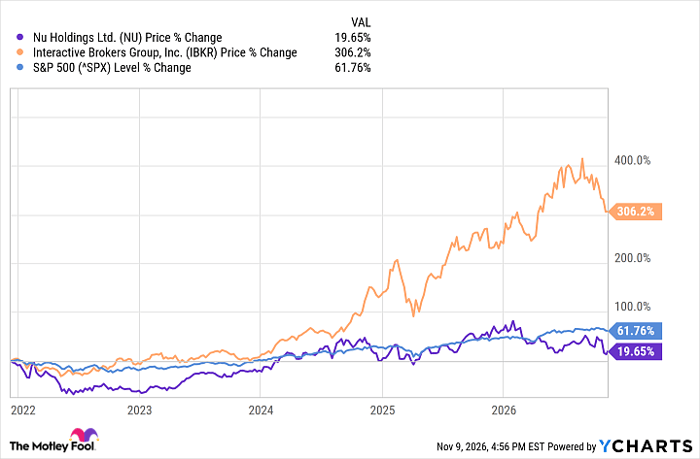
NU data by YCharts
Since going public, Nu's returns have only slightly outpaced inflation, and the stock has massively lagged shares of Interactive Brokers. Nu hasn't beat the S&P 500, either. Of course, past performance is no indication of future results.
I think the better buy comes down to how comfortable you are with risk. Nu has all the hallmarks of a high-risk, high-reward stock, and that may appeal to some investors. But I'd prefer adding Interactive Brokers to my portfolio.
Should you buy stock in Interactive Brokers Group right now?
Before you buy stock in Interactive Brokers Group, consider this:
The Motley Fool Stock Advisor analyst team just identified what they believe are the 10 best stocks for investors to buy now… and Interactive Brokers Group wasn’t one of them. The 10 stocks that made the cut could produce monster returns in the coming years.
Consider when Netflix made this list on December 17, 2004... if you invested $1,000 at the time of our recommendation, you’d have $341,966!* Or when Nvidia made this list on April 15, 2005... if you invested $1,000 at the time of our recommendation, you’d have $1,146,819!*
Now, it’s worth noting Stock Advisor’s total average return is 852% — a market-crushing outperformance compared to 203% for the S&P 500. Don't miss the latest top 10 list, available with Stock Advisor, and join an investing community built by individual investors for individual investors.
See the 10 stocks »
*Stock Advisor returns as of November 10, 2026.
Erin Kennedy has no position in any of the stocks mentioned. The Motley Fool has positions in and recommends Interactive Brokers Group and Nu Holdings. The Motley Fool recommends Robinhood Markets and recommends the following options: long January 2027 $43.75 calls on Interactive Brokers Group and short January 2027 $46.25 calls on Interactive Brokers Group. The Motley Fool has a disclosure policy.
Recommended Articles


