




Tesla's Free Cash Flow Just Turned Positive. Here's Why That's Only Half the Story.
Key Points
Tesla's improved free cash flow came as capital expenditures declined to $4.73 billion, versus the roughly $7.77 billion analysts expected.
Operating income fell 56% to $718 million, so the increased cash flow doesn’t reflect increased profitability.
Tesla now expects about $20 billion in capex rather than $25 billion it forecast earlier.
- Motley Fool Issues Rare "Total Conviction" Buy Alert ›
Tesla's (NASDAQ: TSLA) third-quarter earnings report came with at least one notable surprise -- the company announced that it generated $1.53 billion in free cash flow, just one quarter after burning through more than $1 billion in cash.
That's certainly encouraging news for a company spending heavily on artificial intelligence (AI), autonomous vehicles, and humanoid robots.
Missed AI’s "Act 1"? Act 2 Could Be 15x Bigger. Most investors think they missed the AI boat because they didn't buy Nvidia in 2005. But according to our analysts, we’re only at the end of "Act 1"—the R&D phase. "Act 2" is the global rollout. Continue »
But before investors get too excited, there's something important buried in those numbers. Tesla's free cash flow fell 62% from a year earlier, and the positive result was largely due to lower capital expenditure (capex) than forecast.
That raises some interesting questions about how Tesla intends to finance Chief Executive Officer Elon Musk's ambitious plans -- and what those investments could mean for Tesla stock.
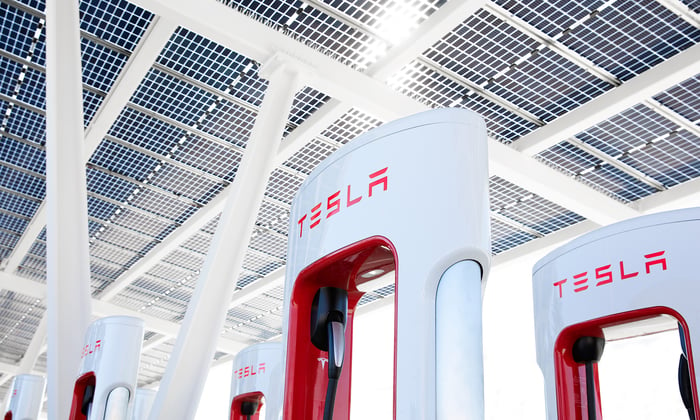
Image source: Tesla.
Tesla's cash flow surprise comes with a catch
In the third quarter, Tesla generated $6.26 billion in operating cash flow, essentially matching the $6.24 billion it produced a year earlier. That was an improvement from the $4.7 billion generated in the second quarter.
But capital expenditures tell a different story. Tesla's capex totaled $4.73 billion during the quarter, down from $5.79 billion in the second quarter. That helped turn a $1.09 billion free cash flow deficit into a $1.53 billion surplus.
The result was also considerably better than Wall Street expected. According to Tesla's own pre-earnings average estimate, analysts had anticipated about $7.77 billion in third-quarter capex and negative free cash flow of $4.51 billion.
Instead, Tesla spent roughly $3 billion less than expected.
That's a big difference. And while generating positive free cash flow is preferable to burning cash, spending less money doesn't necessarily mean the underlying business has become more profitable.
In fact, Tesla's third-quarter operating income fell 56% year over year to $718 million, while net income attributable to common shareholders declined 43% to $787 million.
The company is generating cash, but its earnings remain under pressure.
Tesla still has billions left to spend
Earlier this year, Tesla announced it would make more than $25 billion in capex. But during the third-quarter earnings call, Chief Financial Officer Vaibhav Taneja lowered that outlook to about $20 billion.
That's a substantial reduction, but Tesla isn't exactly putting its checkbook away. Through the first nine months of 2026, the company's capex totaled $13.01 billion, more than double the $6.13 billion spent during the same period last year.
Reaching $20 billion would require another $7 billion in spending during the fourth quarter -- considerably more than Tesla spent in either of the previous two quarters. And the company's latest regulatory filing still projects capital expenditures exceeding $20 billion this year.
So, although Tesla's third-quarter free cash flow looks encouraging, the spending demands aren't going away.
Musk has outlined plans to expand Cybercab production, build manufacturing capacity for Optimus robots, invest in AI computing, and develop semiconductor manufacturing capabilities. These are expensive undertakings, and most have yet to demonstrate that they can generate meaningful profits.
Tesla also secured $30 billion in additional borrowing capacity in the third quarter to help finance its future investments. Management says it doesn't expect to draw on those funds during 2026.
What does this mean for investors?
I've previously written about Tesla's ambitious spending plans and the challenges of turning its AI and robotics investments into profitable businesses. The latest earnings report hasn't resolved those concerns.
There are some encouraging developments. Tesla's operating cash flow improved sequentially, automotive gross margins strengthened, and the company continues to generate substantial cash from its existing operations. But Tesla is also spending aggressively at a time when its operating profits are declining.
For investors, the next few quarters should provide a better indication of whether Tesla can fund its ambitions without placing additional pressure on its balance sheet. With billions in additional spending still on the agenda, Tesla needs to demonstrate that its cash generation can keep pace with Musk's ambitions.
We just issued 'double down' alerts on 3 stocks — find out if Tesla made our list
Ever feel like you missed the boat in buying the most successful stocks? Then you’ll want to hear this.
On rare occasions, our expert team of analysts issues a “Double Down” stock recommendation for companies that they think are about to pop. If you’re worried you’ve already missed your chance to invest, now is the best time to buy before it’s too late. And the numbers speak for themselves:
- Nvidia: if you invested $1,000 when we doubled down in 2009, you’d have $561,556!*
- Apple: if you invested $1,000 when we doubled down in 2008, you’d have $65,603!*
- Netflix: if you invested $1,000 when we doubled down in 2004, you’d have $344,608!*
Right now, we’re issuing “Double Down” alerts for three incredible companies, available when you join Stock Advisor, and there may not be another chance like this anytime soon.
See the 3 stocks »
*Stock Advisor returns as of October 28, 2026.
Patrick Sanders has no position in any of the stocks mentioned. The Motley Fool has positions in and recommends Tesla. The Motley Fool has a disclosure policy.
Recommended Articles


